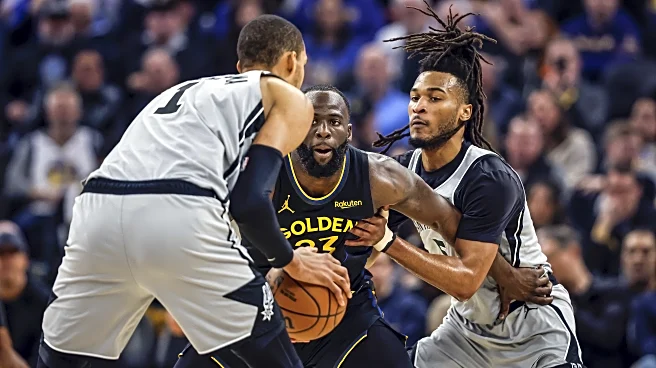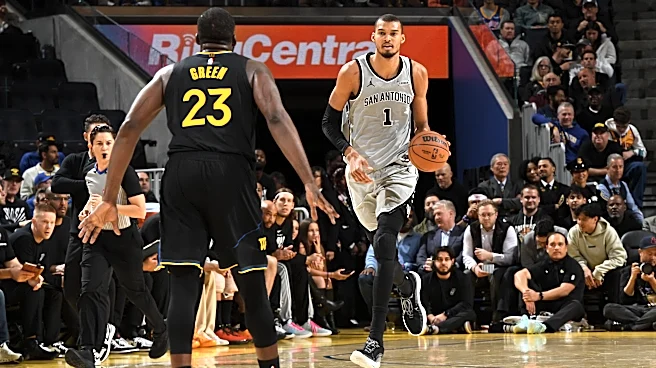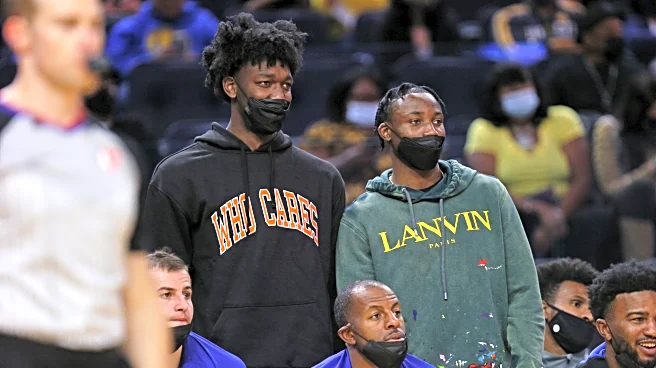

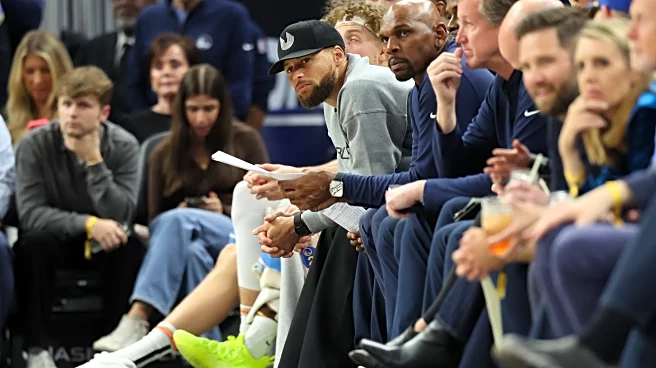
The first round is done. Here’s the full accounting:
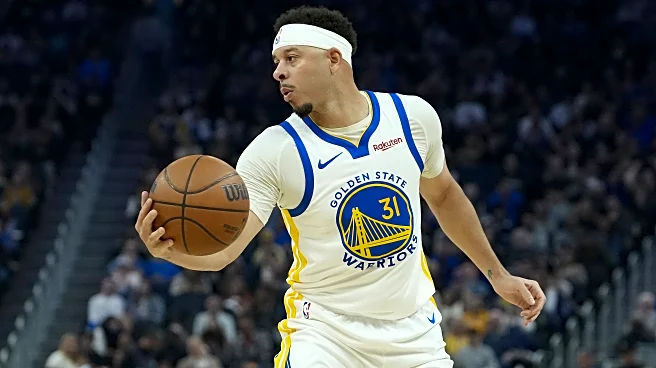
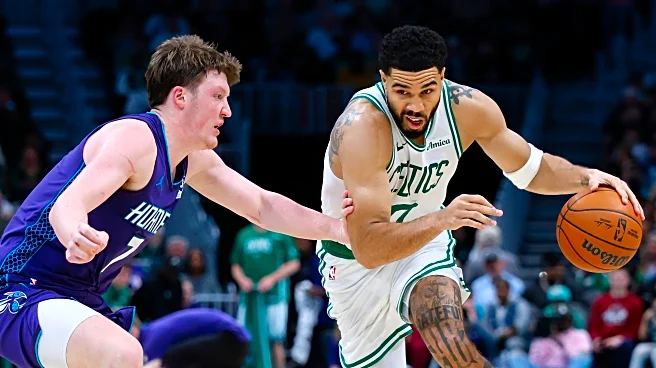
Jordan Poole ran through Alen Smailagic 85% to 15% in the first matchup, and James Wiseman crushed Ryan Rollins 80% to 20% in the second. Jonathan Kuminga cruised past Patrick Baldwin Jr. 74% to 26%, followed by an upset when Trayce Jackson-Davis knocked off Eric Paschall 66% to 34%.
The bracket’s down to four, and this is the one that’s been sitting underneath the whole thing the entire time. This is about what you thought the future looked like,
and how long you held onto it after it started to slip. We’ve been calling this a vote about belief, but for most of the first round there was still a little distance to it. You could still lean on stats, moments, production, whatever version of the argument made you comfortable. This one doesn’t really give you that option.
Wiseman and Kuminga never really overlapped in that way. Not in how people talked about them, or what they were supposed to become. They sat on opposite ends of the same idea.
(2) James Wiseman — “The Fallen Giant” 2nd overall pick, 2020 NBA Draft
With Wiseman, the belief didn’t take time. It was there the second the pick came in.
That whole season had felt like something ending. Steph’s hand, Klay rehabbing, empty arena, fifteen wins…it didn’t feel like a gap year, it felt like the floor had dropped out. And then the lottery hits, and suddenly you’re not looking at the wreckage anymore, you’re looking at what comes next.
What made Wiseman different wasn’t just the tools. It was how cleanly he fit into the one place the Warriors had never quite solved. For years they got away with not having a real center. They didn’t just survive it, they turned it into a philosophy. Spacing, movement, Steph pulling everything out of shape; if you did it well enough, you didn’t need size anchoring anything. And for a long time that was true.
But there was always that quiet question sitting there. What happens when it isn’t enough? What happens when the game slows down, when the margin gets thinner, when you actually need something at the rim that isn’t scheme?
Wiseman made it feel like you didn’t have to ask that anymore.
You could see it right away without having to convince yourself. Steph running a simple pick-and-roll and the possession ending before the defense even gets organized. A mistake on the perimeter not turning into a layup because there’s actually someone behind it. The same offense, the same principles, just with less strain on everything.
That’s what people were buying into. We were looking at confirmation, not reinvention. Everything you already believed about the Warriors still worked. It just worked more easily now. I mean, you remember the hype the team had around adding a limping Boogie Cousins. Imagine what a young #2 overall pick athletic, shooting, ballhandling big would do! Or so the logic went.
That’s why Joe Lacob said what he said barely a month after draft night, calling him a “once in a decade kind of player.” It wasn’t really about Wiseman as a prospect. It was about what he represented. The idea that the dynasty didn’t need to change shape to keep going. It just needed one missing piece.
And then it never really got off the ground.
By the time it’s clear what’s not clicking, the gap between what the team needs and what he does well is already too wide. It wasn’t subtle either. The things that made their centers work — the screening, the reads, the feel for the defense — those were the exact things Wiseman hadn’t had time to learn. The things he was naturally good at weren’t the things the system asked for.
Wiseman was the only Warriors center in recent history whose best skill was his shot and whose weakest skills were the ones the system needed most. What you’re left with isn’t just a player who didn’t pan out. It’s that version of the team you had in your head, the one where nothing had to change, never actually existing outside of a few flashes and a lot of projection.
(3) Jonathan Kuminga — “The Almost” 7th overall pick, 2021 NBA Draft
Kuminga never worked like that. There wasn’t a moment where it all snapped into place. If anything it was the opposite: every time it felt like you were about to see the full picture, it would pull back again.
What made him different was that he never really felt like he belonged to the system in the same way everyone else did.
Most young players either figured out how to live inside Steph’s gravity or they didn’t last. You move, you cut, you make the extra pass. Kuminga didn’t quite operate on those terms. There were stretches where he did everything you were supposed to do, and then there were stretches where it felt like he was playing a different game entirely: attacking downhill, taking possessions into his own hands, forcing the defense to react to him and not just orbit Steph. And those moments didn’t feel like mistakes. They felt like something the team didn’t fully have access to otherwise.
That’s where the belief came from. Not that he had already arrived, but that there was another version of the Warriors sitting there if they ever decided to lean into it. One where you still had Steph doing what Steph does, but you weren’t dependent on it every single time down. One where there was another way to win a possession when everything got loaded up on the perimeter.
And the reason it held on for so long is because it never went away.
Every time it started to feel like it wasn’t going to happen, there’d be another stretch where it looked completely real again. Like the 11-for-11 game against Atlanta. Or the 30-point Game 3 against Minnesota in the 2025 playoffs with Coach Kerr gushing about the skillset, where the whole fanbase let itself believe again. But the structure never changed.
Over time it stopped feeling like a development curve and started feeling like a standoff. How much of himself was he supposed to give up to fit into this, and how much of that made him less of what made him interesting in the first place?
On New Year’s Eve 2025, I wrote the piece that named it directly: either that playoff run was the turning point that finally saved the relationship, or it was the last great thing Kuminga did as a Warrior. By February 5, 2026, the Warriors had traded him to Atlanta for Kristaps Porzingis, a mere four months after signing him to a two-year $48.5 million extension.
It just never got to happen here. Neither one really failed in the way we talk about failure. They just didn’t become the version we built for them.
The Matchup
This is the point in the bracket where the question stops being abstract.
The Wiseman belief was easy to hold onto because it made everything make sense right away. You didn’t have to project very far. You didn’t have to imagine the system changing. You just had to picture it continuing, with one gap filled in.
The Kuminga belief asked more from you. It asked you to sit with something that never fully resolved, to keep adjusting what you thought he might become, to keep believing through stretches where it didn’t quite line up. It wasn’t clean, but it stuck.
One of them disappeared while the other one never really let you go. And even now, it’s not completely gone.
That’s the difference you’re voting on.