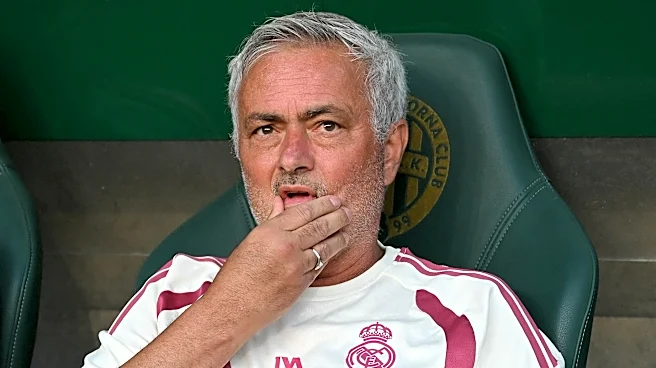


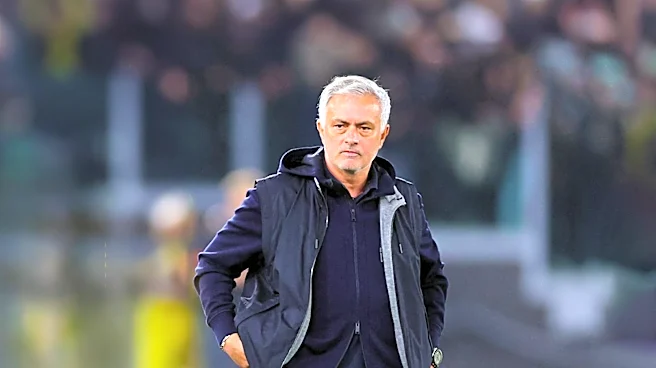
Miles Coleman, the producer behind the new Netflix documentary ‘Mourinho’, sat down for an exclusive interview with Managing Madrid’s Lucas Navarrete to discuss the “Special One’s” enduring legacy. Over the course of the conversation, Coleman pulls back the curtain on a two-and-a-half-year production process, revealing that Mourinho was granted no editorial control over the final cut—a decision that led to moments of raw tension when the film challenges the manager’s recent record. From the “burnout”
of the record-breaking 100-point season to the psychological weight of the 2012 Champions League exit and the deliberate calculations behind his media persona, Coleman provides a rare, behind-the-scenes look at a man who is making his return to the biggest club in world football.
Please note that this article contains selected highlights from the discussion and does not include the interview in its entirety, which you can access through the Managing Madrid Podcast.
The documentary
Navarrete: What have the general reactions been like on social media? I know the Madrid fan base has been very positive, but how are Chelsea or Inter Milan fans responding?
Coleman: The reaction has been very good. I was actually dreading the social media response because football is so tribal. In the series, we show both the positives and the negatives—the moments when things went well and when they didn’t. I expected fans to be protective, but it has turned into a wonderful nostalgia trip. We’ve even seen Liverpool fans saying that while they “hated” the guy, the series was incredibly entertaining because it brought back so many memories. We woke up to find we were number one in the U.K., which is a great feeling.
Navarrete: Nostalgia is definitely a major factor here. We are talking about a man whose first stint at Chelsea was decades ago and who left Madrid 15 years ago. I have to admit, I’m generally not a fan of the “single-character” documentary format because it can often feel like a PR piece that avoids the negatives. However, I think you threaded the needle perfectly here by addressing the friction that comes with a character like Mourinho. How did you manage that balance while having him involved in the show?
Coleman: I appreciate that because it was one of the hardest parts of the project. The criticism of biographical documentaries is often that they are too “chummy” or hagiographic. From day one, we told Jose this couldn’t just be a positive PR piece. While we had his cooperation and interviewed him for many hours, he never had editorial control. He didn’t have the right to approve the final product; we told him, “It’s not your film; it’s for the audience. He is a smart man who understands how the media works, and he knew that if he had “sign-off” power, the product wouldn’t be legitimate. This allowed us to push him on subjects he didn’t necessarily want to discuss, such as Iker Casillas, Eva Carneiro, or even his father. We wanted to take the audience on the same journey we went on as fans—starting with the “Special One” aura at Chelsea and gradually increasing the pressure as his career progressed. I challenge anyone to watch the third episode where our director, Joe, essentially calls the second half of his career a failure. The tension in the room was so thick you could cut it with a knife. We wanted to be balanced. A lot of people who dislike Mourinho just wanted three hours of him being called a narcissist, but that would be unfair to a man who has been remarkably successful and changed the game.
I challenge anyone to watch the third episode where our director, Joe, essentially calls the second half of his career a failure. The tension in the room was so thick you could cut it with a knife. We wanted to be balanced.
Navarrete: Did you get the feeling that Mourinho connected most deeply with the Chelsea players?
Coleman: I actually think his strongest connection was with the Inter Milan squad. At Inter, he took a team that no one expected to win the Champions League and brought them to unbelievable glory before leaving at the very top. At Chelsea, there was “unfinished business” because they never won the Champions League together. You can hear it in John Terry’s voice; he still feels a sense of guilt over the match that led to Jose’s first sacking at Chelsea. At Inter, Jose also felt he had something to prove after being sacked by Chelsea and being passed over for the Barcelona job in favor of Pep Guardiola.
On Mourinho’s Real Madrid career
Navarrete: I think his reception at the Bernabéu will be very positive because nostalgia tends to filter out the negatives. However, did you address the “fiascos,” such as the 2011 Champions League press conference, the Guardiola rivalry, or the incident with Tito Vilanova?
Coleman: We spoke to him about all of it. As a filmmaker, the challenge is deciding which details serve the macro story. We focused on the “symbolic” moments. Regarding Vilanova, he viewed it as a “rush of blood” and a bad moment where he felt provoked. It’s always hard to leave things out, but we had to focus on the bigger narrative of his time in Madrid.
Navarrete: What about the 2012 penalty shootout against Bayern Munich? He has called that one of the worst nights of his career.
Coleman: We discussed it. He still seemed baffled that three of the most brilliant, psychologically strong players—Cristiano Ronaldo, Kaká, and Sergio Ramos—all missed. He didn’t seem “haunted” by it, but rather viewed it as the ultimate example of the helplessness a manager feels during a shootout. Our focus for the Madrid years was largely on the domestic battle for supremacy with Barcelona and how he pushed that squad so hard they almost “burned out” to win the league with 100 points.
He didn’t seem “haunted” by the penalties against Bayern, but rather viewed it as the ultimate example of the helplessness a manager feels during a shootout
Navarrete: He had a very contentious relationship with the Spanish press. Did you address that?
Coleman: Yes, we even interviewed Diego Torres, perhaps the journalist most critical of him. Jose felt that while he was loved in England, he was not loved by the media in Spain. The media scrutiny in Spain is on another level, and the exhaustion of his third season was largely due to those pressures.
Mourinho’s return to Real Madrid
Navarrete: It’s been odd because he hasn’t had a formal presentation or press conference yet. Do you think he has the energy to face the Spanish media again?
Coleman: With Jose, everything is deliberate. If he isn’t speaking to the media, it’s a calculation. He used the media brilliantly in England to help his team win. If he thinks being close to the media doesn’t help his team win in Spain, he won’t do it.
Navarrete: Where do you think this second tenure goes?
Coleman: The story of Mourinho is that everything that makes him brilliant also sows the seeds for his downfall—his intensity, his aggressiveness, his uncompromising desire to win. It’s hard to imagine him still being there in ten years. The question is how quickly it turns. He often creates an “enemy” within the squad to motivate the group. The challenge now is that players have more power than they did 20 years ago. If a manager calls out a modern player, that player can just wait him out. It will be interesting to see Jose at a club that is truly bigger than he is again. And I think in in some ways I wonder if the Madrid job will give him some fire back where previously it was just harder to do that.
This interview has been edited for length and clarity.
Listen to the full interview here on the Managing Madrid Podcast.