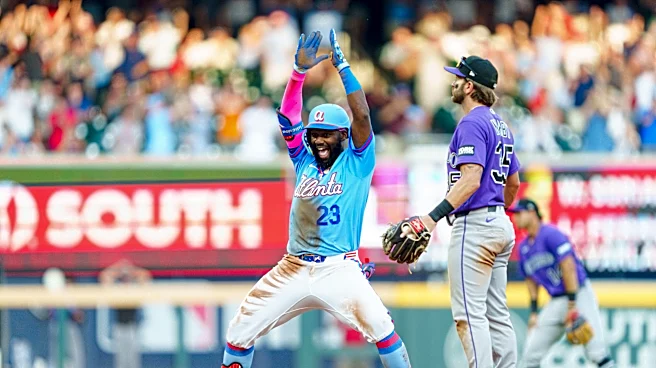

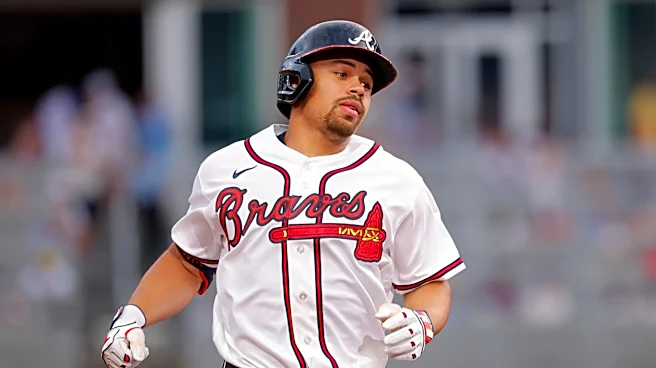
When Hall of Famer Todd Helton retired after 17 seasons with the Colorado Rockies, the carousel of replacements at first base has made for a grueling search to fill his position. For 13 years, the Rockies have tried again and again to find a first baseman who could provide stability and production at first base, but again and again they failed to do so. Helton set the bar high for the position, and no player has quite been able to reach it.
Until now, perhaps.
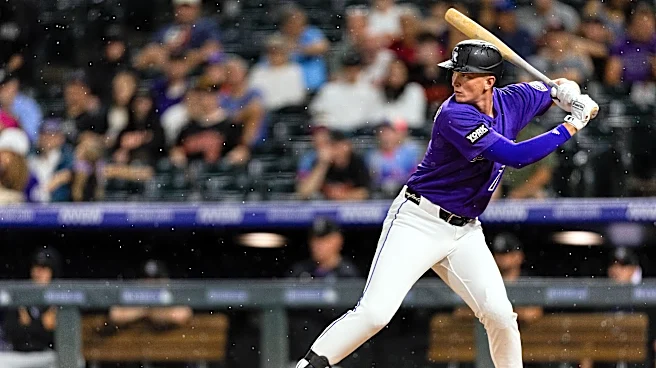
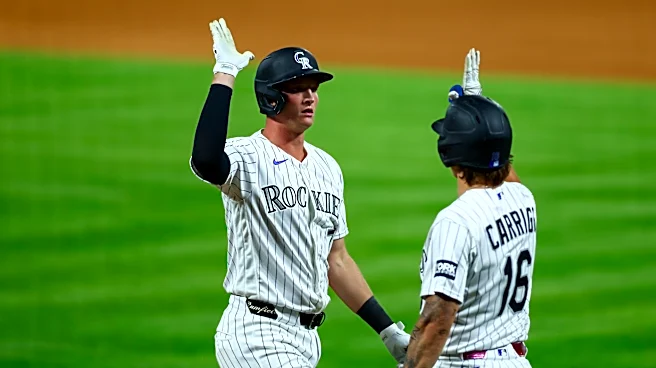
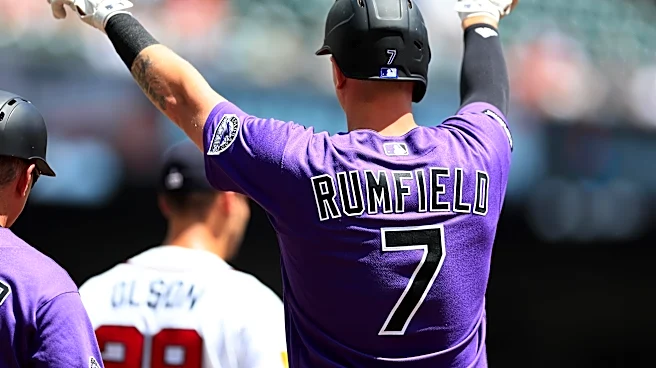
TJ Rumfield has had a phenomenal year
for the Rockies as a rookie. We’ve sung his praises plenty here at Purple Row, as he seems to have solved the riddle of first base for the club and has acompelling case to be in the Rookie of the Year conversations more than he already is.
As the season has progressed, it’s become apparent that Helton and Rumfield share similarities in their playstyles. How similar are their rookie seasons? Let’s dive into some of the numbers and see what we can find.
Surface value
A glimpse at the standard counting stats shows that Helton has the upper hand in nearly every category (more on the other stat in a moment).
In 152 games during his true rookie season in 1998 — after appearing in 35 games in 1997 — Helton proved to be a productive middle-of-the-order bat that could hit for power and drive in runs. He slashed .315/.380/.530 and benefited greatly from the fearsome lineup surrounding him, featuring four of the remaining Blake Street Bombers, and the pre-Humidor environment of Coors Field.
Rumfield has proven to be a steady bat in the lineup despite the statistically weaker lineup than that of the 1998 team. He has some power hiding in his bat, but he focuses on making contact and getting on base, as he is slashing .290/.383/.437, which has helped him keep pace with Helton.
According to Baseball-Reference, their value is nearly identical. Helton accumulated 3.2 rWAR in 1998 while Rumfield currently sits at 3.3 rWAR. FanGraphs has quite a bit more disparity between the values, with Helton accumulating 2.9 fWAR and Rumfield 2.1 fWAR. Helton is the overall better player, which is absolutely reasonable and expected after all, but Rumfield is keeping pace in his own way,
While they aren’t exactly replicas of each other, it’s the similarities that are making Rumfield such an effective player this season and could help him raise his level of play in the seasons to come.
On-base machines
Let’s direct our attention to the ability that made Helton so incredible in his career and has been the highlight of Rumfield’s rookie season: getting on base.
In franchise history, the list of rookies with at least 500 plate appearances and a .380 OBP in a season is as follows:
- 2026: TJ Rumfield (.383)
- 1998: Todd Helton (.380)
That’s it; that’s the list.
As we know, on-base percentage is the rate that a player gets on base by either a hit, a walk, or a hit by a pitch. By both accounts, Rumfield and Helton excel in the two main parts of the stat’s distinctions.
Entering the final month of the season, Rumfield has 136 hits, which leads the Rockies. In 1998, Helton tallied 167 hits, which was good for fourth on the team. Now, Helton was a true hitting machine as he tallied 49 multi-hit games during his rookie year, including several four-hit games. Meanwhile, Rumfield has 34 multi-hit games, including one four-hit game. With 23 September games left to play, Rumfield could have a chance to match Helton’s rookie total, which is second in franchise history behind Troy Tulowitzki’s 2007 season total (177). Rumfield has averaged about 26 hits per month this season, but to match Helton, he needs 31, which would be a month-high this season.
As for the walks, that is where Rumfield takes the crown. Helton was always known for impeccable vision at the plate, and that translated into a solid walk rate throughout his career. In 1998, he managed 53 walks for an 8.9% walk rate, the second-lowest rate of his career. Rumfield currently possesses an 11.6% walk rate while surpassing Helton’s walk total with 63. In fact, Rumfield is likely to overtake Dexter Fowler (67) for most walks in a season by a rookie in franchise history before this week is through.
Plate discipline
The plate discipline is what is so strikingly similar between these two players. Both have been excellent at getting hits and drawing walks, but the process leading up to them is what is so interesting.
It became a trademark for Helton to deliver grinding at-bats because it was so difficult to strike him out. During his rookie season, he struck out just 54 times with a 61.3% strike rate. He was a little more eager to swing the bat back then but still averaged 3.78 pitches per plate appearance, which was above league average. Helton would average about 4.1 pitches per plate appearance the rest of his career. He made plenty of contact (88.5%) and attacked pitchers with a 29.2% swing rate on the first pitch, which isn’t a lot but enough to do damage. Such a contact-oriented approach is what made Helton successful and complemented his ability to hit for power. Let’s not forget he had a .530 slugging percentage that season with 25 home runs and 37 doubles.
Rumfield has also proven to be a stickler at the plate with a quality contact bat. Sure, he has 75 strikeouts, but that is the 24th fewest in baseball this season. Much like Helton, he has a 61.5% strike rate and has averaged 3.77 pitchers per plate appearance. That may be lower than league average this season, but that’s because Rumfield is aggressive with his 42.5% swing rate on first pitches and has a solid 80.3% contact rate. There isn’t a specific stat to indicate how many foul balls either player hit beyond the ones that counted for strikes, but it’s safe to say that Rumfield does swing earlier and more often than Helton, but tends to put more bad pitches in play. Still, Rumfield has managed a .437 SLG with 13 home runs and 26 doubles.
Splits
As mentioned before, Helton thrived at Coors Field in 1998. He mashed to the tune of a .354/.417/.585 slash in 77 games with 13 home runs and 61 RBI. That type of production made the split so drastic on the road, despite Helton putting up quality numbers. In 75 road games, he batted .273/.340/.470 with 12 home runs and 36 RBI. He took advantage of his home ballpark, but Coors Field did not create Helton. He struck out more on the road, but that’s simply because opposing pitchers were terrified of throwing to him at Coors Field, so he walked more.
Rumfield, on the other hand, has been consistent regardless of whether he’s at home or away. At Coors Field, he is slashing .290/.375/.459 with eight home runs; while on the road he is batting .290/.391/.416 with five home runs. Nearly every stat for Rumfield is similar, save for RBI, because he’s just had fewer opportunities on the road. Much like Helton, Coors Field is not defining Rumfield, but rather highlighting that he is a great hitter regardless of where he plays.
The same can be said of the platoon splits. Both players are at their best against right-handed pitching with Helton punishing righties for 20 home runs and a .318 AVG. Rumfield is batting over .300 against righties as well with 11 home runs but his numbers do take a dip against lefties despite being solid enough. He only has two home run, but his .266 AVG and .367 OBP are quality enough numbers to keep him in the lineup every day instead of a platoon. Helton saw fewer opportunities against southpaws in his rookie season, but still bashed them for a .304/.394/.482 slash with five home runs in 133 plate appearances.
Either way, the ability to adapt and find consistency at the plate regardless of the varying factors is a valuable trait that so many Rockies have failed to develop over the team’s history.
Defense
Lastly, let’s touch on defense.
Over the course of his career, Helton won three Gold Gloves and was always regarded as one of the best defensive first basemen of his generation, if not baseball history. As a 24-year-old rookie, his score of 9 Total Zone in runs above average indicates that his fielding saved the Rockies roughly nine runs more than a statistically average major league first baseman would have saved over that same playing time of 146 games.
This gave him a 9.76 Range Factor per 9 innings, which was comfortably higher than the league average of 9.46 for first basemen that year. He committed only 7 errors on 1,317 total chances for a .995 fielding percentage.
Rumfield matches up with an 8 TZ, tying him for the MLB lead among first basemen. Rumfield actually accumulated his eight runs in fewer innings than Helton (982.1 vs 1,208.0). Because Rumfield plays in the modern era, his defense is also validated by modern tracking data, showing an outstanding 11 Defensive Runs Saved and 6 Outs Above Average.
The eye test helps us understand that Helton was a quality receiver at first base, butnew metrics help us actually put into context how Rumfield is at manning his position and the growth he still needs to make. In his case, the eye test still holds water, and he’s become a sound first baseman for the Rockies this season and deserves to be a contender for a Gold Glove.
Conclusion
The numbers tell a clear story: Rumfield’s disciplined eye, split-neutral bat, and surprisingly stellar glove match up with Helton’s 1998 campaign in ways few thought possible for a rookie.
While Helton remains a franchise icon whose rookie ceiling was elevated by a legendary surrounding cast, Rumfield is carving out a dynamic identity of his own. He is getting on base at a historic clip, anchoring an infield defense in desperate need of stability, and giving Rockies fans their first genuine taste of long-term answer at first base since Number 17 walked away.
Whether Rumfield takes home the Rookie of the Year hardware or a Gold Glove this fall, one thing is certain: the 13-year search is officially over. The Rockies have finally found their guy at first base, and the best may be yet to come.
On the farm
Triple-A: Tacoma Rainiers 6, Albuquerque Isotopes 3
The Albuquerque Isotopes out-hit Tacoma 11-10, but scored just three runs as they lost 6-3. Every Isotope had a hit, with Bryant Betancourt going 3-for-4. Roc Riggio also contributed his third home run, a solo shot in the sixth inning. The Isotopes went 3-for-5 with runners in scoring position, while the Rainers with 3-for-10 with RISP. It was a bullpen day for Albuquerque as Ryan Miller made the start with two innings of work, giving up a run. Blake Adams followed and took the loss after giving up four runs in the fourth inning. Parker Mushinski then gave up a run in 1.1 innings, followed by a trio of relievers who gave up just one hit.
Double-A: Hartford Yard Goats 5, Reading Fightin’ Phils3
The Hartford Yard Goats collected 11 hits, but it didn’t pay off until they scored three runs in the seventh inning to take the lead for a 5-3 victory. Andy Perez, Jacob Humphrey, and Cole Messina each had two hits to lead the offense. Perez and Messina both doubled in runs in the seventh and Jared Thomas delivered an RBI single to cap the scoring. On the mound, Sam Weatherly fired two scoreless innings to start the game and was followed by four innings from Cade Denton, who allowed three runs. Victor Juarez and Austin Smith closed out the game with three scoreless innings.
High-A: Everett AquaSox 7, Spokane Indians 1
It was a tough night offensively for the Spokane Indians as they scored just one run on six hits in a 7-1 loss. Spokane’s lone run came in the second inning on an RBI double from Clayton Gray to score Robert Calaz. On the mound, Aiden May made the start, allowing four runs on seven hits over 3.2 innings of work. The bullpen fared better, allowing three runs in three hits over 4.1 innings between four arms.
Low-A: San Jose Giants 8, Fresno Grizzlies 6
Tied 4-4 through the first seven innings, the Fresno Grizzlies and San Jose Giants combined for six runs, with the Giants coming out on top 8-6. Fresno took a brief lead in the bottom of the eighth, but San Jose scored three in the top of the ninth. Ashly Andujar had two hits for Fresno, while Juan Martinez also had two hits and drove in four runs. Sandy Ozuna made the start, allowing three runs through four innings of work. Grif Hughes then delivered four strong innings, allowing just two runs on one hit. Yanzel Correa had a rough night, giving up the three runs on two hits in the ninth.
Rockies Reacts Survey: Where will TJ Rumfield finish in NL Rookie of the Year voting?
Affected by Altitude Episode 223: The Final Countdown (of 2026) | Rocky Mountain Rooftop
This week, Evan Lang and I talk about expectations for the final month of the season, the struggles of Tomoyuki Sugano, and the Cole Carrigg finger incident.
Rockies ‘unlikely’ to call up top prospect Charlie Condon in September ($) | The Denver Post
Due to the looming lock out in December, it would appear the Rockies are going to hold off on calling up Charlie Condon to ensure he can continue utilizing the team’s resources in the offseason and also leave a 40-man spot open for other players they need to protect in the offseason.
Get the best of Purple Row on the new SB Nation app! | Purple Row
In case you missed the news, SB Nation has released a new app! You can easily access the Purple Row community to read articles, participate in game discussion threads, and access other communities.
Help Gabriel Barbosa Fight Colon Cancer | GoFundMe
Rolando Fernandez, vice president of international scouting & development for the Rockies, has organized a GoFundMe for former Rockies prospect Gabriel Barbosa. Barbosa was recently diagnosed with Stage 3 colon cancer and is preparing for the arrival of his first child.
Join the conversation!
Sign up for a user account and get:
- Fewer ads
- Create community posts
- Comment on articles, community posts
- Rec comments, community posts
- New, improved notifications system!
Please keep in mind ourPurple Row Community Guidelines when you’re commenting. Thanks!