

Injuries in pro football happen all the time. There is no way to predict what will occur once the whistle blows and no assurance that every players will end up without getting hurt during each contest.
A common injury is the “non-contact” variety. This generally occurs when the foot gets planted as the athlete begins to turn his or her body and go in a different direction. The foot doesn’t release its position, something on the body doesn’t give, and then an injury occurs. This can be a knee sprain,
tendons that pop inside the knee, or various hip issues.
RELATED: CADDIX CLEATS SET TO ALTER THE ATHLETIC SHOE LANDSCAPE
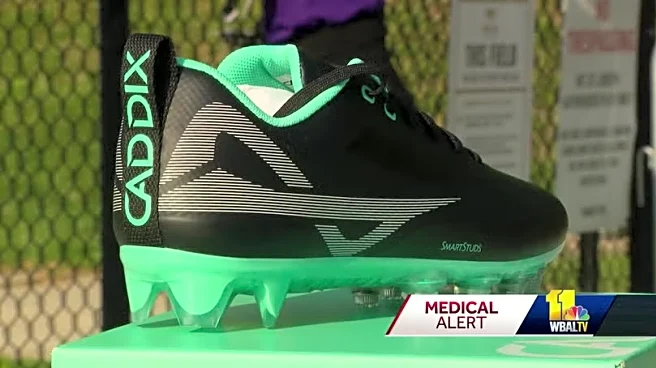
A company called “Caddix” has invented cleats that contain studs that actually give depending on the movement of the athlete and help get rid of non-contact injuries. Yes, a cleat that flexes instead of gets stuck in the turf.
The Caddix Company refers to their athletic shoes as “cleats for your knees” because the cleat studs have a degree of rotation installed into their technology that gives a bit instead of becoming stationary.
Here at Revenge of the Birds, we did a deep dive into the Caddix Company, along with the technology regarding their new sports footwear, so that you, the fan, can keep up with new inventions that are happening in the sport. The link is just above.
The company’s X handle, as well as their Instagram icon, is @caddixcleats.
And now, ROTB’s Barry Shuck presents a full interview with the CEO of Caddix Cleats, Jack Rasmussen.
—————————————————————————————————————————-
Jack Rasmussen and his father Jeff are the company co-founders. Jeff has 30-plus years of marketing experience so a new product and promoting it fits nicely in his toolbox. Jack played college football.

Also, on staff at Caddix is Dr. Kirk McCullough, who is listed as their medical advisor. Anytime a company has a product that makes claims regarding injuries, a board-certified doctor better be on board. Dr. McCullough specializes in orthopedic sports medicine, is a foot and ankle surgeon, and has current ties to teams in MLS, the NWSL, and was once the team physician for the Kansas City Chiefs.
Three professional athletes are company advisors and investors: Tight ends Todd Heap and Dennis Pita, formerly with the Baltimore Ravens, and Kayla Sharples, who plays defender with the KC Current of the NWSL.
Arizona Cardinals players who wear Caddix: Budda Baker, Joey Blunt, Darren Hall, and Starling Thomas.
Caddix is currently marketed toward football players, soccer athletes, and Lacrosse players. It is continuously looking to innovate and help keep players on the field for longer.
A former high school and junior college basketball player, Rausmussen began his college football career as a punter for Missouri Western State University from 2018-2021. In his final season, he transferred to Western New Mexico University, where he was named an All-American at the D-II level with an average of 43.4 yards per kick and a long of 66 yards against Central Washington.

The company is located in Baltimore, Maryland. The company name has its own story.
Summertime is synonymous with fly fishing and caddisflies. These are aquatic insects that are an important part of freshwater ecosystems. Their larvae, known as caddisworms or caddisfly larvae, are often found in rivers and streams. The adult caddisflies have moth-like wings and a hairy body, and just happen to be a favorite meal for many fish species.
Rasmussen just happened to be fly fishing in a river in Colorado. His thoughts were still engaged on what his new company should be called. As he was fishing and dealing with his caddis artificial lures, it hit him to simply take out the “S” in caddis and replace it with an “X”. That’s it. That’s the whole story.
Shuck: You are a former athlete. How did this background help you in your new field?
Rasmussen: That is really part of the motivation. Because in college football, you always see injuries that derail these careers that were so promising. So much potential and then injury occurs and its gone. The connections I built in college were invaluable. This web of interconnectedness that helped build this field of outreach portion of the company kept us going.
Shuck: So, the beginning of this journey is that you were watching a football game with your dad, and somebody in the game got hurt?
Rasmussen: Jamaal Charles went down with the Chiefs. My dad and I were thinking we could fix it. My dad was in advertising, and I was just a nobody. I was living in Utah and was working as a housekeeper at a National Park. I quit my job, moved back to my parents’ house in Maryland, and studied biomechanics for a year. My dad and I actually wrote our first patent when I was just 19 years old.
Shuck: What was the timeline of the final idea?
Rasmussen: Nothing is straightforward as to a path. The idea came, and then I took a year off. I came back and went as heavy as I could for a year. And waiting for the patent award was the most arduous process because you have to re-file and re-claim things and pay extra. It’s like a four-year hiatus. I was just a 20-year-old kid claiming all these ideas and all this science-based data with nothing tangible. Without a patent, we couldn’t do anything. So, I was dead in the water for four years. The patent got awarded in August 2019, and that’s when I started raising money to go out west to prove my theory at a university. After that, I got in touch with I-Generator and went back and forth with them. They helped with the design, got me in touch with factories in China, and kept this thing together.
Shuck: How have President Donald Trump’s tariffs affected your process with China?
Rasmussen: It hasn’t affected us yet because they suspended it for 90 days. We got in a production order during that window, which is so nice. But ultimately, what is going to happen is we are going to have to go overseas and maybe find somebody else. But at the same time, we don’t know how this is actually going to end.

Shuck: At what point did the words “make the cleat studs able to flex” come out of somebody’s mouth, and after how many beers?
Rasmussen: No beer involved, just a couple of guys who are crazy. The original idea was conceptualized around the shoe sole itself. We didn’t think about studs right away. The original specs were that the shoe sole was comprised of certain layers that had certain jobs to make it rotate and flex. One layer moves left, one moves right, one moves laterally front and back, with an amalgamation of movement within a shoe sole. Fast forward to 2020, and the practicality of the manufacturing standpoint wasn’t feasible. So, we focused on the technology and the functionality of the studs rather than the shoe itself.
Shuck: To finance this, you were either rich, were engaged to somebody rich, went on “Shark Tank” and got funded, or you went the “beg, borrow, or steal” approach. Where did the money come from to get this thing going?
Rasmussen: My dad and I bootstrapped it for the first couple of years for the first patent. And in 2018, I raised a very small amount from family and friends just to fund the study out west. Last year, when we decided to make cleats, I raised money from professional athletes, including Joe Flacco. We denied Shark Tank twice. They called, and we didn’t want to go. The language in their contract wasn’t favorable. It was geared towards the sharks and the show itself. Plus, I think the show is more of a “look at me” approach instead of being a good business model. We already had investors. It just didn’t make sense at all.
Shuck: What are the cleat stubs made of?
Rasmussen: Within every stud, there is a post. And around that post is a rubber washer that allows it to freely move in any direction. And around that is encased in plastic. Nothing out of the ordinary except that washer.
Shuck: Cleat stubs are designed to catch and grip either grass, the Earth, or a synthetic surface. Your cleat nubs aren’t designed to catch, but at the same time, they don’t slip. Why?
Rasmussen: It is designed to optimize traction. Traction equates to performance. But when there is too much traction, there is inefficient traction to the point where it’s injurious. So, if you go to plant and cut, and your cleats do exactly what they’re designed to do, you will have the traction. Now, depending on the playing surface, how you train, your muscle features, all of these variable factors go into this equation that either goes well or goes badly. Our whole concept, yeah, we need traction to perform, but if there is too much traction, our cleats can realize it. They can flex and reduce that injurious load while still maintaining the performance load. After lots of testing, we found a really sweet spot that tested well.
Shuck: How does the technology help to avoid non-contact injuries?
Rasmussen: If you get stuck in the ground and your foot is locked to the playing surface, your knee tries to compensate for that lack of motion. But if your stud will flex, it kills the force of the ground level before it propagates up the kinetic chain to your ankle, your knee, and all the way up to your hip.
Shuck: Is the reduction of the rotational force from the ground up the goal?
Rasmussen: That is correct.
Shuck: Overall, how much time was spent to come up with a working prototype that was approved as the right one?
Rasmussen: Probably three years. And during that time, we were constantly looking for money under every couch cushion and rock.
Shuck: How many prototypes did you go through until you perfected the idea, and where is the original prototype?
Rasmussen: Close to 10. Under 10. There were so many obstacles. The stud wouldn’t lock into place. Sometimes it would fall off. There would be a manufacturing error. We were constantly fine-tuning our efforts, and then finally last year, we figured it all out. The original my dad threw it away. I had made it with dish soap and quick-hardening caulk. It was a transparent rubbery substance that could easily be worked with. It’s long gone.
Shuck: What has your medical data stated?
Rasmussen: There have been decades of data that support this plan. I want you to know this. There was a dude in his garage in the 1970s who tried to figure it out. Each shoe weighed four pounds, which isn’t going to work. But it did support the theory that it would work. Our cleats have a faster relief coefficient. That’s how fast you get out of the playing surface, whether it’s turf or grass. That enhances the amount of time you need to get out of the surface, which equates to a reduced force reduction. We put our SmartStuds on the worst-performing cleats that the NFL had last year. And we increased the score by 17%.
Shuck: Is your technology a retrofit or just on your shoes?
Rasmussen: Just on our shoes.
Shuck: Do athletes feel the cleat bottom taking some of the force out, and does it take anything away from their performance?
Rasmussen: While you don’t feel the studs actually move, you do feel the reduction in your ligaments and joints. You do feel that you get out of your breaks faster because the force is reduced. And our shoes were tested on all possible surfaces and works the same.
Shuck: So, you invent the bottom portion of the cleat and change the entire dynamic, and everyone is happy and ecstatic about what you have invented. But now you have to make the application work. And it’s not like what you developed can be retrofitted to every pair of cleats out there in the world. Which means, all of a sudden, you have to attach your invention to a new set of cleats. Which also means you have to become a shoe designer and a shoe manufacturer. Your grandfather wasn’t Geppetto, and y’all didn’t grow up making shoes. How did you go about solving this?
Rasmussen: I was a basketball player and didn’t belong on the football field, but I was an All-American. We were set with this task, and we either choose to do them or not. I chose to do this to the best of my ability. Whether that is hiring an organization that knows what they are doing, or sitting at my house and learn biomechanics. We feel we are going to figure it out. Always. Every job is to figure it out. Making shoes is a task we had no business solving, and we hired the right team, and they had the answers to it. We are a team of doers. And nobody on our team isn’t up for a serious challenge. I know it’s not a great answer, but we figure it out.
Shuck: What does your patent cover?
Rasmussen: We actually have nine patents for the different design iterations and a similar functionality to the one we are selling now.
Shuck: Cincinnati Bengals quarterback Joe Flacco, and Super Bowl MVP, wears your cleats. How did you get him into the process?
Rasmussen: Ravens tight end Todd Heap called me, and I wanted to make it a Baltimore thing. I told Todd I would love to get some former Ravens involved. He told me he was still friends with Flacco, and I told him to call. I got on the phone with Flacco who was with the Indianapolis Colts at the time, and made a pitch. I didn’t think it went well, but he invested and we sent Joe a pair for Colts’ training camp, and he loved them. It just blew up from there.
Shuck: The standard cleat comes in teal, which is a great look. But many leagues, such as the NFL, have a lot of color stipulations with uniform contracts. How do you get around that?
Rasmussen: We actually made Joe (Flacco) a blue pair for the Colts last year. We made him a different color for the Browns. We set aside a few hundred blank plates in our manufacturer’s warehouse. We have them painted for different NFL players. This year, we are going to release a black pair and a white pair for all athletes because that doesn’t interfere with anyone’s apparel contract. We will have more standardized color options.
Shuck: The number of outdoor sports leagues is staggering in a ton of sports such as football, lacrosse, softball, field hockey, soccer, rugby, baseball, flag football, cricket, not to mention the explosion of women’s sports. The way female bodies are designed, they are more susceptible to tearing up their knees, hips, and lower body injuries. Will these cleats help women?
Rasmussen: Yes, but the same way it helps men – it is just at a different rate. The problem with women is that their hip, as it relates to their knee angle, is more dramatic because of their ability to reproduce. Their menstrual cycle is a huge factor. Women have been wearing men’s cleats since the inception of sports. It is not cost-effective to offer women their own cleats because that market didn’t exist until a few years ago. These companies don’t care until they publicly have to. The Achilles structure is different because it is so narrow. No one has addressed this until recently. We are one of the few that do, and I am proud of that. It’s what everyone should be focused on, regardless. Other companies haven’t wanted to try things that are new because women have been using the same cleat for two decades.
Shuck: The shoe market is a crazy industry. What demanding encounters are you facing as a new shoe company?
Rasmussen: There are uphill battles that we’ve had come with experience. These companies lock up these schools with apparel and shoe contracts.
Shuck: Professional athletes who have shoe contracts are an elite class. Not only is it monetary, but there is a lot of status. Here you have a cleat that would help their career by preventing injury, yet how do you get athletes to switch?
Rasmussen: Players who wear name brands and have contracts can’t wear our cleats. I ask them how much they are making in a year. They tell me. It is never a small number. How they are the most valuable is when they stay on the field. If you go down with an ACL tear, you are going to miss the rest of that season and half of the next. There is a lot of pride in being a Nike athlete. That’s a very elite room to be in. I get that. These large companies have not properly innovated their footwear in decades. I didn’t start this company to make millions. I started this to help athletes because they are afraid of their sport and is incredibly wrong on every conceivable level in my opinion.
Shuck: Are you strictly selling online on your website, or do you also have a retail presence?
Rasmussen: We sell online and in a few small lacrosse stores along the East Coast. The scale of this thing is I am looking to branch out to a bunch of retail stores.
Shuck: Every sports shoe company out there is going to want this technology for their own products. What is your assessment of what it is worth?
Rasmussen: In the right hands, this is worth billions of dollars. It’s incontrovertible evidence that it works. If the evidence is that strong and that sound, it might become mandated from the top down. And whoever has this, may own the whole market.
Shuck: Where do you see your company in five years?
Rasmussen: I see it mandated, or I see it merge with a larger company that has a bigger reach. More funding, more resources, and a reputation that is attached to a name that already exists. Or blow it up, which we can do easily.