







Much has been documented and written about the success of Peter Reid’s tenure as Sunderland manager, and notably the two seventh-place finishes. That fact has, of course, been resurrected even more at the end of this season, with the achievement of RLB’s team and qualification for the Europa League.
I’ve supported the Lads long enough to have experienced many false dawns. Just when you think we’re establishing ourselves back amongst the elite, where most of us believe we should be, we experience another
slump and another setback. I came into this world in 1958, coincidentally – the first time this great club was ever relegated. What a turbulent history we’ve had since then! Maybe it’s all my fault!

I remember countless people quoting phrases similar to: “The days of this club fluctuating between the leagues are over.” I know sentiments like that were expressed by Ellis Short, Bob Murray and even Niall Quinn, amongst others.
To analyse exactly why clubs – not just Sunderland – lose their elite status after seemingly being perfectly set up for decades to come is, of course, very complex. The whys and wherefores are varied and numerous. If there were one major factor, all clubs would ensure it never happened to them. But no – multiple factors come into play.
Having a dedicated owner with a long-term plan, a manager – or head coach – and backroom staff all singing from the same hymn sheet, while buying into the club’s identity and ethos, is crucial. Add to that a solid youth development system and player recruitment that identifies the right players who fit into the club’s trajectory. Does any of this sound familiar regarding our current position? At the moment, it’s all beautifully aligned, but if any one of the long list of positive requirements goes wrong, the whole structure can collapse before your very eyes. Most notably in recent years – just ask Leicester City or even Wolves.

I’m not going to attempt, at this juncture, to explain exactly why it all went wrong for Peter Reid and that fantastic period. He would tell you one thing, and Sir Bob Murray would tell you another. But one thing is certain – having the right player recruitment is essential to developing and growing the club, and keeping it moving in the right direction. Buying for the sake of buying is a potential car crash. Buying a player who doesn’t fit the club’s identity or the current squad will almost certainly result in an MOT failure.

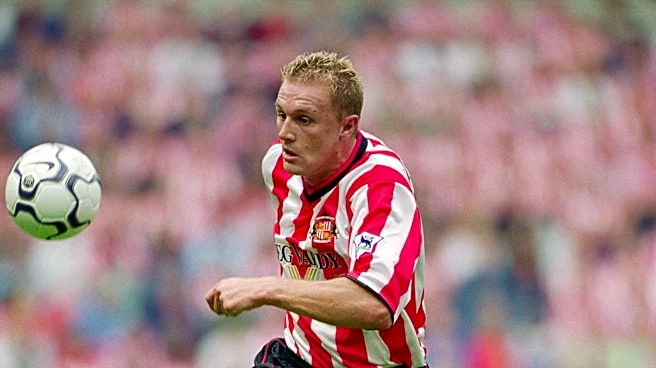
So – back to the piece in hand – one Monsieur Lilian Laslandes.
Now, I’m not saying for one moment that he was the reason the pack of cards collapsed, but he was perhaps, nevertheless, a part of that deck.
The second seventh-place finish in 2001 was followed by a 17th-place finish in 2002, just one place above the drop zone. Along with Laslandes, other signings that year were Nicholas Medina, Bernt Haas, Jason McAteer, Joachim Björklund and Claudio Reyna. Of those, Laslandes, Haas and Reyna only played a handful of games. It must be said that Reyna was potentially an excellent signing, but injury robbed us of seeing more than his 28 appearances for the Black Cats. McAteer and Björklund were in the final years of their careers, so it was not an especially impressive transfer window.
Before purchasing Laslandes for £3.5 million – a substantial amount in those days – he had played three times for the French national team. He had, however, already turned 30 years of age, so the club weren’t exactly forward-thinking back then. He was brought in to replace an ageing Niall Quinn, but it became obvious quite early on that he was never going to adapt to the pace of the Premier League, nor Sunderland’s direct style of play in those days. His relationship with Peter Reid reportedly deteriorated as well.
Looking back at that catalogue of errors for one player alone yet again highlights why there is such positivity around the club and the area at the present time. Can you imagine the current regime bringing in a player who couldn’t adapt to the league, the team’s style of play, or get on with Régis Le Bris? Comparatively, it’s quite astonishing really.

After only 12 appearances and no goals, he went on loan to German side FC Köln, where he again failed to score, before a slightly more successful loan spell at French club Bastia during the 2002/03 season.
He returned to Sunderland for pre-season training under new manager Mick McCarthy, where all parties agreed his future was no longer at Sunderland. So the damage from that transfer window hardly helped Reid’s cause, as he had already parted company with the club.
Our crippling debts meant we were in no position to bargain, and we had to let Laslandes leave on a free transfer to OGC Nice. He went on to play another 132 games, scoring 25 goals, before retiring in 2008 – maybe it was our climate he didn’t like!
It was a squad that shouldn’t really have struggled, but they did, and could even have been relegated on the final day of the season. Following that struggle, Reid’s seven-and-a-half-year spell came to an end. The following season, we went one better and were relegated.
Every cog has a part to play, every piece is important to the car engine. Laslandes was a misfiring part in more ways than one, it seems. He was on a big wage, which was one of the reasons we let him leave on a free, but wages aside, he cost us nearly £300,000 per game he played. In the early part of the century, that was even more eye-watering than it sounds today.
Looking back at a transfer like his allows us to reflect on just how much the club has moved on in terms of structure, identity and alignment. With, thank goodness, some much more impressive French players.
Merci, mais non merci, Monsieur Laslandes.