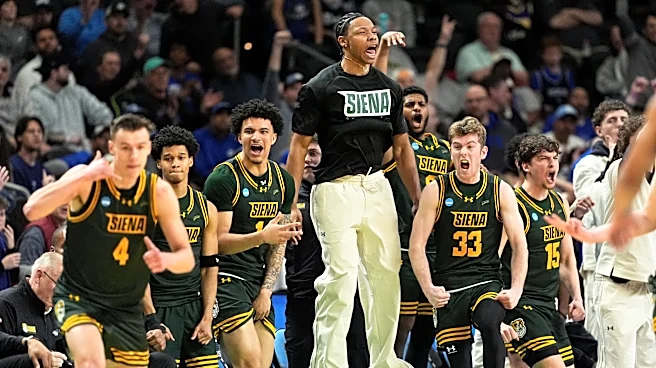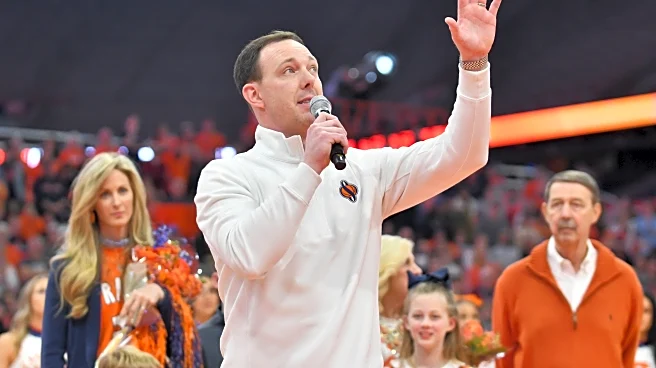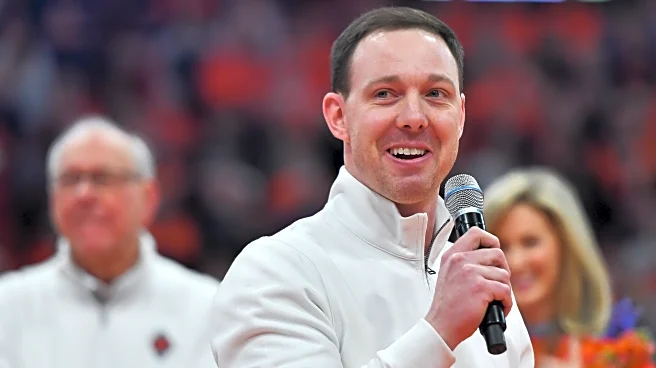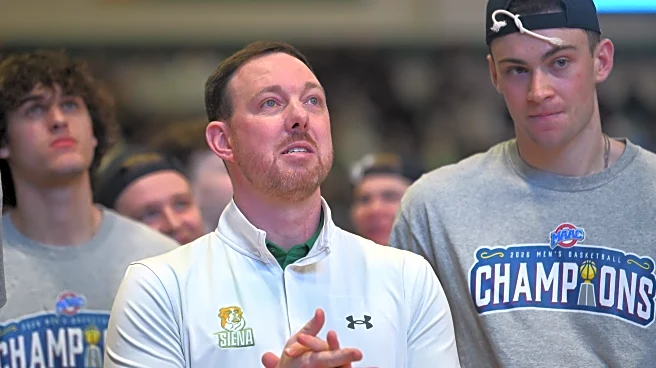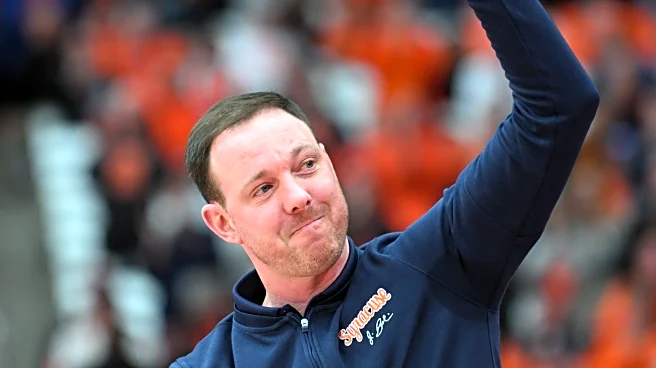

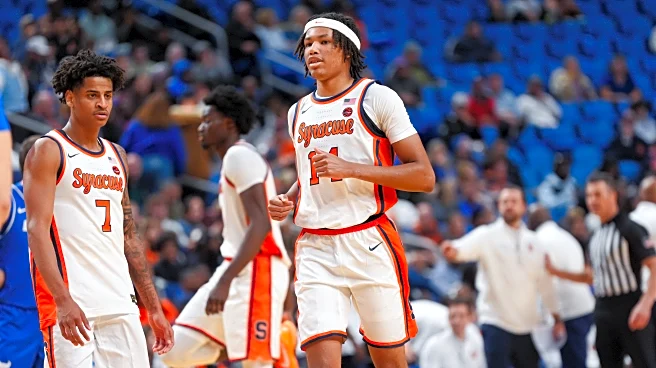
The Syracuse Orange men’s basketball program held its first press conference with its ninth all-time head coach on Monday. Gerry McNamara met with members of the media following his “welcome back” event at Miron Victory Court.
McNamara had to juggle two programs last week as he transitioned from Siena to Syracuse. He’s been on the phone with Syracuse donors to spearhead support while also making sure loose ends were tied up at Siena, helping some members of his team at Siena find new homes.
Syracuse
is reportedly working to up the ante to its resources, which McNamara stated last week to Syracuse.com he’d need $9.0$10.0MM to be competitive for 2026-27.
“Obviously the financial piece is so huge. We’ve got a lot of energy right now, a lot of people that are stepping up that want to help,” McNamara said Monday. “The work’s not done.”
The next steps for McNamara at Syracuse include getting his staff finalized, then continue to re-recruit the 2025-26 Syracuse roster how he sees fit. He and his staff will then hit the ground running when the transfer portal opens a week from today to fill in any gaps.
McNamara acknowledged the pressure of situation at Syracuse but stated he’s unconcerned with outside pressure to success at Syracuse.
“No more than I already put on myself,” McNamara said of the pressure. “I think it’s magnified here than in my precious spot. You wouldn’t believe the chest pressure I had when we lost three in a row at Siena last year. Coaches, we take it home with us. You can’t shut it off. So it’s no different here than what I already felt in terms of the responsibility. I understand. We need to get back.”
Here’s some of the most noteworthy topics of conversation from McNamara’s first official press conference as Syracuse head coach.
His vision for building the program
“I like the way we looked at the end of this year with Siena. If you look at a lot of these teams playing now (in the NCAA Tournament) they’ve got positional size. We’ll be very strategic the best we can here the next few weeks of having some athletes and size. Being able to offensive rebound and still be able to shoot.”
McNamara said he likes to think of himself in terms of a coaching mold as a motivational leader. He said he thinks it’s more important now more than ever to have those characteristics in today’s game when programs might only have kids for a season or two.
On where his drive came from and how he got to this point
“My dad was a hoop junkie but I don’t know if any of the older heads in here if they’ve ever seen have seen the NBA superstars,” McNamara said.
McNamara said he must’ve watched it a million times. He wasn’t pushed into basketball by his family. It was just that he loved it.
“Because I loved it my father gave me as much of it as I could absorb,” McNamara said, citing a love for the game.
McNamara had a key to the Holy Rosary gym where he grew up because his father’s best friend, Teddy Bloom, was the coach.
“When you love something you want to do it all the time. When you do it all the time you want to be really good. To be really good you’ve got to beat other people. That’s probably how it just all evolved.” – Gerry McNamara
The kind of players McNamara wants and how he’d like his Syracuse teams to play stylistically
McNamara wants to be flexible in his coaching approach, adapting to players’ skillsets. Getting top talent is trading one basket of strengths and weaknesses for another.
“I would’ve loved to have made more threes this year,” McNamara said of his Siena team. “But I wouldn’t trade the toughness and ability of [Gavin] Doty and [Justice] Shoats, their on-ball presence defensively. So to me, I’m a coach. I can adapt to a player to help them and put them in my style within my offensive system.”
McNamara had said earlier in the day he wants his guys to play smart, value the basketball, to be tough, resilient and be high character kids.
“Obviously I’ve got criteria but I’m never going to turn down good,” McNamara said. “And when i see good I’m going to go after it and figure it out later.”
What he values in coaching beyond just resources and modern Xs and Os
“Relationships,” McNamara said definitively. “I’m still a big believer. It think it’s gotta be part of it for me. I know there’s going to be some transactional stuff in this industry. It’s just inevitable now with the agents and these guys having options. I think for me to truly be at my best there’s that communication level in the relationship. I think that stands the test of time, I do.”
McNamara brought up Purdue point guard Braden Smith as an example of someone who could’ve made more money elsewhere but chose to stay and building relationships and have success. Smith just moved to the top of list in college basketball’s all-time assists rank (passing Sherman Douglas’ 960 assist mark earlier this season).
McNamara likened Smith’s four-year career at Purdue to his time as a player at Syracuse.
He’ll play some 2-3 zone on defense, but mostly man
“I used it situationally at Siena,” McNamara said of the 2-3 zone. “So hopefully our man-to-man defense is as good for the majority of the year that it was this year and I don’t have to use it. But we absolutely will have it in our pocket.”
McNamara can out-coach opponents, but he wants to out-talent as well
“John [Scheyer] helped me when he said it. I want to out Jimmy and Joe too. Not just Xs and Os. I want the Jimmys and Joes. I want the players,” McNamara said. “You need to be able to coach kids that allow you to coach them. Every day. No nonsense. So when we put in a scout because of their professionalism and maturity they didn’t miss a beat, ever. I think that stuff builds as you go. I’ve got to do both. I’ve got to be able to have strategically a plan to put us in position to win from a coaching side. But I like one of those nights that I have an off-night that these guys are so good they have my back too.”
On whether there were hard feelings to work through after not being selected as Syracuse head coach the first time around
“I don’t look at it like that. I love Adrian Autry. There was no one happier for Red when he got the job than me. I was actually grateful that he wanted me to be his associate head coach,” McNamara said.
McNamara said it meant a great deal that Autry trusted him to be his top assistant.
“I was genuinely happy for Adrian because I thought he worked his tail off. I watched him. He’s terrific. He’s going to land on his feet. He’s awesome. He’s so well respected. The way I looked at it was I was grateful that he believed in me.”
McNamara shared a bit of his thinking in terms of what led to him jumping to take the Siena head coaching job.
“But I also knew during that time but my window is getting a little but smaller in terms of me at the right age going out and trying to what I’m capable of too,” McNamara said. “If I found the right opportunity — I would never leave here unless I did — and I was lucky enough to and here we are. But no, not slighted at all. I feel like this is a blessing in disguise. The right opportunity for me to go prove myself on my own under no one’s blanket. Just go do it.”
When Adrian Autry was named the eighth head basketball coach in Syracuse history, McNamara was soon named associate head coach. He’d spend one year on Autry’s staff before pivoting to Siena.
“When I left here I was hoping I’d never come back here because it would mean that Adrian had success,” McNamara said. “I was hoping like, ‘alright man, get this thing going. Be there 30 years.’ … I walked away — that’s why I was emotional — because I walked away thinking I probably won’t be back.”
Working to ensure a graduating class at Syracuse experiences being part of the NCAA Tournament
“That’s a shame,” McNamara said. “I came back to change that. Part of being in college at Syracuse as a a student is the basketball team needs to be good. That’s should be non-negotiable. That should be part of your journey as a student. It should be so much fun because the basketball team’s so good. I was a player when we were and I’ll tell you right now this place was jumping. That’s whats a shame. It needs to change. I know that. And I’m gonna do my best to work my rear-end off the change it.”
His staff at Syracuse
The pieces are in place for McNamara’s next staff at Syracuse, but there’s more background work to be done before announcing publicly.
“We’re not in limbo,” McNamara said. “I want to make sure that everyone in terms of getting on payroll and everyone getting through HR and then we’ll start to roll everybody out. We’re in position. Don’t follow me home tonight but I got a couple guys waiting. We’re getting right to work. And like I said there’ll be a lot of familiar faces. You’re going to know a lot of them. There’s going to be some new faces and we’re going to get it right.”
McNamara has said he values having a veteran head coach at Siena, but at this point in his career as head coach it might not be necessary.
“With this staff it wouldn’t surprise me if you saw somebody with experience,” McNamara said. “But at the same time I think it’s overblown a little bit too at the stage where a coach is doing it for a while. Once you do it and you see it and you live with the chest pressure you bring home and you lose at the buzzer for the first time, or you feel like you made a mistake late in the game that cost you. You’ve lived it already. I’ve gone through all those things.”
His offensive system and how it differs from Boeheim and Autry philosophies
“I have a certain system obviously in terms of multiple families of plays,” McNamara said.
McNamara’s teams have run zoom action at Siena. Just about every coach at the Power Four level (and division one level for that matter) runs action off of horns and has multiple variations off those sets. Modern basketball emphasizes spacing in a positionless basketball system, meaning, players today have multiple skillsets irrespective of position (centers that can handle the ball on the perimeter, pass and shoot. Point guards that can also shoot and defend multiple positions. Shooting guards that can dribble and pass, etc.)
But McNamara highlighted his intention to play through the big.
“I had [Francis] Folefac and [Riley] Mulvey where I had two different guys that I could kind of work through late,” McNamara said. “Where things if they broke down on the initial action I could work through a guy and get through something easier. Whether Folefac — whether it be he could bully a guy and get to 12-feet and create a three-on-two or two-on-one. Or if it’s single coverage go on his own. Mulvey where you could X off of him and run action, he’s a terrific passer. So you’ve got to have late guys, late action that you can get to that you can just create and guys can conceptually make plays.”
McNamara said he didn’t know if William Kyle was used in dribble-hand-off (DHO) scenarios this past season, but suggested he wanted to deviate from isolation basketball and pick-and-roll.
“For us it would end up more in a hit action or chase,” McNamara said.
Chase action is where an offensive player passes the ball into the big — usually at the elbow (the pinch-post, as McNamara refers to) — and sprints to receive a handoff. From there the big can make a read to hand off to a guard or fake the handoff and drive, or pass if help defense overcommits.