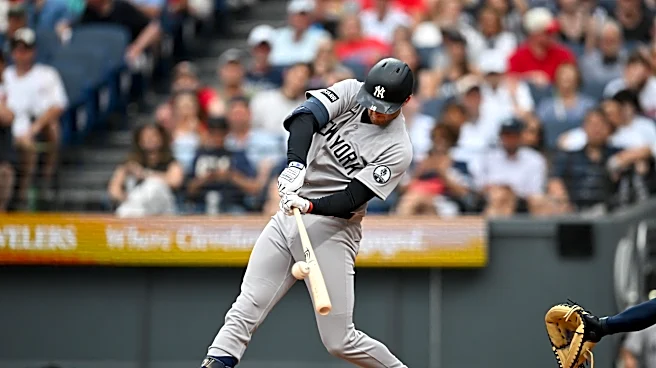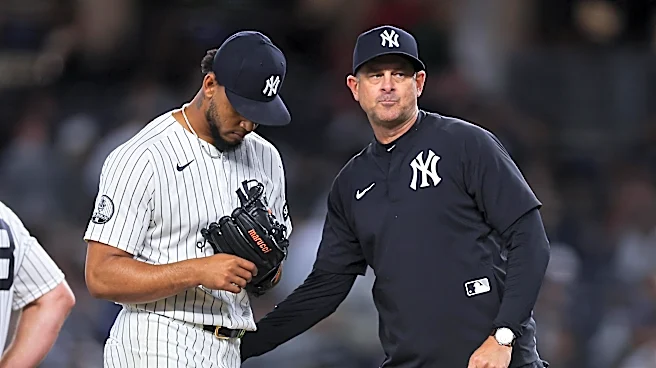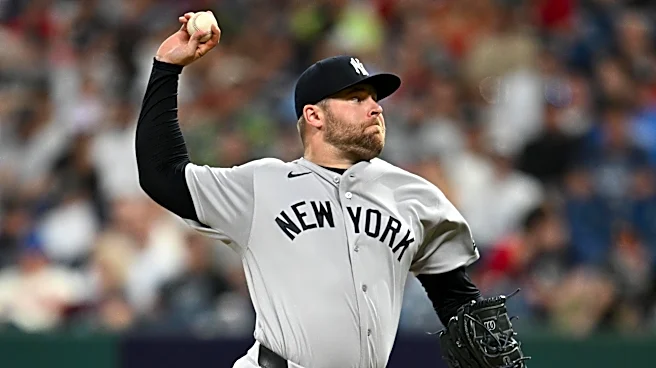





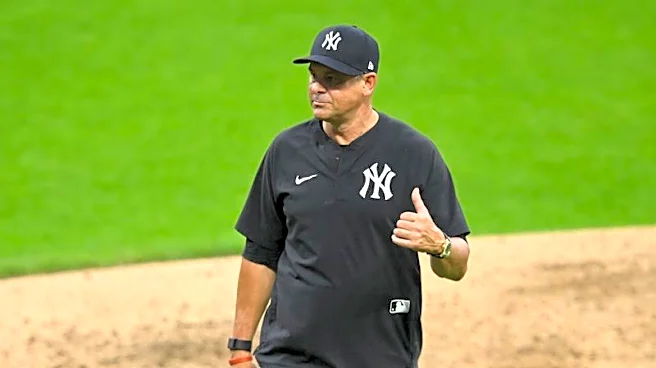


The proof of the pudding is in the eating. Despite featuring a closer who has, at times, underperformed and lacking a clear bridge to him in the late innings, the Yankees’ relief corps has posted the third-lowest ERA in the AL. Yes, a big reason for that statistic is the fact that New York’s starters have done their part, allowing their counterparts in the bullpen to toss the second-fewest innings in the league as manager Aaron Boone has been able to put his relievers in position to succeed. But
it’s also a testament to the overperforming veterans who’ve buoyed the bullpen as a whole.
As I do each month in a given season, I’m going to take a look at the Yankees’ relievers to identify how Boone is deploying each and offer a verdict as to how much trust we can place in them moving forward.
Statistics below are as of June 15th.
The Closer
David Bednar
Recent stats (since May 15th): 11.2 IP, 3.86 ERA, 14 SO, 3.62 FIP, 4 Saves (in 5 opportunities)
After a sloppy start to the year, Bednar appears to have settled in. He’s rolled off eight straight scoreless outings, including a stretch of four hitless appearances to start the month of June. A few of those goose eggs put up by the Yankees’ closer came in games where the Yankees led by more than three runs, negating a save opportunity and perhaps providing an easier avenue for outs against an overpowered opponent. Still, zeroes are zeroes.
Confidence level: High
Bednar’s peripherals anticipated some positive regression after his early struggles, and that has started to come to fruition. Opponents are chasing on pitches outside the zone 39.4 percent of the time and putting the ball on the ground 59.8 percent of the time when they make contact, both of which are in the game’s upper echelon. Expect the eight-year veteran to continue an upward trajectory as he remains unchallenged for the ninth.
The Set-Up Man
Fernando Cruz
Recent stats (since May 15th): 14.2 IP, 1.23 ERA, 16 SO, 2.56 FIP
Cruz has gradually become the Yankees’ de facto set-up man. It’s not hard to see why. The 36-year-old has built on a breakout 2025, pitching to a 2.01 ERA in 34 games (only five MLB pitchers have made more appearances) while bringing an explosive intensity to the mound that has helped galvanize his teammates. As was the case last year, the only scary part of his game is control; Cruz has walked five batters over his last three appearances, creating the kind of traffic that can quickly lead to big innings.
Confidence level: High
Until proven otherwise, Cruz’s splitter remains an unstoppable force. Opponents are hitting just .117 against the pitch and are showing no signs of adjusting to its confounding vertical drop. The walks are a concern but, for now, he remains in the driver’s seat.
The Middle Relievers
Camilo Doval
Recent stats (since May 15th): 11 IP, 4.09 ERA, 8 SO, 3.38 FIP
In Doval, the Yankees have a textbook case of analytics versus outcomes. The former Giants closer’s 2.76 expected ERA is sparkling; his 5.06 season ERA, not so much. FIP, looking at a 25:5 K:BB ratio but four home runs in 26.2 innings, is in between at 3.74. The good, old-fashioned eye test tells us that we have a pitcher with impressive stuff and strong control who struggles far too often to command the zone (his nearly 50 percent hard-hit rate backs this up as well). Where does that leave us?
Confidence level: Low
While Doval has pitched better of late, holding opponents off the board in his last five outings, there’s been far too much boom-and-bust in the right-hander’s game since he joined the Yankees at last year’s deadline (and before) for him to garner much trust. While he’s lost the set-up role with which he entered the season, Doval has remained in the late-inning mix and, considering his recent success, should see more opportunities, but we’re still in breath-holding mode when he enters in high leverage.
Brent Headrick
Recent stats (since May 15th): 12 IP, 1.50 ERA, 14 SO, 2.27 FIP
Headrick has been one of the sport’s biggest surprises at reliever and, considering the chasm between expectation and performance, arguably the biggest reason the Yankees’ bullpen has been as successful as it has so far this year. He’s one of those five pitchers with more than 34 appearances and has posted a 1.87 ERA while shouldering that heavy workload. Opponents are hitting below the Mendoza line against both his four-seamer and slider, the two pitches he throws nearly 85 percent of the time.
Confidence level: High
I’ve been skeptical of Headrick’s staying power in the column. And, while most metrics expect some regression, at some point you have to accept that the man is for real. Boone is using him often as a stopper in the middle innings, and to great success. As the season progresses, it will be interesting to see if he ends up throwing the southpaw into more eighth-inning work.
Tim Hill
Recent stats (since May 15th): 9.1 IP, 9.64 ERA, 7 SO, 6.00 FIP
It finally happened, folks: Hill had a bad month. When I wrote my last installment of this series a month ago, he had an even 1.00 ERA. It’s jumped all the way up to 3.95 after a doozy of a stretch that saw two different four-run blow-ups and a run of nine outings in which he escaped just three without putting runs on the board. While the sidewinder’s ground-ball rate has remained typically pristine, he’s allowing more hard contact and no longer getting by on the strength of his all-world sinker.
Confidence level: High
Hill has tossed off perfect outings his last four times out, lending credence to the notion that his nine-appearance implosion was just a fever dream. Between his track record since joining the Yanks last year and the specificity of his role in the middle innings, I remain confident in the 36-year-old’s ability to deliver. All signs point to his MLB-best 69.6 percent ground-ball rate continuing to carry the day.
Jake Bird
Recent stats (since May 15th): 7.2 IP, 5.87 ERA, 10 SO, 5.84 FIP
The Yankees just keep running Bird out there. He’s floundered since coming over at last year’s deadline, never settling in and bouncing between the bigs and Triple-A. He’s allowed 12 runs in 21 innings this year, a ratio that’s simply noncompetitive.
Confidence level: Low
Bird is a black hole in the Yankees’ bullpen right now, mostly entering in pretty close games and mostly exiting with the team worse for wear. He’s thrown more than 20 pitches just once this year, meaning he doesn’t even offer many bullets for a garbage time role. The 30-year-old’s roster spot should be considered tenuous at best, particularly since he can still be optioned down to the minors.
The Long Reliever
Paul Blackburn
Recent stats (since May 15th): 12.2 IP, 1.42 ERA, 10 SO, 3.03 FIP
After mostly using him in blowouts or bulk-type roles early in the season, Boone has experimented with inserting Blackburn for shorter appearances in closer games. The former starter has acquitted himself nicely, dropping his season ERA under 3.00 while avoiding any multi-run outings despite pitching more than one inning in six of his eight appearances over the past month.
Confidence level: Medium
Outside of a strong ground-ball rate, there’s not much to indicate Blackburn has transformed himself from a middling starter into a top-tier reliever a la Luke Weaver. Still, the Yankees are getting great value out of the 32-year-old on a one-year, $2 million contract.
The Mop-Up Man
Ryan Yarbrough
Recent stats (since May 15th): 7.2 IP, 3.52 ERA, 4 SO, 4.02 FIP
Clearly jumped by Blackburn in the pecking order, Yarbrough is an afterthought in the Yankees’ bullpen. He’s pitching about once a week, usually in a game that’s not particularly close. His outcomes remain serviceable but, after an excellent run last year that netted him a return engagement, it appears the honeymoon is over.
Confidence index: Low
The last man out of the bullpen is a dangerous place to be. It appears Yarbrough is sticking around because there’s no one in line to replace him who would offer more value (or who the team would not prefer to stash at Triple-A for the time being). If the Yankees add another bullpen piece — either from the minors, off another team’s scrap heap, or by bouncing a struggling Ryan Weathers to the bullpen — the veteran lefty is at serious risk of a DFA. Perhaps his best case to stick around is the team’s ability to option Bird down to Triple-A without passing him through waivers.