





When Sunderland dropped to the third tier of English football for the first time in our history in 1987, it was clear a fresh start was needed at Roker.
Chairman Bob Murray had looked to the past in an attempt to save us from the drop when cup-winning legend Bob Stokoe was parachuted in after Lawrie McMenemy had finally left the club. As it turned out, it was too little, too late and we dropped out of Division Two.
After looking back, it was time to look forward once it became clear Stokoe wasn’t a long-term
option to get us out of Division Three. Murray looked no further than down the road at York City, where the management team of Denis Smith and Viv Busby had built a good reputation in the game, especially with York’s FA Cup exploits.
Despite an offer from Smith’s former club Stoke City potentially being on the table, he and Busby took on the rebuild at Roker. The problem was, however, there wasn’t much in the coffers to bring in fresh blood and Smith had to be clever in the transfer market.
For our first-ever game in the Third Division, Smith’s Sunderland travelled to Griffin Park to take on Steve Perryman’s Brentford and there were four debutants in red and white that afternoon. Steve Hardwick made his Sunderland bow between the sticks, new signings John Kay and John MacPhail took their place in the back four, and in midfield an 18-year-old Gary Owers made his Sunderland debut.

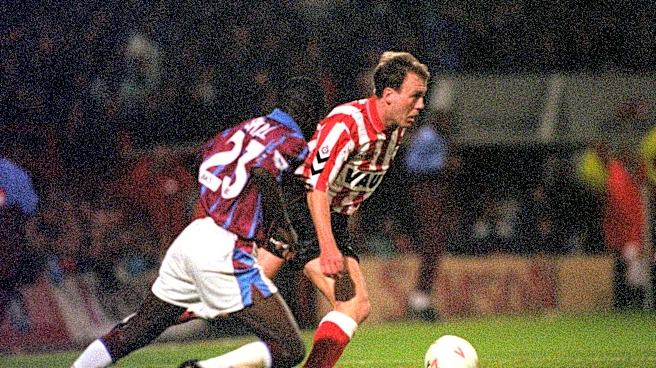
He would become one of the main components of Smith’s side that, in three years, went from Division Three up to the top flight. In that time, Owers moved around the pitch a little. He started on the right of midfield and would play centrally on occasions, but the manager thought his best position might be at right-back.
By the end of 1991, Sunderland were back in Division Two and struggling at the wrong end of the table, which resulted in Smith getting the sack. An FA Cup final appearance would follow for Owers, but things were on the downturn at Roker.
Malcolm Crosby didn’t last long on the back of that cup run and he was replaced by his central defender, Terry Butcher. This seemed the beginning of the end for Owers at Sunderland when, in the summer of 1993, Butcher placed Owers – along with a number of other players – on the transfer list.
A year later, Mick Buxton was now in the Sunderland dugout and Smith had moved from his job at Bristol City to Oxford United. On this day in 1994, he placed an offer of £300,000 to take a now 25-year-old Owers to the Manor Ground. But, reading his comments in the Sunderland Echo, it was clear he wanted to stay and prove his worth:
Denis Smith was great for me, but I have a year of my contract left and aim to make Sunderland want to keep me. The only way to do that is to do the business on the field. With missing the end of last season, I’m raring to go and I’m still ambitious.

Buxton seemingly agreed that Sunderland was the best place for Owers, as he rejected Oxford’s approach:
Gary Owers seems to be perfectly happy here and he was playing quite well last season until he got injured. I’m in no rush to sell him. It’s the same with any player at this club. If somebody makes a good offer, I will speak to the player.
Smith made his bid for Owers after selling Joey Beauchamp to West Ham United for £1m, but as Buxton explained, the offer fell way short of Sunderland’s valuation of the former England Under-21 international:
Denis spoke to me, he made an offer which was unacceptable and I rejected it. Denis has sold a player who has never played in the Premier League for £1m and offered considerably less for a 25-year-old with a hell of a lot more experience.
Buxton also talked about his hopes of completing the signing of Aston Villa’s Dariusz Kubicki. The defender was back home in Poland, but Buxton ruled out a move for Sheffield United left-back Tom Cowan, who had shown his keenness to join Sunderland.