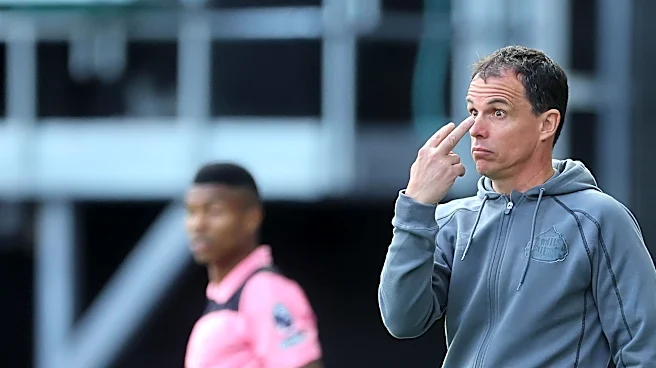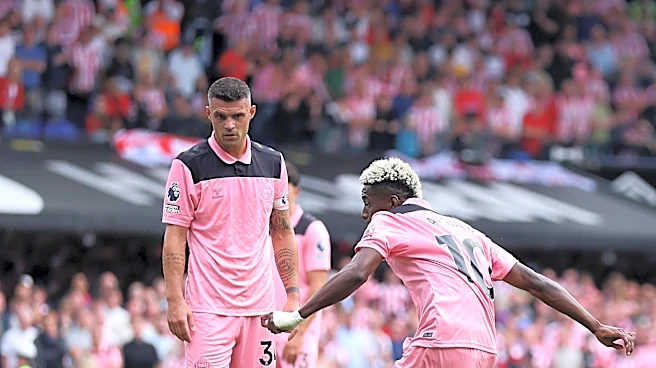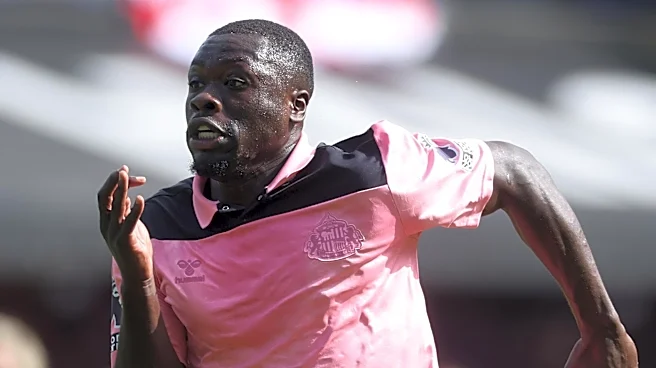

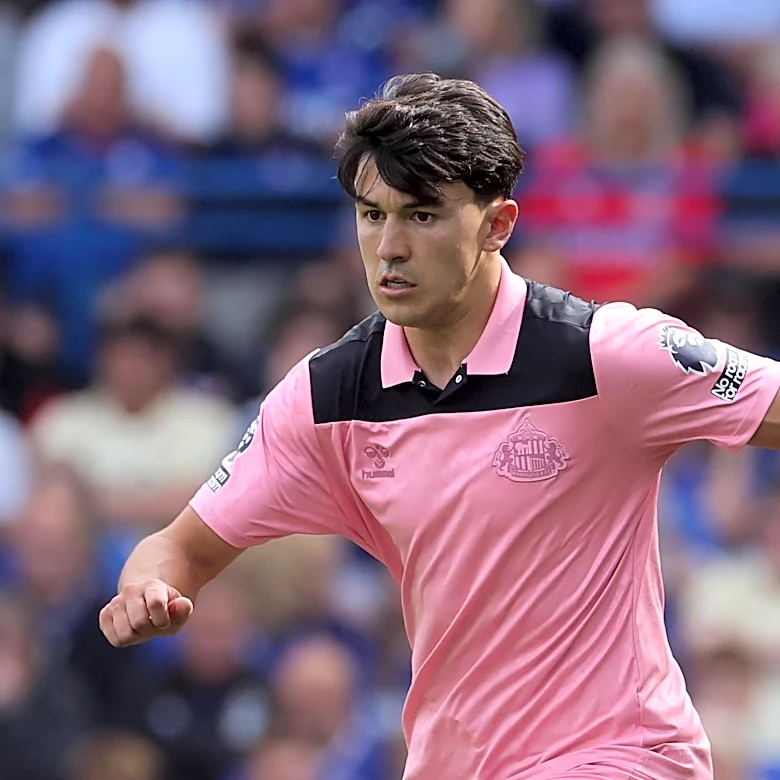
Losing is never a good feeling. I know that all too well.
So, rather than simply venting after today’s defeat, I want to reflect on what I think we learned from Sunderland’s performance. This is an attempt to look at the problems within the team, but also to give everyone a more objective way of looking back on a defeat.
O’Nien was left out last time so that he could be left out for five games
The first question that needs answering is why O’Nien started today.
From Le Bris’ perspective, the reason O’Nien played today is actually quite simple: the decision not to play him in the previous game was made so that he could then go five games without playing.
Le Bris knows exactly what level this player is at, and he knows what O’Nien is capable of when placed under pressure. So why start him today? Because Sunderland’s two first-choice centre-backs are both injured.
Alderete has been managing an injury problem ever since returning from the World Cup, while Mukiele only recently returned to training after suffering a leg injury in early August. Le Bris explained that the club did not want to risk aggravating the injuries of two key players, because re-injuries are generally more troublesome. Given the pecking order, O’Nien was therefore the logical player to start.
The club also did a lot of work to shape the narrative around that decision, giving supporters reasons to believe it was the right one. And many fans were happy with it because O’Nien is a popular player, while he had genuinely impressed during pre-season.
But today, the decision to start O’Nien directly contributed to the first goal conceded. And the mistake was almost identical to the error he made against Newcastle last season.
Le Bris eventually recognised the problem and brought Alderete on in the 60th minute to try to solve it. But Alderete’s loose pass then gifted the opposition another goal.
At that point, perhaps some supporters finally realised that Alderete’s lack of match fitness may also have been one of the reasons Le Bris did not start him in the first place.
Is this a depth problem?
Absolutely.
Because you simply do not have enough capable players to replace your first-choice centre-backs when they are unavailable.
In my view, there is no longer much room for debate about O’Nien’s ability to deal with pressure when building out from the back. Using him today was a fairly conservative decision in terms of protecting the injured starters, but an extremely risky one in terms of the result of the game.
And Sunderland paid the price.
There was no Brobbey this time to come along and save him from losing his place.
Is today’s problem difficult to solve?
Not really. Stop playing O’Nien.
That is precisely why I said the previous decision to leave O’Nien out was made so that he could then stay out for five games.
As for squad depth, Methalie, who can cover both left-back and left centre-back, is certainly a good answer. But with only him available, Sunderland still look desperately short at centre-back while both first-choice defenders are injured. That is how we ended up watching O’Nien put in such a poor performance.
So yes, we still need another centre-back.
And perhaps Ahoka being capable of playing there is another indication that the club is trying to improve its depth in central defence.
As for Ahoka himself, we are all still at the stage where we simply do not have enough information about the player. Even when you see a huge gap between his market value and the reported transfer fee, you cannot rush to judgement. We need to watch him ourselves.
But the fact that Antwerp supporters are genuinely disappointed to see him leave for that kind of money is a good sign.
If they sold Alan Browne for £10 million, were they disappointed about that?

The problem with playing out from the back
Both goals we conceded today originated from mistakes while our defenders were trying to play the ball out.
Last season, I held the view that Sunderland’s defence actually made relatively few mistakes compared with other teams in the league.
You can use Alderete’s mistakes against that argument. But if Sunderland really made that many errors, combined with an attack that was as poor as ours, how on earth did we finish seventh?
I want to offer a preliminary thought about Sunderland’s performances towards the end of last season and today’s match. There may well be parts of this argument that are still underdeveloped.
One thing is very obvious: Sunderland’s approach at the end of last season and in yesterday’s match was fundamentally similar.
Le Bris has increasingly encouraged his players to press higher and to be brave when they have possession, building from the ground rather than simply going long.
That is why you saw those high-scoring, high-conceding games towards the end of last season.
This style naturally puts more pressure on defenders when they try to progress the ball from deep. And the more ambitious a defender is with the ball, the more likely he is to make mistakes.
That is Alderete.
O’Nien is different. His mistakes are more fundamentally about his unstable basic technical ability.
But today made me wonder whether Sunderland are actually suited to this kind of build-up approach from the back.
I admit that the opening defeat disappointed me. But it also made me think about how much influence Le Bris’ tactical adjustments have had on these mistakes.
I cannot answer that yet.
So these are only some preliminary thoughts. I want to find an answer, and I also want to hear what everyone else thinks, which is why I am putting these imperfect ideas out there.
As for the solution, one part is obvious: stop playing poor old O’Nien.
The other is that our defenders need to be more cautious when attempting these passes. Even if that means reducing the amount of build-up play slightly, the number of these errors simply has to come down over the course of the season.
If the passing lane does not make sense, just put your foot through the ball.
Do not mess around.

Fatawu eating Reinildo alive
We all saw Fatawu absolutely roast Reinildo twice, right?
The decline in Reinildo’s recovery ability and acceleration is obvious. There is really nothing more to explain. Otherwise, the club would not have gone out and looked for a faster, taller new defender.
I am much more concerned about Reinildo going into this new season than I am about the 34.94-year-old veteran Meunier.
The reason is that Reinildo’s style of play has not really changed.
He still relies heavily on his physical qualities, reacting instantly to an opponent’s movement and using his body and limbs to get involved in challenges.
But his reaction speed is clearly declining.
As a functional player whose main strength is defending and whose attacking contribution is limited, if his defensive quality also begins to decline, his overall value will fall considerably.
So why am I less worried about Meunier, who is also a functional player?
First, he has adapted his game with age and experience.
Second, besides his experienced defending, he offers a lot more in possession. His ability to receive the ball, contribute to attacks, cross, and carry the ball forward gives Sunderland far more than Reinildo’s relatively narrow skill set.
After criticising Reinildo this much, do I still consider him a Premier League-level player?
Yes.
Even with these signs of decline, I would still say he is.
But “merely Premier League level” is no longer the standard Sunderland should be aiming for.
The club needs to evolve.
That does not mean you can simply take Reinildo’s place away from him overnight.
First, from a long-term perspective, Methalie needs enough time to adapt. We should not rush the process and risk creating physical or psychological problems for him.
Second, Reinildo has influence within the dressing room. Replacing an established figure without giving Methalie the chance to prove himself could damage the cohesion of the squad.
That would not be wise.
So let us hope Sunderland can manage a smooth handover at left-back this season.

The left winger is serving a prison sentence
I want to ask a question: was Angulo really that good today?
If you take away the goal, I would say no. He lost a number of physical duels, his attacking movements looked overly rigid, and in one-v-one situations he had plenty of aggression but not enough technique.
This is how I currently understand Angulo as a player.
I think he is an extremely hard-edged footballer, and that hardness explains a lot about his game at both ends of the pitch.
In ground duels, Angulo is not afraid of physical contact. Even when he may not actually win the duel, he is willing to go into it.
His aggressive tackling style gives him opportunities to win the ball high up the pitch and create chances. But it also makes him look clumsy when facing quick, technical and agile opponents, as we saw today.
The same “hardness” appears in his attacking game.
Some of his attempts to beat defenders are essentially based on going straight through them – collision, contact, physical confrontation, and then losing the ball.
His body also looks quite stiff when dribbling, and his coordination is not particularly convincing.
But was everything about Angulo simply because he was poor?
Not really.
Interestingly, on Sunderland’s left side, both Ipswich’s winger and Sunderland’s winger were repeatedly being asked to deal with 1v2 situations.
Of course, that is partly the result of both teams deliberately trying to restrict the opposition wingers.
But you cannot expect a winger to beat two players every single time.
You need to provide support.
And who is supposed to provide that support?
Reinildo.
The use of Reinildo is also one of the reasons Sunderland’s left-wingers struggled so much last season.
His contribution in attack is limited, which can leave the winger isolated against multiple defenders.
Le Bris has also deliberately asked Reinildo to reduce his forward runs. Firstly, because his attacking output is not particularly good, and secondly, because Sunderland simply cannot afford to let him bomb forward completely in most situations.
It is dangerous.
So Sunderland’s problems on the left wing cannot simply be blamed on the left wingers being bad.
Both wingers found themselves in similar situations today.
That is why I hope Methalie, who is much more attack-minded, can bring a little light to Sunderland’s two left-wingers.
Even if he merely allows these two blind men to see a tiny crack of daylight towards the opposition goal, that would already be a contribution.

Lower your expectations of Brobbey
Even though Brobbey has been lighting it up in the Netherlands, and even though he scored several hugely important goals for Sunderland last season, I still want to stick to my view: despite his enormous tactical contribution, he is still some distance away from being an elite striker.
Here are my reasons.
First, his shooting technique.
He has a tendency to simply absolutely smash the ball. There is not always much technique or thought behind those finishes. It is often just pure power.
His movement is good, which is why he gets himself into plenty of those situations, but I do not think his finishing efficiency is particularly high.
I would call it average.
Second, there are games in which he lacks influence and presence.
Today was one of them.
Brobbey became lost in his physical battles with Ipswich’s big English centre-backs. That is partly his own style, but it was also a result of Ipswich specifically targeting him.
Today’s match reminded me a lot of the games against Nottingham Forest and Aston Villa.
He did make two good runs and almost scored from them.
But can you remember him dropping deep to receive the ball?
Can you remember many duels that he actually won?
I cannot. The referee was also quite strict today, and Brobbey clearly did not enjoy that.
Another factor is that Brobbey was asked to contribute to some of the aerial battles inside the box during settled attacks.
Given his height and the way the opposition were targeting him, that clearly made life even more difficult for him.
These are all things that can improve with experience. And that is exactly why I am saying this: I still believe he has a lot of room to grow, and I believe he can continue improving this season.
As for the title, “Lower your expectations of the striker”, the reason I chose it is simple.
I do not want Sunderland supporters to turn Brobbey into something he is not. I really like him. But I do not want people to develop an unrealistic perception of him.

Hume the winger is back on the road
Was Hume good today? Normal Hume.
He once again produced a steady performance on the right wing, but we need to discuss what exactly that steadiness is worth. Let us first talk about what Hume can contribute offensively.
He is a technically solid player. He does the basic things correctly and does not try to be overly complicated, which is why you probably cannot remember many major mistakes from him last season.
His two main attacking contributions are the 45-degree cross towards the centre and controlling second balls around the edge of the box to create second-phase attacks.
He is also perfectly capable of playing his role in a one-two.
But Hume’s mentality as a winger is fundamentally that of a full-back.
And I am not rushing to condemn that.
I want to discuss it because Hume has very little willingness to take risks in attack from the wing, while his ability to do so is also fairly limited.
That makes him look extremely safe.
There are none of the bizarre moments we see from Talbi or Angulo on the left.
But it also means Sunderland are missing the benefits that a traditional winger is supposed to provide.
That is precisely why we are looking for a right winger.
Brobbey is fighting and battling with the opposition centre-backs in the middle, creating space for others.
And yet no one is attacking that space from the wing by cutting inside and shooting.
Instead, we keep putting the ball into the box from the right.
And then we expect crosses to find Brobbey, despite the fact that he is not exactly a dominant target in aerial battles.
That is simply inefficient.
Our left wingers also lack the instinct to cut inside and shoot.
Talbi is slightly different because he often does not even get enough opportunities to carry the ball into the left side of the penalty area.
But even when those opportunities do appear, that does not necessarily mean his instinct to cut inside and shoot is particularly strong.
By comparison, based on what I know of Mundle from his time in the Championship, I believe his instinct to shoot is better than that of our other wingers.
And he was essentially bought as a player in the mould of Clarke.
We need another winger.
A winger good enough to start.
Otherwise, the resources Brobbey creates in central areas will continue to be wasted.
Otherwise, we will continue watching this awful attack.
And if the quality of our defending declines as well, the right-wing problem could become genuinely disastrous.
No matter how many goals Hume scores, is he really going to score ten?
Go and buy a bloody right winger!

What kind of right winger do we actually need?
Whether it is Catamo or Soulé, these two players have one major thing in common: they are wingers who are genuinely good with the ball.
Our current wingers all lack that ability to some degree. Apart from Talbi, who I still do not know enough about to make a firm judgement.
That lack of ball-carrying ability makes Sunderland’s individual attacking actions inefficient. It is why we so often resort to putting crosses into the box from outside.
We also like to use combinations to create opportunities to reach the byline and then cross. But sometimes the simplest solution is the most effective one. Use your winger in a one-v-one.
And one-v-one ability comes in different forms.
Fatawu today is one type. He simply uses explosive acceleration and speed to run straight past you.
Angulo is another. He wants to physically overpower you. His dribbling is direct, aggressive and based on contact.
Talbi is poor in one-v-one situations, so I would say his strengths are more about carrying the ball into open space or making long off-ball runs.
Adingra’s technique is terrible.
Mundle’s physical condition is currently not good enough for us to judge him properly.
Our wingers simply lack ball-playing ability. They cannot manipulate the ball in tight spaces, twisting and turning with it while keeping it within a few dozen centimetres of their body so that defenders simply cannot take it away. That is about touch and technique. They also lack the technical ability to find opportunities between defenders.
Take Talbi against Manchester United last season. He repeatedly tried to beat Mazraoui one-v-one, charging at him like Don Quixote attacking a windmill.
To the defender, it was basically just wriggling around in front of him.
Why does he struggle?
His technique is not good enough.
His control of the ball, or his ability to keep the ball closely connected to his body, needs improvement.
And he cannot simply rely on pace to beat people either. One trick is not enough.
That is why Sunderland are trying to sign wingers who actually possess this kind of ball-playing ability.
Players who can beat opponents with their dribbling, or create chances through their individual ability.

What actually caused the defeat?
There is no reason to be overly pessimistic. The individual mistakes were simply too obvious. It reminds me of last season’s game against Forest. Plenty of supporters woke up thinking the sky was falling and asking whether the entire season was already over. And then Sunderland went on to have a very good season.
The reason I say this is because we need to distinguish between individual errors, collective errors and tactical problems.
All three can produce equally damaging results. But individual mistakes are clearly the easiest to fix.
For both goals today, I have considered the tactical factors. But I think we need more time before making a definitive judgement.
At this stage, I believe both goals were the result of lazy and sloppy defending rather than a systemic problem throughout the team. Stop playing O’Nien, and remind the other centre-backs what happens when they make those kinds of mistakes. That can prevent this from becoming a much bigger problem.
One more thing: Meunier was excellent today.
But his performance needs to be judged according to his role. He was brought in to provide depth at right-back. He arrived on a free transfer and is essentially taking over the role previously occupied by Højer last season. If you look at him from that perspective, how can you be disappointed?
Today, Meunier positioned himself very well defensively and did a good job limiting Town’s winger. He also made several progressive runs down the right, delivered multiple crosses, and showed that he is very comfortable controlling the ball with his technical ability.
Compared with some of the bizarre defending we saw elsewhere today, isn’t that pretty good?

Do we actually want possession?
Let us discuss another issue: our possession problem.
One statistical characteristic from last season was that Sunderland often produced better results when our possession percentage was lower.
Today, once again, the numbers showed Sunderland controlling the game.
And once again, the result seemed to confirm that trend.
But will most teams in the Premier League allow Sunderland to play this way?
I would say three-quarters of them will not.
And then, right at the start of the season, we run into a team that does.
What a blessing.
There are not that many teams in this league whose managers will deliberately change their entire approach simply to target their opponents.
There are some. But not many.
Emery is one. You may struggle to describe exactly what style Emery’s teams play. But you always feel that Aston Villa are extremely effective against you.
That is because every tactical decision Emery makes has a specific purpose in relation to the opponent. He is probably the best manager in the Premier League when it comes to this kind of tactical preparation.
Anyway, I think Sunderland’s inability to consistently control games needs to be taken into consideration. The team still has not found a proactive and reliable way of creating chances.
That is just as frustrating as the individual defensive errors. But I suspect Sunderland will actually look better when they are not controlling possession.
For now, we have to give Le Bris the opportunity to correct this.

Let the defeat accelerate the recruitment
We still need to rank our recruitment priorities.
First: the absolute necessity of a right winger. Hume’s potential losses and gains in this position simply cannot compare with those of a traditional winger. High risk, high reward. At the moment, Hume gives Sunderland very little risk, but the reward is equally limited.
And that lowers the team’s ceiling. We need a winger who can consistently cut inside and shoot.
Did you see Clarke cutting inside? That is what an actual inside-forward movement looks like. Compared with that, our other wingers are barely real modern wingers.
Second: a striker. Preferably a tall centre-forward with strong aerial ability. Because even if you keep putting all those crosses in from the right from players like Meunier, Hume and Mukiele, you still need someone to aim at.
Otherwise, what other attacking route are you going to use? Is there a third priority? No. Or rather, apart from the positions of goalkeeper and midfield, almost everything else can be considered third priority.
Any further strengthening in defence or out wide would be a bonus for Sunderland. It would obviously be better to have it. But it is not something we absolutely cannot survive without. If we have to rank our needs by urgency, that is how I would do it.
Surely this defeat should influence the recruitment strategy? I hope the club takes a serious look at the problems exposed today.
I will be watching the transfer window closely to see what kind of answer the club ultimately provides on the wing.
It is time for the winger position to become the area where Sunderland can make the biggest improvement.
I have always been very patient with this transfer window. But if the club fails to address an obvious necessity, then how on earth can we trust Ghisolfi so desperately?