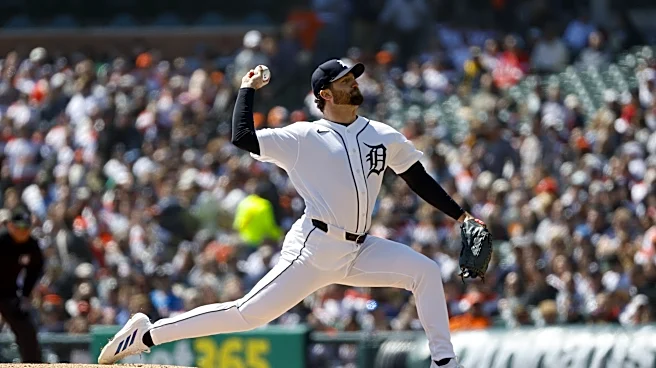






Casey Mize has had an interesting career since being drafted 1st overall in 2018. Despite career highlights that include a Minor League no-hitter in his AA debut and a 2025 All-Star Game appearance, Mize has often felt underwhelming for a one-time top prospect. Some of that is due to injuries like Tommy John surgery wiping out most of 2022 and 2023, some of it’s due to rotation mate Tarik Skubal outshining the entire American League for almost three full years now, and some of it’s just unfair expectations.
Regardless of metric, Mize has been a solid, if not exciting, major league pitcher.
Coming into 2025, Mize was the owner of a 4.36 career ERA and 18.2% strikeout rate. Put those together and you get a competent backend starter. 2025 was a step forward, as he earned his first All-Star appearance, bumped his strikeout rate to 22.2%, basically league average, and lowered his career ERA down to 4.19. By ERA, his 2025 season was a bit bumpy from the first half to the second, but a combination of a high BABIP and a low strand rate down the stretch hid the fact that he looked a bit better under the hood. His second-half strikeout rate was 24% as he added a bit of vertical movement to his fourseam and finally started getting better results with his splitter. He steadily looked more comfortable as he got further away from the injuries that had plagued him earlier in his career.
Coming into 2026, expectations were for Mize to be a perfectly fine 3rd or 4th starter. The biggest optimists amongst us might have hoped for another small set of improvements to build on the increased strikeouts he flashed down the stretch. Once Reese Olson went down with a shoulder injury, it became clear Mize would need to help stabilize the middle of the rotation behind Skubal and Framber Valdez.
So far, so good.
Five games into 2026, Casey Mize looks like the best version of himself we’ve seen in the Major Leagues. Right now, his ERA sits at 2.51 and his strikeout rate is a whopping 27.4%, each career bests. Yes, it’s early in the year, and yes, I know he has an 83% strand rate, so he’ll eventually start leaking more runs. That’s inevitable. It’s also ok. This early in the year, process stats like strikeout rate or pitch mix can be far more indicative of a change in talent than a descriptive stat like ERA, and thankfully, two identifiable changes seem to be fueling this early season excellence.
The first is pitch mix. After years of searching for the right third pitch to pair with his four seamer and splitter, Mize – likely with the help of Chris Fetter, et al. – seems to have found the right combination so far. Gone are the cutter and knuckle curve he introduced in 2024, and the ’slurve’ from 2025 has seen its usage drop to near-negligible amounts. Instead, he’s using a simple four pitch mix: four seamers, sinkers, splitters, and sliders.
Like a lot of pitchers, Mize has started spamming his secondary pitches because they’re just outright better options than his fastballs. Mize doesn’t throw particularly hard, averaging a bit over 93 mph on his heater after losing a little gas from his post-TJ peaks of 2024, and that four seamer has never gotten strong results. Not even throwing it at the top rail with elite extension has saved it from subpar shape and velocity in the past. Only throwing it around a third of the time helps negate all that. Hitters are less likely to hunt fastballs, making it easier to get away with them, and the more you throw your best pitches, the less likely anyone is to really do damage anyways.
The second big change is in his pitch movement. When compared to 2025, every one of Mize’s pitches is moving more. Here’s a quick breakdown: the four seamer is running 2 extra inches armside, the splitter is running 1 extra inch armside, his sinker is breaking downwards 1 extra inch, and his slider is both dropping and tailing 1 extra inch. Even the slurve is dropping 6 more inches and tailing about 5 more inches, although it’s such a small sample size that seems a bit misleading. Considering a baseball is about 3 inches in diameter and a bat is about 2.5 inches in diameter, an extra inch or two of movement across the board is a big deal.
With this extra movement has come loads of weak contact and more strikeouts. Mize is currently allowing the most soft contact, the least hard contact, and the second-highest flyball and infield flyball rates, of his career. Soft flyballs don’t really tend todo all that much, especially in Comerica Park, so this feels like a good path forward for Mize. It might not work as well in a smaller stadium, but hey, he’s a Tiger, not a Red.
As good as those popups are, the extra strikeouts are definitely more exciting. It’s early, but Mize has quite literally never had a five-game stretch with this level of strikeout upside before. Below I’ve included one of my favorite visuals for early season analysis, a ‘rolling average’. The graph shows Mize’s average walk and strikeout rates over every five-game sample since 2024; it’s pretty obvious that early 2026 stands out from the rest.

Right now, Mize’s strikeouts are up a ton from his previous normal. Occasionally he would flash this stuff for a good game or two, but he’s never shown an ability to maintain a 25%+ strikeout rate for even 5 starts at a time until now. That, paired with his walk rate staying pretty consistent and his soft contact skills trending up, all at the same time, have me cautiously optimistic this is an upgraded Mize. He might not run an ERA under 3.00 all year, but this is the high-floor, mid-rotation or better arm we all envisioned out of college. It’s just too bad it took until his walk year to reach this point.