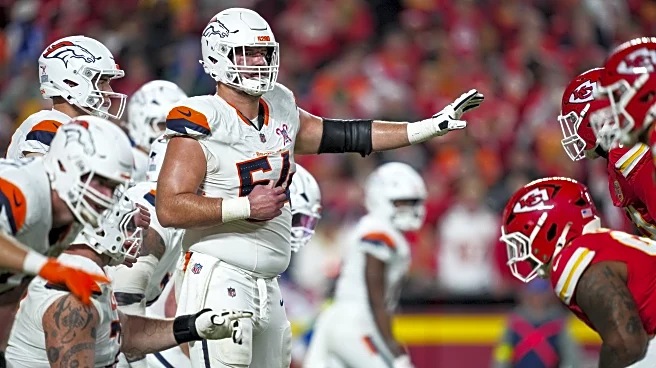




It’s not often in football that you get the sort of chance to redeem yourself that Alex Forsyth got last week against the Kansas City Chiefs. A little over a year later he gets to return to the spot where he, in part, cost his team a win, and this time around he helps get them in position to clinch a divisional championship.
When Luke Wattenberg was listed out during the week, I was disappointed on behalf of Wattenberg, but there was a part of me happy for Forsyth and confident that he’d be able to
get the job done. I’ve been a fan of him over the last couple of seasons, and was even a proponent of him getting a chance to be the starting center this year. Now, Wattenberg more than earned that spot, but this is to say that Forsyth is no slouch.
Forsyth played well on Thursday. But just how did he do and can Denver rely on him for the extent of Wattenberg’s injury? Let’s see what the film says.
Stat crunch
The Denver Broncos had 70 offensive snaps, not including kneel downs. They had 32 designed run plays and 38 designed pass plays. Alex Forsyth played every snap.
Forsyth did not have any blown blocks and gave up zero TFLs. He also gave up zero pressures, WB hits, or sacks.
He had one pancake.
He finished with zero penalties.
Forsyth had zero “Bad” blocks, one “Meh” block, 12 “Alright” blocks, 56 “Good” blocks, and one “Great” block. This was good enough for 66.75 points out of 70, or 95.4%.
In run protection he had 29.75 points out of a possible 32 (93%) and in pass protection he had 37 points out of a possible 38 (97.4%).
In general
Alex Forsyth played very well, especially considering the circumstances surrounding his start and the defensive talent that he was going up against. He filled in seamlessly for Wattenberg, and he was better on a handful of snaps than Wattenberg is on specific blocks.
One thing that is very clear is that (I’d hope for this to be true considering how much they pass) every offensive lineman on this team has solid pass protection fundamentals and instincts. They’re always on the same page as a unit, and it doesn’t matter if it’s the starters, or if someone like Forsyth or Alex Palczewski are in.
It’s also the pass protection that helped Forsyth score as high as he did. This is something I usually expect centers to do, considering how they usually have help from one of their guards.
One thing that jumps off the screen in the run game is how smooth and athletic Forsyth can be on their Outside Zone concepts. He was nailing the majority of his reach blocks, and if he wasn’t able to secure the reach he was quick to transition to washing the defensive tackle out to open up the cutback lane for the running back. Not necessarily making the point that he’s more athletic than Wattenberg, but Forsyth is strong in this department.
And there were a couple of instances of Forsyth getting good vertical displacement on the defensive tackle without guard help, which is not something this offense usually gets. However, Wattenberg is getting better each week with his physicality.
The specifics
Run play – Outside Zone Lead – Good block

Here’s an example of what I was talking about when it comes to his athleticism in the Outside Zone scheme.
Forsyth’s job here is to reach the 1 tech to his left. He takes a nice drop step that loses him a bit of ground vertically, giving him more space to work across the face of the defender. He quickly puts himself in a good spot, and then adjusts his head, putting it on the play side, giving him the leverage needed to properly execute this block.
And if he doesn’t end up running into Adam Prentice, he can keep working laterally for a few more steps and then change his movement to start working vertically and up through the shoulder of the defender. Good block.
Run play – Outside Zone – Good block

Another example of Denver running Outside Zone, but this time Forsyth shows off another technique an offensive lineman can use with this play scheme.
He likely makes the read pre snap that there’s no way he’s going to be able to reach a DT that is lined up that far away from him, so he decides to turn this block into a wash and give Jaleel McLaughlin a cutback lane instead. And that’s exactly what he does.
Forsyth gets his hands underneath the shoulder of the DT, and since the DT has to first engage Ben Powers, Forsyth has an entire midsection to work with, simply driving the man to the sideline, and with the help of Quinn Meinerz and Mike McGlinchey, he opens up a gap big enough to sail an oil tanker through.
And a quick note to point out how McGlinchey’s incredibly quick reach block allows for Meinerz to get enough of a hit on that backer to give Jaleel room to run.
Run play – Inside Zone Lead – Meh block

This is the only “Meh” block that Forsyth had all game. There’s a simple reason as to why he got stalemated at the line of scrimmage: dead feet.
A common saying on the offensive line is stop your feet – get beat. It’s a basic idea but one that can make or break blocks, especially if you don’t have a clear size and strength advantage as the offensive lineman. You can see that Forsyth is able to get his first couple of steps in the ground at a decent speed, but he then transitions to trying to lean on the DT, noticeable in his hip posture, and that freezes his feet for a second, which is long enough to prevent him from getting any vertical displacement.
He then gets shed, giving up the tackle just beyond the line of scrimmage.
Pass play – Drop back – Good block

As most of Forsyth’s reps in pass protection are relatively bland, here’s one of the more challenging blocks he had to make against the Chiefs.
The Chiefs show two men in the C gap, but obviously only one will attack the gap while the other one slants to the inside. The only question is who is going to slant: the DT or the LB?
Forsyth shows good patience on this block, snapping his eyes to the right after making sure the backer in front of him doesn’t blitz, and then waits while keeping his feet moving, anticipating one of the defenders to slant to him. Note that he avoids going out to the defender, but rather gets to the hip of Meinerz and waits for the defense to come to him. This lessens the risk of him lunging at the defender, losing his balance, and getting beat.
On contact he absorbs the hit and settles into his base, stopping the defender in his tracks.
Run play – Outside Zone – Great block

I know we’ve already seen two Outside Zone reps, but I had to talk about this one.
Now there might be some controversy with me calling this both a “Great” block and a pancake, considering that the defender only falls down when Forsyth drives him into the feet of Courtland Sutton. What made me give him this grade is that I really feel like he was going to get the pancake even without Sutton getting in the way. The leverage that he had on the backer, how far back on his heels the defender was getting, and the general feel of the block leads me to feel that way.
Almost every time an offensive lineman gets their hands on a second-level defender in this manner, that ends with the defender on the ground.
Debate me if you want on this. It’s fair. But no matter what, Forsyth does such a good job of clearing his gap, closing the space between him and the backer, getting hands on the chest, and running through the block. This block can’t really get much better.
Final thoughts
Alex Forsyth is another piece of evidence that the Broncos might have the best offensive line backups in the entire league. Between him and Palczewski, it feels like Denver has the ability to just plug in anyone into their starting line and have it look like nothing ever happened. It’s seamless. Forsyth could be a starter on a good chunk of teams.
If they can keep producing talent at this rate, then Zach Strief should be the highest paid offensive line coach in NFL history, and Paton and Payton should be in charge of talent acquisition for decades to come.