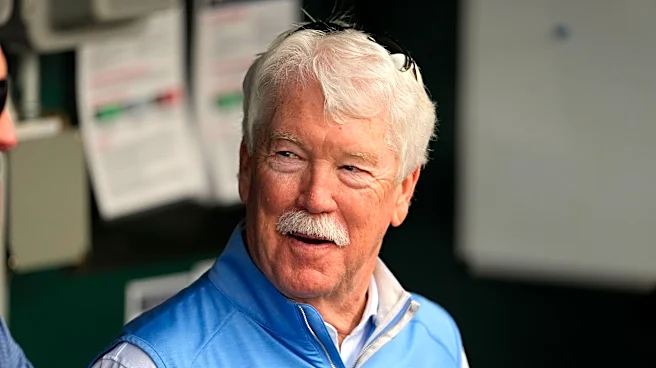





When principal owner John Sherman first floated the idea of a downtown stadium nearly five years ago, I’m guessing that he didn’t foresee the long and bumpy road that Kansas City and the Royals would take to get there. But on August 20, the City Council approved a funding commitment that, for the first time, sends the project past a point of no return. The proverbial check has been signed and approved.
This is undeniably a win for Sherman and the Royals. Kauffman Stadium is a great venue, but it is located
in the middle of a concrete desert far from shopping, hotels, and dining. Sherman and the Royals can now build a modern stadium and modern revenue sources—more and better suites, the in vogue “entertainment district” surrounding the new location, the like—all while getting $600 million from the city and $540 million from the state to do so.
Is it a win for taxpayers? That is the question. Taxpayers didn’t think so in April 2024, when they turned down a proposal to put a stadium in the Crossroads Arts District (and give the Chiefs a bunch of money for a half-assed improvement plan for Arrowhead). In response, the Royals and the city largely went silent until they announced a new proposed location at Crown Center. Notably, the city and the team landed on a funding vehicle that did not require a public vote.
Since then, there have been some interesting developments.
- Missouri Workers Power, a labor group, began to collect petition signatures with the goal of forcing the City Council to put the funding proposal to a vote.
- They succeeded in getting enough signatures. Election officials verified the petition and set a deadline of August 31 for the City Council to review it.
- The City Council discussed the entire project and voted for it in less than a week, approving it before the August 31 deadline.
- On October 1, the City Council finally approved an ordinance that would require stadium projects to go through a public voting process, and it will be on the ballot this upcoming April…but Mayor Quinton Lucas and the city won’t consider it to apply to the new stadium.
To summarize: We know that the last vote failed. We know that the city wanted to keep the Royals, especially since the Chiefs moved across State Line Road. We know that the city and the team worked together to propose a funding mechanism that didn’t require a public vote. We know that the City Council reviewed the project before they reviewed a petition that the public be able to weigh in. And, thanks to a Sherman press conference on October 5, we know that the team plans to break ground on the new stadium before the ordinance measure is put up for a vote.
Add in the money and incentives involved, and it sure seems like the city, the Royals, or both parties were desperate to avoid the public weighing in on any aspect of this situation. Now, I know that both city and team officials would disagree, as they have the right to, but they also can’t refute the optics here. At the end of the day, the public will have no say in where the new stadium is being built, how much funds will be available to the Royals to do so, and where those funds will come from.
So the cat here is totally out of the bag. Fine, sure, one might say. There’s a follow-up, then: Regardless of—and perhaps especially because of—the public not being able to voice their opinion, Sherman and the Royals bear a responsibility to handle these tax dollars with care. The project is moving forward. All that’s left is a responsibility to provide the public with a return on their investment: a good stadium and, importantly, good baseball.
And, well, about that last part.
Looming like a green monster over this offseason is the expiration of the Collective Bargaining Agreement between ownership and the Major League Baseball Player’s Association. Labor disputes are nothing new for baseball. The last time the CBA expired, the two sides didn’t come to an agreement until March 10. That delayed Opening Day by one week, although no games were canceled.
This time around, there won’t be any lingering COVID-related nonsense. But there will be lots of discussions around a salary cap, and the two sidesunveiled opening offersthat were very far apart back in May. Essentially, the league wants a cap. Players don’t. This has been true forever, but the success of the Los Angeles Dodgers over the last two plus years has thrown the whole thing into overdrive.
This is where Sherman steps in, and where he can step in it. At Monday’s press conference, Sherman, who is on the labor committee for the new CBA, said that what fans want is important; he cited that fans want revenue parity and competitive balance. That, I think, is largely true.
But what fans do not want is a work stoppage. Baseball fans want to see baseball, funny how that works, and most fans are unsympathetic to money squabbles of the magnitude that causes such work stoppages.
The good news is that a work stoppage is not a necessary part of CBA negotiations. Under the National Labor Relations Act, a labor contract can remain in effect while the parties continue to negotiate for a new one:
The parties’ obligations do not end when the contract expires. They must bargain in good faith for a successor contract, or for the termination of the agreement, while terms of the expired contract continue.
There is more than legal precedent to this as it relates to Major League Baseball. Notably, in 2000, the union exercised an option to extend the then-current CBA through the 2001 season. No new agreement was settled that offseason, and yet the league played the first four months of the 2002 season under the old agreement.
This year, the CBA expires on December 1. So, the league and the union could continue into the offseason with the previous CBA active while they negotiate. The union can’t really go on strike until camps open in February. And if you do the math, you’ll find that the only other party that could act in the meantime would be the owners.
In labor practice, a lockout occurs when management prevents union employees from working at all. The MLB owners operate as management in this scenario. In other words, lockouts don’t just “happen.” An MLB lockout, if it occurs, will be because the owners decided to do so. It happened the last time, when the owners locked out the players in December 2021.
And here, after almost 1,200 words, we get to the crux of it all. Sherman was an owner then. And we know that Sherman voted for the lockout to happen because voting was unanimous. But that was then. Sherman hadn’t been handed over a billion dollars in public funds, funds that—again—were decided without any vote. Given the chance to vote again, will he side with his fellow owners to lock out his employees?
I think we all know what’s going to happen. In two months, I expect Jeff Passan or whoever to report that the owners unanimously voted to lock out the players. That will include Sherman, who will probably couch it in terms of doing it for the fans, as he did just this week.
However, I don’t think that’s good enough. Sherman and the Royals stuck out their hands to the city and state to say “money, please,” and the governments dutifully responded. The Royals are using the hard-earned tax dollars of millions of residents to construct a building and entertainment district. They are a for-profit professional sports team who charge for merchandise, parking, and entry and will one day make the current ownership group a few billion dollars richer when it’s sold to the next ownership group. Pardon me if I think it should be the bare minimum that the ownership take the stewardship of public money into account when pondering a lockout of their own key employees.
Believe me, I know that even if Sherman were the only owner who voted against a lockout that a lockout would still happen. I know it doesn’t matter what I write here, and I know that there are so many layers to these CBA negotiations, and I know that the players could still go on strike anyway.
Yet I think it’s important that Sherman do everything within his power to keep baseball being played, and while he can’t do everything himself, he can do this one thing.