


The New York Giants are 3-1-1 despite the Week 2 season-ending injury to starting quarterback Jaxson Dart. That injury brought veteran Jameis Winston onto the field and he became the Giants’ full-time starting quarterback the next week against the Tennessee Titans.
Since then, the Giants are 2-0-1, but each time have secured those outcomes by the skin of their teeth. Big Blue might be more aptly nicknamed “Code Blue” this season, as they’re waiting until a critical moment to steal a favorable outcome from
the jaws of defeat.
Part of the problem seems to be an identity crisis on offense.
Before I continue, I do want to extend some grace to the Giants’ offense. They’re going through the process of tailoring the offense to Jameis Winston’s preferences and skill set, much as they did with Dart over the summer. To remind those who forgot, all reports had the Giants’ offense as being just bad those early weeks at Greenbrier. At the time, they were going through the process of installing the entire playbook, then paring it back to what Dart executed the best.
While I can’t say definitively, I do suspect that the coaching staff is going through that process again, but doing so in full view of the world and while also preparing for a new opponent each week. Likewise, the weather conditions have been difficult in each of the last three weeks.
So I want to be as patient and understanding as possible.
Recognizing the problem
The Giants need to be realistic about the world in which they now live. They desperately want a power running game to be the foundation of their offense. The problem is that the Giants’ running game has just been bad since the loss of Dart. The Giants’ running backs have averaged just 3.49 yards per carry over the last three games, with zero touchdowns and three fumbles.
That is simply not winning football, to the point where the failure to produce combined with the philosophic focus on the run game is actively harming the team.
Against the Tennessee Titans, the Giants’ had a success rate of just 55% on series that started with a run. That is, the percent of series that picked up a first down or ended in a touchdown. Starting series with passes were much more effective and generally led to favorable outcomes.

All rushing plays averaged -0.15 EPA per play (in other words, each run made it less likely that the Giants would score on the next play), with their early runs (on first and second down) had a -0.17 EPA per play. Late runs were actually useful at 0.26 EPA per play, however.
The next week against the Cardinals, the rush continued to hurt the Giants. They didn’t have any good options for starting drives, but the run was still the worse option.

Early runs in that game averaged a putrid -0.37 EPA per play with a 19 percent success rate, while runs on third and fourth down also hurt the offense with a -0.54 EPA per play.
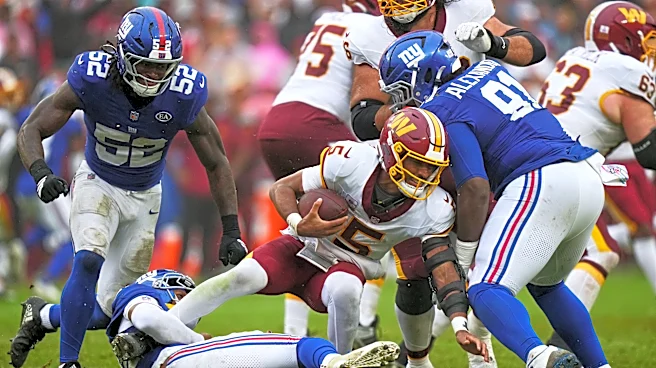
The split was particularly lopsided this past week against the Commanders.

The Giants averaged -0.40 EPA per play on all running plays, while their 1st and 2nd down runs had a -0.52 EPA per play and a 19 percent success rate. Their late runs did have a 0.14 EPA per play, but that doesn’t really outweight negatives of early down runs. All passing plays had a 0.29 EPA per play, with a modest 0.04 EPA per play on early passes and a great 0.99 EPA per play on late passes.
It is worth noting that the Giants threw far more against Washington than they did against Tennessee and Arizona. The Giants ran 36 times to 27 passing plays against Tennessee and had 30 runs with 37 passing plays against Arizona. Compare that to 65 passing plays and just 25 running plays against the Commanders.
The weather likely impacted how the Giants called the games, as well as their need to mount a furious comeback against the Commanders.
That said, we also know how John Harbaugh wants an offense to operate.
He wants his teams to be tough, physical, and run-first with an emphasis on the power run game. That much is absolutely plain to see when we look at how often the Giants throw the ball on neutral downs. Their 48.7% pass rate on neutral downs (first and second downs, prior to the two-minute warning, and outside of garbage time) is the fourth-lowest rate in the NFL.

The problem is that despite having the fourth-highest run rate on neutral downs, the Giants’ -0.2.18 EPA per play on neutral-down runs is among the worst in the NFL.
The Giants’ EPA on dropbacks, meanwhile, is 12th in the NFL at 0.141 per play — just between the Bengals and Packers.
But why, though?
There have been plenty of theories tossed out as to why the Giants’ running game has struggled since Dart went down.
Is it based too much on the threat of the quarterback run? Is the offensive line just regressing and blocking poorly? Are the running backs too slow?
I would posit that each of those plays a role, but also that the Giants’ coaching staff isn’t doing the players any favors.
As noted above, the Giants’ tendencies are pretty apparent from both tape and charting. They want to run the ball, and if they line up on a neutral down, odds are that it’s going to be a running play. And if the defense has a good idea of what’s coming, the offense needs excellent play design, excellent execution, or both to be successful.
For instance, fullback Patrick Ricard was on the field for 22 plays against the Commanders, two of which were penalties. Of the remaining 20 plays, 12 of them were runs and 10 of those were between the tackles.
The Giants had a strong tendency to play out of condensed sets, and then run between the tackles into the teeth of the defense.

The Giants bring both Ricard and Aaron Stinnie onto the field for a first down run at the start of a drive, as well as tight end Chris Manhertz and wide receiver Malachi Fields. This is a clear signal to the defense that the Giants intend to run the ball and they respond with a true “Base” personnel package. Furthermore, the Giants align Stinnie on the play-side to start, which pulls the bulk of the Commanders’ defense to the strong side of the offense.
At the time of the handoff, the Giants had seven blockers with on the play-side to eight defenders. That automatically puts the Giants at a numbers disadvantage at the point of attack. The Giants do try to manipulate the Commanders’ defense by putting Ricard in motion and pulling Sisi Mauigoa. Unfortunately, that simply causes the defense to shift back to their original alignment while Jon Runyan Jr. gets tripped up in the trash trying to work to the second level. That delays his block and effectively leads to Sisi having to block three defenders at the point of attack.
Using motion and pulling blockers is almost always a good idea and something the Giants did to great effect in Week 1. However, here — and far too often over the last three weeks — their play selection and design made it too easy for the Commanders’ defense and too hard on the Giants’ offense.
Overall, Cam Skattebo ran the ball 13 times and Najee Harris carried the ball 5 times. In each case, most of their carries came in heavy, condensed formations. However, their best carries came when the Giants spread their formation out. In fact, Skattebo’s 19-yard run and 9-yard run both came when the Giants used 11-personnel and wider formations to lighten the box an force Washington to defend more field.


What to do now?
Quite simply, the Giants need to open their offense up, they need to lean into the pass, and they need to help their players.
I want to make it clear that I don’t think the Giants need to turn into the Cowboys and throw 40 times per game.
However, it’s clear that despite Jameis Winston’s history of turnovers and the Giants having a razor-thin depth chart at wide receiver, passing is their better option right now.
Even with the interceptions (the first of which I’d chalk up to a great defensive play more than “Jameis gonna Jameis”), Winston was efficient and an asset against the Cardinals.

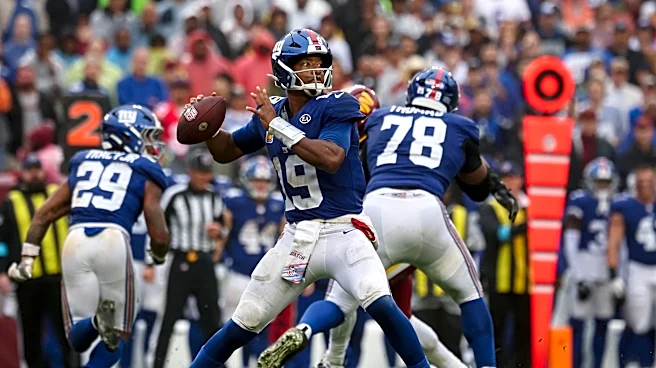
He took it up a notch against the Commanders, and his total EPA was in the 93rd percentile of all quarterbacks since 2010.

As mentioned above, perhaps the Giants’ play calling has been influenced by the weather (they did play three rainy games in a row) and a desire to not put too much on Winston while they’re still tailoring the offense to him. However, the last two games have made it clear that the Giants need to use their pass game to open up the run game with Winston at quarterback.
That doesn’t mean that they have to go full “bombs away” or play a 4-verts spread offense. However, bumping their neutral down pass rate up to the league-average of (roughly) 53% would not only help to emphasize their strengths, but also force defenses out of base personnel and spread them out.
That also doesn’t mean that the Giants need to abandon their heavy personnel packages. Take the first play we looked at above. Had the Giants used Isaiah Likely and Theo Johnson as their tight ends instead of Chris Manhertz and Aaron Stinnie, they would have had four capable receivers on the field. We know Likely is an excellent receiving threat, and Fields has significant upside, while each of the Giants’ four running backs can catch the ball, and Theo Johnson seems to have a solid rapport with Winston.
Their condensed set against a base defense was ripe for a play-action pass. We saw the run-action pull the linebackers in, and the Giants could have slipped Skattebo, Likely, Fields, or Johnson through the defenders and to the intermediate area of the field. Any of those players would have been a tough tackle for the lone free safety.
Likewise, using more spread formations doesn’t mean the Giants need to abandon the power run game. Mauigoa and Runyan are both capable pulling guards, while 21 or 12-personnel packages would have multiple receiving threats as well as athletic move blockers. As we saw above, spreading the defense out makes it that much easier for the offense to manipulate the math post-snap to get the numbers in their favor.
Likewise, I completely agree with the calls to make greater use of Tyrone Tracy on offense. I suspect his offensive snaps have been limited because he’s one of the Giants’ primary returners, and Deonte Banks has become too valuable on defense to use as a kick returner despite his skill. However, Tracy is not only the Giants’ most dynamic running back, he’s also their most versatile. However, his usage thus far has been a clear signal to the defense that the Giants are going to pass. He was on the field for eight passing plays to just three runs against Washington.
A more fluid running back rotation will help keep defenses from keying on the Giants’ tendencies. Also, Cam Skattebo’s pass protection is nearing “Ahmad Bradshaw” territory and is an asset when defenses bring pressure.
Final thoughts
Something has to change for the New York Football Giants.
They simply can’t continue to push their luck as they have the last three weeks. Their defense has been exceedingly fun to watch and has done just about everything possible to keep the offense in the game. The Giants’ defense stepped up again and again to get the ball back to give the offense more chances. And frankly, it was the defense that stepped up to win each of the last three games.
The offense needs to step up, and we know that it’s capable of doing so.
However, I would contend that it means making a philosophic shift for the offense to become a real asset. And again, we know they can do it — we’ve seen direct A-B comparisons in each of the last two games. The Giants’ offense struggled to find anything like consistency or traction against the Cardinals or Commanders, until things got desperate and they opened it up.
Perhaps the Giants shouldn’t wait until the game is almost out of hand in order to unleash their offense to its fullest. It isn’t a betrayal of their core philosophy to use the pass to set up the run, nor does scheming to use math and mass to their advantage mean they’ve abandoned physicality for finesse.
The Giants have to play the hand they’ve been dealt, and need to reach for every tool at their disposal in order to do so. Even if that means becoming a bit more of a pass-first offense than they’d prefer.