





The Sunderland fanbase spreads far and wide, thousands of miles away from the shores of Wearside.
We have supporters’ branches dotted around the globe, each full of members that, no matter their background, all share the mutual love of Sunderland AFC.
Up until 2015, Germany was without a dedicated supporters’ branch, but this all changed after Lads’ fan Martin Steffner met up with Supporter Liaison Officer Chris Waters in Hannover when Sunderland were in town for a pre-season game against Hannover 96.

After a chat over a couple of beers, Martin agreed to create a branch. Living in Nuremberg at the time, he said the goal was to have members from across Germany — a goal which has been achieved with members in several towns and cities, including Leverkusen, Wuppertal, Bremen, and Munich.
One city in Germany has a particular link to Sunderland, which many on either side of the English Channel hope will be built upon in the near future.
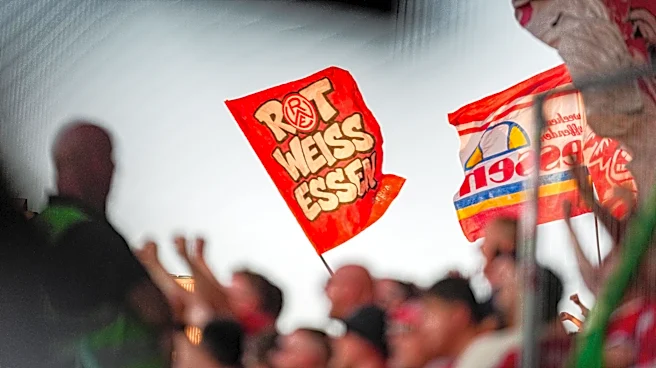
The city of Essen, which sits in the middle of the Ruhr Valley, has a population of 600,000, and much like Sunderland and the surrounding area, heavy industry took off in Essen in the nineteenth century.
The Ruhr Valley became the heartland of industrial Germany, with coal and steel becoming huge industries — a reason why the RAF often targeted the valley on bombing raids during the Second World War.
Football-wise, Rot Weiss Essen (RW) had their glory days back in the 1950s, winning the Cup in 1953 and the league in 1955, with their centre forward Uwe Rahn scoring the winning goal to make it 3-2 in the final of the World Cup in Bern, Switzerland, in 1954.
This was the first time that Germany had won the tournament and it marked the start of the football renaissance in the country. Unfortunately, RW Essen subsequently fell through the leagues and were playing in the fifth division as recently as 2019, but are now fighting their way back up.
Martin is German-born and bred but other members have also joined up, having moved to Germany from Wearside.
One of these is Ian McNee, who left Seaham for Wuppertal, located between Düsseldorf and Dortmund, in 1988. Working for the British Army — a role he left and took early retirement from in 2013 — Ian is still enjoying life with his wife, whom he met whilst living in Germany.
The efforts to create a German Sunderland supporters’ branch were brought to Ian’s attention in the late 2010s when he read an article on Roker Report about Martin trying to set up the branch.

“I got in touch with him and the rest, as they say, is history,” said Ian.
“I’ve been following the Lads since I was two and liked the idea to be part of the club. After the RR interview, I got more and more messages from supporters in Germany,” added Martin.
“Most of them were based close to Cologne. All of them liked the idea of a meeting. We found an agreement with a pub in Cologne and watched the match against Portsmouth (we won 2-1 thanks to goals from Maguire and Willis), in 2019.”
As the branch grew, they started to plan trips to Sunderland with a focus on the football and the city.
“Our trips are called the ‘German Black Cats Comeover’ and take place once every year. Now we have thirteen signed members and are looking for more.”
There’s something that the German Black Cats have over other supporters’ branches — one of their cities is twinned with Sunderland.
On this, Ian said:
“Essen and Sunderland were twinned in 1950, so seventy six years ago now. After the war, there was a wave of town twinning which was very much aimed at reconciliation between former enemies to promote understanding and friendship between the towns and therefore the countries.”
“Essen and Sunderland were both based on heavy industry so had common ground, as do my hometown Wuppertal and their twin town South Tyneside. The partnerships do seem to be promoted more here in Germany.”
“I see lots of news articles in the local papers about visits from South Tyneside and Wuppertalers going the other way, and last year the German Black Cats were invited to give a talk to the German-British club in Essen about our interest in Sunderland football club and the city.”
“This helped us to make a few important contacts and also paved the way for the British-German club to visit Sunderland later in the year.”

Martin agreed that the two cities are similar in the way they love football and are down-to-earth, hardworking places, and following the Lads has got a lot easier as time has passed, both Ian and Martin explained.
“It’s a lot easier following the Lads these days than in the past. Due to my work, I had access to Forces Radio and the British press. The Footy Echo coming through my letterbox every Thursday was also a godsend.”
“These days, we are well up to date with social media and the likes of you guys keeping us up to speed.”
“Most of our members also have Sky Germany Sports, which transmit about 80% of the Premier League games during the season, including the games which kick off at 3:00pm on a Saturday, so we’re better off than the fans at home in that instance, unless they’ve got a dodgy stick.”
“I think they haven’t broadcast the Lads live on three or four occasions (last Saturday at Wolves, for example) but it’s a lot easier following the Lads than it used to be.”
Martin added:
“In the time of League One and Championship, the club broadcast the match on safc.com. If you buy the international streaming pass, you could watch every match — except for the matches which are on German TV (these are the Sky matches).”
“Last year, no channel picked up the rights, so we could watch every Sunderland game on safc.com and you don’t need to pay for two pay-TV broadcasters. Of course, the price for the streaming pass increased every year, but I guess every football club would do this.”
Martin also believes that Essen and Sunderland could come together and celebrate the twinning in additional ways.
“I think there are so many opportunities where the two cities could connect. First of all, football. Essen tried to organize a sports festival, but unfortunately the clubs found no way to talk about.”
Essen play in the third tier whilst Sunderland are in the Premier League.
“I guess Sunderland has more interest in playing against a Bundesliga side (like they did in the summer in Augsburg). Also, you could organize a beer festival. Brits and Germans love beer; why not bring the people together with a good pint of Camden Eazy or Stauder Premium Pils (local beer in Essen).”
“There is also music.”
“British acts can easily play in Germany, and I guess Brits would listen to a good German musician (they are rare, I know, but sometimes you will find them). Theatre is also possible, but may be more work due to translations. All of these ideas are shared with the city of Essen.”
Ian added:
“The best way is to make people aware.”
“I’ve spoken to loads of folks back home who have no idea that Sunderland is twinned with Essen, and I know from my discussions with Michael Ganley of the Fans Museum that there seems to be a certain reticence in Sunderland council to get involved in furthering relationships with Essen.”
“I suspect some of the councillors don’t know about the twinning either.”

The German Black Cats are always working hard to keep connections with Wearside strong, but the recent ownership change has put an end to this — a couple of teams were interested in a game.
Martin hopes, once again, for a Sunderland pre-season game, but this year there may even be a European trip to Germany.
“We have our German Black Cats Comeover. Because of the huge request, we have to split it and will organize two trips, one of them being International Fans’ Weekend.”
Ian talked about another footballing plan that he’s playing a part in.
“Michael Ganley approached me a couple of years ago asking if I could fix his handicapped team up with a friendly in Germany. Through questions asked at the talk we did in Essen for the German-British club, I got in contact with Ralf Bockstedte, who is responsible for sport on Essen City Council.”
“It looks like the match is going ahead in early September, but we are still waiting for things to be finalised so Mike can go ahead with trying to find the money to make it happen.”
“My original idea was to get the lads over for a game; RW Essen and Sunderland have never played against each other, which I also think is a good illustration of the lack of ambition and/or knowledge in promoting the twinning.”
“Unfortunately, Ralf has told us that a game between the men’s teams would be very difficult to organise because the police are concerned.”
“They say they would have to put a lot of coppers on the ground and it’s just not worth it for a friendly. I think that has more to do with the Essen fans than any daft lads who would come over from the UK.”
“There were certainly no problems pre-season when we played at Augsburg, although Essen is a lot easier to get to. A one-hour flight from Ponteland to Düsseldorf and then thirty-minute train ride to Essen.”
The twinning is highly important to both Ian and Martin, with hopes high that it can be strengthened in the near future.
“For me,” said Martin, “It would be so important.”
“We have many parties here which could benefit from a good relationship. To speak English is something that helps you in all parts of your life. Job, holidays and illness — you find together. And maybe the people in Sunderland can learn German and come over as Ian did and many before and after.”
“I think, for example, for people who are working in the medical field. You are not unprepared, and it helps you in your life to speak a second language. Two of my best mates are living in Sunderland.”
“I would not know them without football and English. Also, there are economic partners in another country. People can come together, and it is only a eighty-minute flight.”

Ian added:
“In this day and age, I think it’s important that we take every opportunity to get to know other people and cultures instead of sitting in our own little cubby hole and grumbling about how terrible everything is.”
“The more we try to integrate, the less strife there’ll be. Essen, like Sunderland, was very dependent on heavy industry, and when the steelworks and the coal mines closed they suffered just as badly as Sunderland did when Wearmouth colliery closed, and Pyrex and the shipbuilding went down the pan.”
“But the people of Essen, like Wearsiders, are made of tough stuff, and they’ve turned it around. Both towns have changed beyond recognition in the last fifteen years, and the opportunity to learn and grow even more is right there on the doorstep — if they’d only take it.”
“Let’s have Essen Council visit Sunderland, and Sunderland Council return the favour. It won’t harm anyone and can only be of benefit to both towns.”