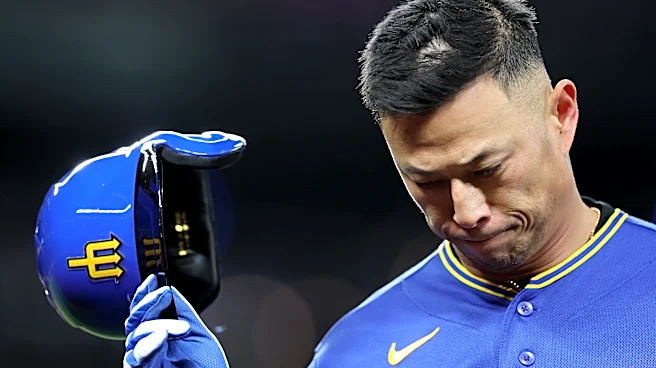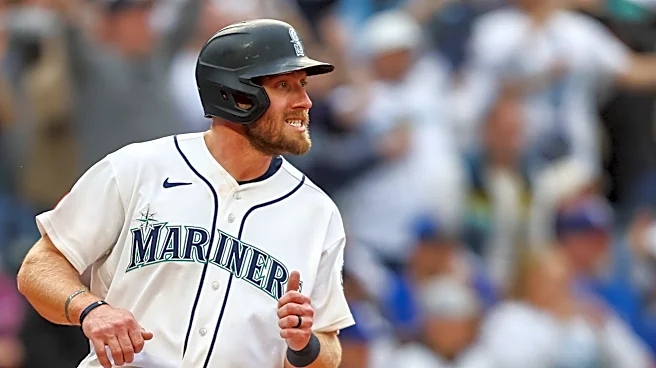



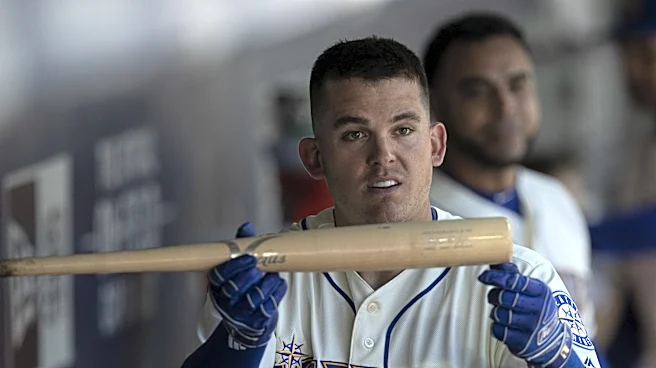
Luke Raley sat in front of the assembled media postgame for the first time in this young season after the third game against the Astros, a decisive 6-1 win where Raley fell just a homer short of the cycle. For a split second after sitting down at the podium, he seemed overcome by emotion, maybe struck by how long it had been since he’d last had an opportunity to sit in that spot, after losing most of his 2025 season battling injuries.
Three days later, Raley would record the first four-hit game of
his career. Three days after that, he’d add another home run to his season total, already surpassing the number of home runs he hit in all of 2025.
“He’s putting together really good at bats,” said Dan Wilson late this spring, back when Raley began his campaign of terrorizing opposing pitchers. “It’s great to see, especially coming off what he went through last year. It was a difficult year for him with the injuries. But his intent all spring, his intent here in the beginning of the year, is to get back to who he is.”
“And wow, he’s really done it.”
Raley has been showing what he can do as a fully-operational battle station since spring training, where he announced his return to health, slugging his way through the Cactus League. When the bright lights came on, Raley packed his thunderous bat along with him from Arizona. Raley currently ranks in the top 20 in MLB for barrels per plate appearance, right behind Kyle Schwarber and slightly ahead of Bryce Harper.
There’s an argument to be made that not only is Raley set to return to his 2024 form – a campaign where he was worth 2.3 wins – but to improve upon that version of himself. 2024 Luke Raley ranked in the 68th percentile for average exit velocity; currently Raley’s average exit velocity of 93 mph puts him in the 88th percentile. He’s hitting balls harder more regularly, but he’s also hitting balls harder, period. Raley’s second homer of the season, a frozen rope off a Tanner Bibee slider, came off the bat at 113.8 mph, which is currently the twentieth-highest max exit velocity in MLB this season.
That’s just .5 slower than Raley’s max exit velo last season, and 1.6 mph slower than his career-best max exit velocity. As we know from Rob Arthur, for every mile per hour above 108 [maxEV], a hitter is projected to gain about six points of OPS relative to their predicted number. ZiPS projected Raley for an OPS this year of .743; that would create about a thirty-five point push for Raley, to .778, which would put him almost exactly in line with his OPS in 2024. Raley’s current OPS is a robust .971, currently good for fifteenth-best in MLB.
That shiny OPS is due for some dinging. Raley is an imperfect player; those big hits also come with big strikeouts, and he doesn’t walk quite enough to be a real three true outcomes player. But the underlying quality of contact metrics portend a fully-healthy Raley to be at least as good or better than his 2023-24 selves, when he was worth 2.4 and 2.3 fWAR, respectively. Add in Raley’s near-pathological love of getting free passes via hit by pitches and some positive regression in the form of walks returning to his career numbers (can’t walk when you’re hitting dingers) and cromulent outfield defense, and Raley’s pre-season ZiPS projection of 1.2 wins (1.0 WARP at Baseball Prospectus) feels shatteringly low.
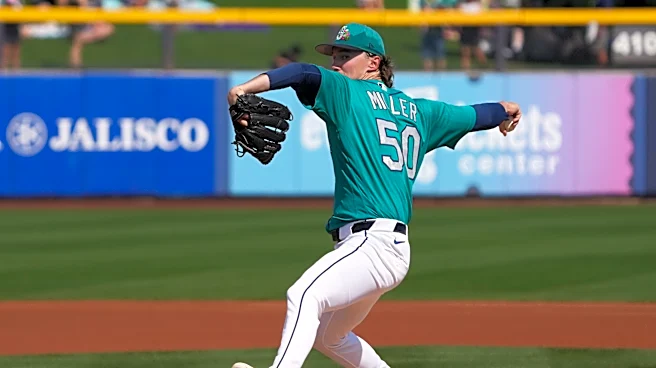
It’s been a long journey for Raley, who spent last year fighting his body at seemingly every turn, first with a right oblique strain, and then with related back spasms. For Raley, the specific nature of the injury was irritating, as obliques are notoriously difficult to rehab, as Bryce Miller could tell you (Raley did offer Miller some advice on rehabbing his own oblique injury). An oblique injury can feel fine up until it doesn’t.
“I was always like, is it going to hurt me on this swing?” said Raley. “It was just no fun to deal with. I’d never dealt with it before, and it’s just one of those things that, until you actually go through with it, you don’t know what it feels like.”
The impact of the injury can have knock-on effects, too, explained Raley.
“You lose a little bit of your bat speed or whatever the case may be, and then your contact point changes, and it just means you’re basically relearning how to hit a baseball at this point. So it just becomes really tough.”
Raley did lose some of his bat speed as he tried to return from his oblique injury last season – from 75 mph down to 73 – but moreover, he just never looked fully comfortable and connected in the box. Really, he never got a chance – he was back from a two-month-long IL stint for about a month in July and then went back on the IL with back spasms for most of August.
But Raley’s comeback season isn’t fueled just by reps in the weight room to increase his core strength (although he’s done that) or hours on the Trajekt machine (although he’s done that too).
“I feel like more than anything, the biggest thing is just changing my mindset. We talk about it a lot, myself and the coaching staff. I’m really hard on myself. And sometimes it’s not a great thing to be so hard on yourself in a 162 game season.”
Raley, who isn’t satisfied with his effort in a game until his uniform is more dirty than it is clean, has had to learn to balance his intense style of play with the demands of the long season. Never a showcase star or D1 top-rated prospect, Raley decided early in his career that his path to being a professional player would be to give unrivaled effort in all phases of the game, literally putting his body on the line by wearing pitches to earn free passes (he ranked third in baseball in HBPs in 2024, with the same number as his jersey number: 20). But that grinder mindset took a mental toll, as well as the physical one.
While he was on the IL in 2025, Raley spent significant time talking with Mariners mental skills coach Adam Bernero about how to respond when effort failed him.
“Just being better about letting a bad game go in the past, and showing up the next day as the same person I came in as the day before. Good or bad, just trying to stay the same.”
Raley said it’s been helpful to have a role models of that mindset in his clubhouse: one in his skipper, Dan Wilson, and the other in first baseman Josh Naylor. Naylor, especially, has been a model of consistency, even throughout some early-season struggles.
“I’m sure Naylz would tell you that he’s not overly happy with the start of his season,” said Raley. “But the way he shows up and continues to grind and play and jokes around, having a good time, it’s a reminder how blessed we are to play this game, and you can’t take it for granted.”
“I’ve actually thought about that a lot with this team. Everyone pulls for each other so hard, it’s so easy to be—you know, however you do doesn’t necessarily matter, as long as the team’s doing well. That’s what you want, teammates that are there for you through good and bad, and you feel like their success is your success, and vice-versa.”
“We spend so much time together. These are all my brothers in here, and you have to pull for one another. You never forget, whether you’re doing good or bad, just how hard this game is, and you just have to keep backing each other and support each other day in and day out.”
Luke Raley is healthy now—mind and body—and it is going to be everybody’s problem, because in this clubhouse, everybody’s problem is also everybody’s solution. Right now it’s Raley leading the charge, pouring back into his teammates all the support they gave him when he was struggling last season. Soon it will be someone else – but hopefully not too soon for Raley, who has certainly earned this moment in the sun.