

Mark Manfredi did not speed.
This is worth establishing up front because he had every reason to. He he ducked out of the clubhouse in Albuquerque the night before to FaceTime his wife and his seven-month-old son before bedtime, and he was back at his apartment when his pitching coach called with a message that was less a request than a summons.
“He goes, ‘Hey, Skip wants to see you,’” Manfredi said. “I was like, ‘Well, I’m saying good night; I’m at the apartment.’ And he’s like, ‘Well, you better want to get
back here as soon as you can. He wants a word with you.’ So I rushed back, trying not to speed for whatever reason it may be.”
It was a 10-minute drive. He was asked, later, whether it felt longer than that.
“Longest 1o minutes of my life.”
Then he walked in, and Isotopes manager Pedro Lopez asked where he’d been. Manfredi told him the same thing.
“And he was just like, ‘Well, you better call them back and tell them that their dad and husband is going to be a big leaguer.’ And I was just like — I am at a loss for words.”

The road to the 26-man
Manfredi’s route here was not linear, and he does not pretend otherwise. A ninth-round pick in 2023 out of the University of Dayton — 272nd overall, a $27,500 bonus — he spent 2024 in High-A as a swingman, moved to the bullpen full-time in 2025, and broke out this spring: a 39.2% strikeout rate across 16 games in Double-A, then 18 more with Triple-A Nashville, where he ran a 3.09 ERA and a 31.3% strikeout rate over 23.1 innings.
Then on August 3, Milwaukee traded him to Colorado. He found out the way most players do — his name scrolling across a television.
“That was the first thing that I had in mind when I saw my name on the TV, and I got the calls,” he said of the chance to reach the majors. “The Brewers are a fantastic organization, but I love it here already.”
The Albuquerque line that followed does not look like a promotion case: four appearances, five innings, six walks, six earned runs. The peripherals were kinder — a 4.76 FIP against a 10.80 ERA — and so was the context. He was learning to pitch a mile up in real time.
“Everyone talks about the PCL and elevation,” Manfredi said. “The only way I can describe it is you don’t really know until you experience it for yourself. Pitching in game, everything is different — besides maybe a pitch or two. And then you go back to non-elevation, and your pitches move the way they have your whole life.”
The data backs the complaint precisely.
His four-seamer averaged 14.1 inches of induced vertical break in Nashville. In Albuquerque, it averaged 11.9. For a pitcher that throws the fastball nearly 60% of the time, that is not a rounding error; that is the pitch he built a career on, arriving flatter than he had ever seen it.
His adjustments followed the shape of the problem. Start two-strike pitches further off the plate, because they won’t chase as far. Get ahead early. And lean on the one thing altitude can’t take.
“I knew that in altitude, the gyro slider is going to play,” he said. “It’s the pitch that’s least affected by altitude.”
He threw it 31.7% of the time in Albuquerque, up from 24.1% in Nashville — partly by design, partly because the two weeks in the PCL brought him more left-handed hitters than he’d seen all season, which also gave the developing sweeper a workout it badly needed. He picked up the grip in spring training from former Milwaukee Brewer-turned-Rockie, Sammy Peralta.
And then, in a touch-and-feel session in Albuquerque the day before he was called up, he found something.
“I threw a two-seam a couple weeks ago in Nashville and never really visited it again. And then I threw one yesterday, and it was my exact four-seam metrics in non-elevation with my two-seam,” he said. “Me and [Craig Bjornson], the pitching coach in Albuquerque, we were just like, we might be onto something here.”
Wednesday night
Kyle Freeland’s neck tightened up, and Manfredi knew what was coming next before anyone told him.
“When I saw the injury, and he was walking off, I was just like, ‘This is 100% going to be me.’ So I ran frantically and started throwing plyos as fast as I could, and then my name got called.”
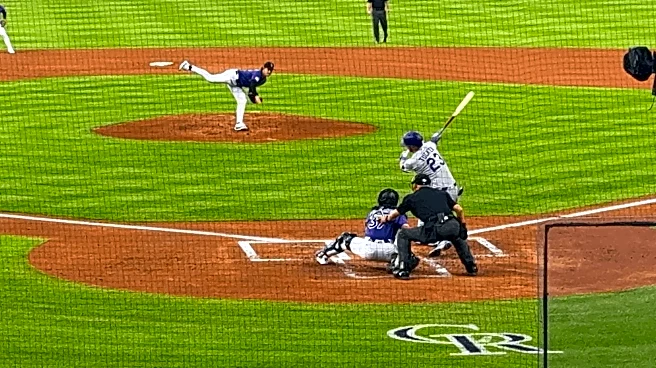
What he walked into was a two-out, bases-empty situation against the Dodgers with Shohei Ohtani due up first. Warren Schaeffer, who watched him take the ball with what the manager described as a big smile, got a five-word scouting report from his own reliever.
“He said, ‘This is the perfect spot,’” Schaeffer recalled. “I’m glad his family was here to see that. I thought he threw that ball exceptionally well. His first at-bat against Shohei — I thought that was perfect. He’ll never forget that.”
Manfredi’s plan for Ohtani was the same plan he’d described that afternoon, before he knew he’d be using it that night: go right at them, don’t pitch around them. He also, finally, got to run his experiment. He threw the two-seamer — one to Ohtani, he thinks, and maybe one to Freddie Freeman.
“And it sank.”

The full debut line: 1.1 innings, one hit, one walk, two strikeouts, no runs, on 19 pitches. Eleven four-seamers averaging 94.0 mph, four sliders, two sinkers, and one each of the sweeper and changeup. He landed a first-pitch strike on five of six hitters.
The second inning of work was where he felt himself arrive — “coming back in, winding down, and starting to be like, okay, this is where I’m at, and I’m here” —and it opened with a strikeout of Freddie Freeman. Which very nearly cost him his first career strikeout ball.
“No, not at all,” he said, when asked whether he’d realized what it was. “I was just kind of in the moment and just rolling with it. And then when he asked me for a new ball, I was like, I want this ball. And then it kind of clicked.”
The people who would want to see that ball were all in the building: his wife Madison, his son MJ, his parents, his grandparents from Cleveland, his college head coach at Dayton, a buddy from Dayton, and both his agents. On less than a day’s notice, across a two-hour time difference.
“That was all orchestrated at like two or three in the morning,” Manfredi said. “I can’t express how grateful I am.”
Prior to his debut, he’d been asked how he processes a season that took him through two organizations, three levels, and a first child in January.
“Me and my wife always say it’s God’s plan; it’s not our timing,” he said. “All I’ve got to do is just throw the ball to the best of my ability and kind of ride the wave. Because in this profession, you’ve got to be like that. If you’re not, you’re not going to last very long.”
To Read: Rockpiles
- Monday: Kyle Karros, Cole Carrigg, and the Power of Friendship | Sam Bradfield
- Tuesday: As Zac Veen and Cole Carrigg show, these aren’t your mother’s Colorado Rockies | Renee Dechert
- Wednesday: Taking stock of the Rockies’ current starting depth | Skyler Timmins
- Thursday: What is fueling the Rockies offensive improvements? | Cory Cohen
- Friday: A look into a new 1B receiving stat and how TJ Rumfield measures up | Joelle Milholm
- Saturday: What Are the Rockies Actually Trying to Build on the Mound? | James Riggenbach
To Read: PuRPs
Full Stream | Jeff Aberle
- Nos. 25-21
- Nos. 20-16
- Nos. 15-11
- Nos. 10-7
- Nos. 6-4
To Read: News
- Roster News: Rockies DFA Michael Lorenzen, recall TJ Shook | Renee Dechert
- Weekly Pebble Report: Jared Thomas lost six months. He never lost his belief. | Eli Whitney
- Roster News: Rockies place Hunter Goodman on the injured list; recall Braxton Fulford | Skyler Timmins
- Roster News: According to reports, Rockies to call up Mark Manfredi | Renee Dechert
- Staff Feature: The Purple Row Mailbag: August 2026 | Skyler Timmins
- Staff Feature: Colorado Rockies 2026 walk-up songs 2.0 | Renee Dechert
- Purple Row After Dark: The Rockies have 50 wins. Let’s celebrate! | Sam Bradfield
Join the conversation!
Sign up for a user account and get:
- Fewer ads
- Create community posts
- Comment on articles, community posts
- Rec comments, community posts
- New, improved notifications system!
Please keep in mind ourPurple Row Community Guidelines when you’re commenting. Thanks!