
While the 2026 NFL salary cap has not been officially set, the Detroit Lions are currently projected to be $8.5 million over the cap. That’s something they’ll have to fix relatively soon, as all 32 teams
must be cap-compliant by the start of the league’s new year on March 11.
Despite the tight salary cap situation, the Lions will be able to be as active in free agency as they want to be. That’s because many of the massive contracts they have on the books are structured so the Lions can lower their cap hit for the 2026 season through a common strategy known as a “simple restructure.”
In its simplest terms, a contract restructure is converting a portion of the player’s salary into a guaranteed “signing bonus.” When that happens, the salary that was in place and was hitting against the cap is now turned into a guaranteed lump sum, but the cap hit is then spread over the remaining years of the contract.
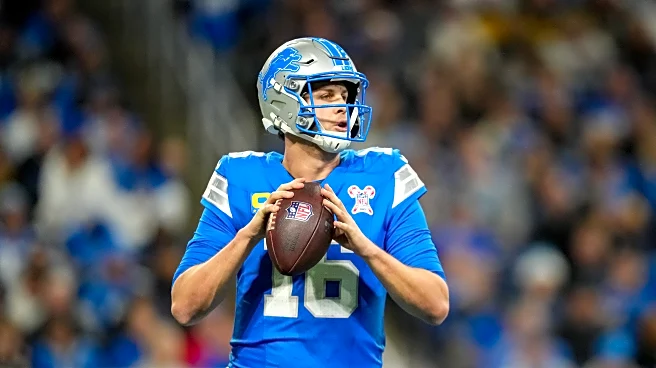
Let’s show an example using Jared Goff’s current contract, which will almost certainly be restructured this offseason. Here’s how his contract looks right now for 2026:
- $55 million salary
- $14.6 million signing bonus proration (from previous signing bonus)
- Total cap hit: 69.6 million
But let’s say the Lions turn $50 million of that salary into a signing bonus via a simple restructure. Then his contract for 2026 looks like this:
- $5 million salary
- $14.6 million signing bonus proration (from previous signing bonus)
- $10 million new signing bonus proration (from new signing bonus)
- Total cap hit: $29.6 million
Minor note here: Teams can restructure as much of a player’s salary as they want each year, as long as at least the veteran minimum salary remains. That number is $1.3 million for Goff.
Boom! Right there, the Lions drop Goff’s 2026 cap hit by $40 million, leaving him with a cap hit that ranks just 16th at the quarterback position (his current cap hit is fifth-highest).
But that $40 million cap hit doesn’t just disappear. It’s kicked down the road into future caps. Here’s a visualization of what that would look like.
(Note: I did add an extra void year to Goff’s contract that doesn’t currently exist.)

So that $40 million would add $10 million to each of his 2027 and 2028 seasons, and when/if the contract voids in 2029, the remaining two prorations automatically hit for $20 million in dead cap.
The Lions could do simple restructures for a few other contracts, as well. Amon-Ra St. Brown ($27.5 million), Alim McNeill ($23.85 million), and Penei Sewell ($19.9 million) all have high salary numbers that can be partially restructured into signing bonuses to increase cap space. In fact, according to OverTheCap, the Lions can create $128 million in 2026 cap space with just simple restructures, the second most of any team in the NFL.
Detroit could also get additional cap relief if Taylor Decker ($11.6 million) and Graham Glasgow ($5.6 million) retire.
But just because the Lions can create all of this cap space doesn’t mean they will. Lions general manager Brad Holmes often talks about wanting to provide sustained success and always keep the future in mind. If the Lions were to utilize all of their restructuring potential, it would cripple the team’s ability to maneuver in the future. Instead, it’s far more likely the Lions utilize one or two of these restructures and get to a comfortable spot where they can spend a moderate amount in free agency.