


All statistics come from the Fantasy Points Data Suite or from NFL Pro in this one.
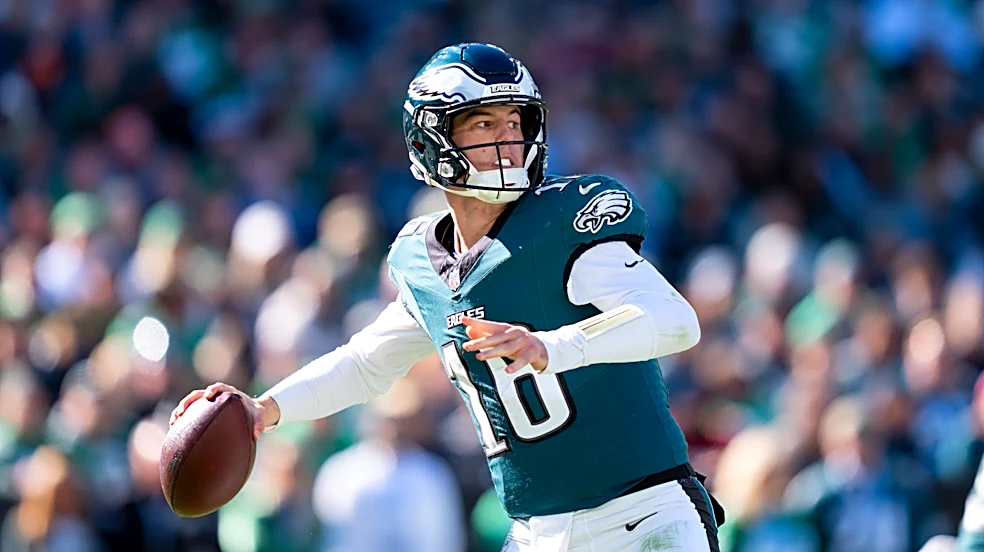
A bonus article! The Eagles’ protection sucks right now. Four-weak pressures and other pressure packages are a major part of today’s NFL, and the Eagles desperately need better answers. They cannot keep allowing pressure to destroy the entire operation before the quarterback has a chance to do anything. Whether it’s Jalen Hurts or Tanner McKee, give the quarterback and the players around him a chance to execute.
I’ve
posted a full video on Patreon breaking down these issues, combining the numbers with film examples to explain what’s going wrong and what the Eagles could do about it. I’d appreciate you checking it out if you want to learn more about how I use stats and film together, or simply join me in getting increasingly annoyed at how incompetent this offense looks right now. Here’s a little spoiler…
This post shows how straightforward basic self-scouting can be. You don’t need to uncover some revolutionary concept. Look at what happens under pressure, identify where you’ve succeeded, and watch the film to understand why. Then work out whether those successful ideas can become a bigger part of the offense. The numbers should prompt questions, and the film should help answer them.
One obvious place to start is formation. Spread the defense out, make the potential threats easier to identify and give the quarterback clear answers to establish some rhythm. Empty won’t magically fix every protection issue, but there is enough encouraging evidence here to warrant using it more. This stuff shouldn’t be this hard. I’m bored of hearing about the Eagles’ pass protection woes, so I thought I’d look at how formation can help them for the rest of the year.
This isn’t a normal film breakdown for me, but I wanted to look at some statistics and what is going on. As often, this post was inspired by this graph from the wonderful Deniz Selman.
That is one of the most insane graphs I’ve ever seen after 6 weeks of a season. It’s not Week 2 anymore! Anyway, let’s look at some results and what the Eagles can do differently.
What the data shows
Let’s start with the Eagles’ overall results under pressure. Empty has been their most productive formation, while under center (singleback) has been a complete disaster. There are only 12 pressured plays from empty, so nobody should pretend this proves it will solve everything. However, when your offense keeps falling apart under pressure, surely you should explore the situations where it has actually functioned?

Next, look at the target depth under pressure. The intermediate production stands out. Beating pressure doesn’t have to mean throwing behind the line of scrimmage or launching a desperate deep shot. Opportunities exist to attack the space behind the rush, but route combinations, timing, and protection rules must give the quarterback access to those throws. “Get the ball out” means very little without somewhere useful to throw it. There is no surprise that throwing deep or behind the LOS hasn’t worked. The stats match the eye test.

Now let’s narrow it to five-plus rushers generating pressure within 2.5 seconds. Empty still stands out. It’s only four plays, but these are precisely the situations that have been destroying this offense. When pressure arrives that quickly, the answer needs to be built into the play. You cannot expect either quarterback to repeatedly escape and rescue a concept that hasn’t had time to develop. Surely, the staff is looking at this?

Here’s empty against five-plus rushers overall. Spreading the defense out can help the quarterback assess the coverage and potential rush before the snap. It also gives him five receiving options, with opportunities to replace blitzing defenders. That still requires coherent protection and hot routes, particularly when six come against five blockers, but at least it gives the quarterback a lot of information pre-snap. It’s easier when you know only six can blitz. No one is blitzing empty with 7 defenders, so you only have to work out who the +1 rusher can be.

The wider shotgun sample shows that simply putting the quarterback in the gun isn’t enough. Spacing, route distribution, and the number of available receivers matter too. I want an offense that helps McKee to identify the problem and deliver the ball with confidence. Empty is one way to simplify that picture and establish some rhythm.

Then there’s under-center against five-plus rushers. Come on. Fifteen plays without a single successful one is horrendous. Turning your back to the defense on play-action makes it harder to identify and respond to pressure, especially when the protection keeps breaking down. How long do you keep asking players to execute something that produces absolutely nothing?

Finally, this gets even more interesting when you look at the number of route runners against five-plus rushers. With three or fewer, the Eagles average 0.6 yards per play. With four, that rises to 3.5. With five, it jumps to 6.3, alongside positive EPA. These are different play samples, so context matters, but keeping extra players in protection clearly hasn’t guaranteed better results. Sending five out gives the defense more receiving threats to account for and the quarterback more answers. That deserves serious attention. The Eagles’ tight ends and running backs are not good in pass protection. How about we stop asking them to do it?

Final Thoughts
Empty won’t magically fix the Eagles’ protection, but the numbers give them an obvious place to start. Spread things out, build in clear answers, and give McKee and the rest of the offense a chance to find some rhythm. The stats do not lie. The frustrating part is how straightforward this is to identify through basic self-scouting.
If you watch the video on Patreon, all of this takes less than 20 minutes to work out. It’s not difficult. The coaching staff has far more information than we do, yet the same problems keep destroying the offense. At some point, they have to adapt to what is actually happening on the field. Obviously, better players will help improve pass protection, but the Eagles’ coaches have to consider their formation to prevent problems from occurring.
Thank you for reading! I’d love to hear your thoughts, so feel free to comment below and ask any questions. If you would like to support me further, please check out my Patreon here!