






The ranking of tight ends is a tricky position. These players are receivers, but are expected to snag passes. They aren’t offensive linemen, but they have to block along the line to assist the running game.
Often referred to as “skinny offensive line”, tight ends are either occasionally utilized in the game plan in 11 personnel or used extensively, like in 13 personnel.
RELATED: TE BRIAN KINCHEN INTERVIEW
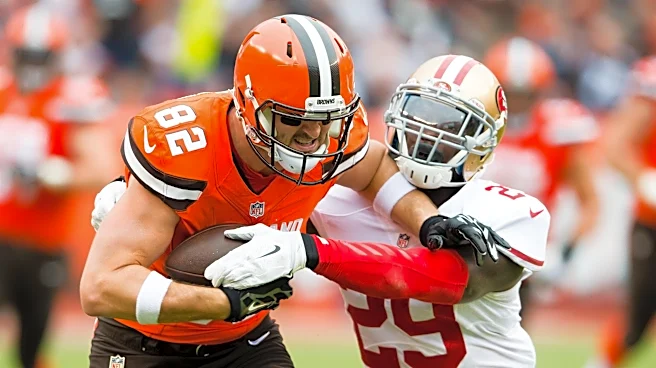
Former Cleveland Browns tight end Gary Barnidge was used in both aspects of the game: as a run
blocker and to help the passing attack. His NFL playing size was 6’-6” and a beefy 250 pounds. He played eight years in the NFL, with his final four in Cleveland.

Barnidge grew up in Middleburg, Florida, just 26 miles down Highway 21 southwest of Jacksonville. He attended Middleburg High School and played basketball and football, but excelled at baseball. As he got older, he played basketball and baseball the longest, where he excelled as a first baseman because of his length, but he became tired of the game and started playing football later.
No longer focused on baseball, Barnidge’s football skills began to grow as he filled out. During his senior year, he had D-I scholarship offers from Louisville, Rutgers, Miami, Florida, South Florida, UConn, Louisiana-LaFayette, Ole Miss, and numerous D-2 programs. He chose to play college football at the University of Louisville, where he played in 47 games over four seasons.
He completed his college career with 108 receptions for 1,491 yards, a 13.8 yards per catch average, one fumble return for a TD, scored 17 receiving touchdowns, and scored 108 points. In his senior year, Barnidge was voted First Team All-Big East.
Barnidge was selected by the Carolina Panthers in the fifth round of the 2008 NFL draft. He was used sparingly on offense and was mainly a special teams member. In 2011, he broke his ankle in a preseason practice and missed the entire season. He came back in 2012 and played in all 16 games with five starts, again, used very little on offense other than as a blocker. He scored his first NFL touchdown on a 24-yard pass from Cam Newton.
He was allowed to test the free agent market and was signed by the Browns for the 2013 season. In 2015, somebody finally realized he had great hands and could get good YAC yardage. Josh McCown started the first eight games, followed by Johnny Football for the next six, and finally, Austin Davis finished out the year with two starts. Barnidge had 125 targets with 79 receptions for 1,043 yards, a 13.2 average yards per catch, scored nine touchdowns, converted 52 first downs, played in all 16 games with just 13 starts, and played on 939 offensive snaps, or 85% of all offensive reps.

Barnidge was playing well, and the ball was finally being thrown his way. For that 2015 season, he was voted to the Pro Bowl as an alternate. He tied the franchise record of most touchdown receptions in a single season by a tight end, which Ozzie Newsome had set. He was ranked the #4 tight end in the league and was voted the best player on the Browns.
As the 2015 season was winding down, he wanted to set up a meeting with the team’s owner, Jimmy Haslam. Barnidge wanted to inform Haslam that he was happy being in Cleveland and wanted to remain in the city. But he wanted to talk to him in person, face to face. Barnidge was appreciative that the Browns hung it out with him, and he finally was able to show his abilities. He was set to hit the free agency market and could have made a bundle, but he chose to remain in Cleveland and ended up signing a three-year extension worth around $12 million.
Barnidge was also named the Browns’ “Walter Payton Man of the Year” in 2015 for his charitable endeavors. During the season, he would take 10 fans to the movies every Thursday. He gave away his game shoes to a kid after every home game for the charity “Samaritan’s Feet.” He was the co-founder of the not-for-profit organization called “American Football without Barriers.”
His thoughts were that the Browns were about to turn the corner and become a successful franchise once again, and Barnidge wanted to be a part of that achievement despite going 3-13-0 under head coach Mike Pettine. On December 10, 2015, Barnidge was signed to a 3-year extension worth around $12 million. Of course, Pettine was fired, Hue Jackson was the new head man, and Cleveland went 1-15-0 in 2016.
Barnidge, age 40, has always been a world traveler. He has been on several TV shows, such as “Total Divas,” “Impact Wrestling,” and competed with former Panthers’ teammate DeAngelo Williams on “The Amazing Race 32.”
Today, the unmarried Barnidge lives outside Jacksonville, Florida. He lists his occupation as “retired.”
Dawgs by Nature staff writer Barry Shuck was able to talk to Barnidge about the famous “Thighmaster Catch,” his charitable side, and to find out if the Browns versus Steelers rivalry is really a hated affair.
Shuck: At Middleburg High School, you were a really good baseball player. Why didn’t you pursue this sport as a professional?
Barnidge: I was recruited heavily for both baseball and basketball, mainly D-2 schools. I got a lot of attention from D-1 schools for football, and some good choices of which one I wanted.
Shuck: My oldest daughter played basketball and softball and was good at both. The problem she had was that the basketball season overlapped with the beginning of the softball season. So, when she finally showed up for softball practices, somebody was already on first base trying to take her starting job. Did you have a similar problem showing up late for baseball season, and in football, you were a defensive end. Did you play both ways?
Barnidge: I always missed the tryout period. I, too, was a first baseman, but was also a relief pitcher. But the coaches knew my skill level, they knew I was coming out after the season was over, and I would miss a week or two. But I showed up and worked harder to make sure the starting job was still mine. Yes, I played both ways in football. Just what you did back then. I played on the edge for the defense, then went over and played tight end with the offense. That’s why I was so good in special teams when I got to the NFL, because I had that defensive background, and I could run and knew how to conserve my energy.

Shuck: Why did you choose Louisville?
Barnidge: They were the first team to recruit me, and they stayed with me and showed the most interest. Plus, they gave me the best opportunity to play right away. They told me that if I came in and showed I was the best player at that position, then I had the right to play. Some schools say that, but their track history says something else. Louisville’s history with Coach Petrino featured the best athlete. I knew coming in, they had only one senior, then it was all freshmen. I knew I had an opportunity to play right away and not wait a few years.
Shuck: One of your favorite teams drafted you, the Carolina Panthers. Do you know how few NFL players get selected by their childhood team?
Barnidge: It is crazy because I grew up outside Jacksonville, and both the Jaguars and Panthers came into the league at the same time. My parents became Jaguars fans. I wanted to go against the grain, so I chose the Panthers, which isn’t that much farther a ride up the Atlantic Ocean. And I played defensive end and loved Julius Peppers of the Panthers. I also loved Tampa Bay because of Warrick Dunn. Huge fan of him as a player and as a person.
Shuck: So if Julius Peppers was your idol, what was it like now playing on the same team?
Barnidge: It was amazing. You really don’t know what to expect going in and idolizing a guy like him. I modeled my game after him. He is one of the nicest guys ever. During my rookie year, after a botched block, he would take the time to explain things about hand placement or leverage. He didn’t have to do any of that, but it shows just how great of a player he was. He is a very quiet guy, but would go out of his way to help me. When he said something, everybody listened.

Shuck: What was your first training camp like?
Barnidge: It was a whirlwind. It is completely different from how everything worked in college. It wasn’t overly hard physically, but it was just work, work, work, work. And unlike college, you knew what your job was, and were able to work on just those things. Nothing was easy in camp.
Shuck: The Panthers didn’t use you much. What were the issues of not getting snaps?
Barnidge: The team drafted a tight end two years before (Jeff King), and another one the year before (Dante Rosario), and then I got drafted. So, we had three guys who were all young guys. Being the new guy, I focused on special teams to show that I wanted to play until I was given the opportunity. And then when I got the opportunity, we had the lockout, and then Carolina traded for tight end Greg Olsen. He ended up being a great player who had a great career and was a wonderful teammate. But now here was I, being second fiddle again. So, he specialized in pass catching, so I focused on run blocking and pass blocking, and was known as one of the best blocking tight ends that year.

Shuck: After your rookie contract expired, you signed with the Browns. Why Cleveland?
Barnidge: In the final year of my rookie deal, I dislocated my ankle. I signed a one-year extension, which paired me with Olsen. Rob Chudzinski was the offensive coordinator with the Panthers at the time. The next year, he got the head coaching job with the Browns and called and told me he was going to make me what Greg Olsen was in Cleveland. I get there, and that’s not what he did. Instead, he put all that effort into Jordan Cameron, who had a great season and showed he could do it, but that opportunity was his instead of mine.
Shuck: In Carolina, you had 11 starts in four years, yet in your first year in Cleveland, you had 12 starts. Every athlete wants to be on the field. Did you realize that you had made the right choice?
Barnidge: It is hard to say. During that time, yes. Now, I would say no because of how the team handled all of that after the 2016 season. They would say we see you in our future and just lie to your face. That’s just the business of the league. And if I had known any of that, I would have gone somewhere else. And I didn’t know they were going to fire the head coach after just one season either. In four years in Cleveland, I had three head coaches and four offensive coordinators.
Shuck: The 2015 season is where you shone. You had 125 targets with 79 catches for 1,043 yards, 52 first-down conversions, and nine touchdowns. Where were you when you heard you had been named to the Pro Bowl? Who was the first person you told?
Barnidge: I was at home and got a call from somebody with the NFL that I have been named an alternate. But that is when I found out it is all about how good the team did and not about individual player stats. Which is why I am not a fan of the Pro Bowl in general terms. Really, the best players don’t always make the Pro Bowl. Name recognition and what teams play a bigger part in who gets in. When they called and told me, I literally had a week’s notice. I never heard from the Browns. I called my mom first. She went with me. It was the very last one that they played in Hawai’i. It was awesome.
Shuck: Okay, I know you have been asked about this a zillion times. Let’s talk about the Ravens’ catch. Week 5 of that 2015 NFL season, with the Browns down 21-16. As QB Josh McCown drops back, Baltimore brought seven defenders with two linebackers plus a safety blitzing. The safety comes free and drills McCown as he throws it deep in your general direction. That catch has since been named the “Thighmaster Catch.” Take it from there.
Barnidge: Josh had shown all year that he had trust in our receivers. If you get in a position where you need to be, he is going to allow you to make a play. With that throw, he wasn’t worried about the interception because he was throwing it where only I could make the play, or it’s incomplete. He wasn’t scared to make a mistake, which a lot of guys would take the sack or throw it away. On that play where they brought everybody, I already knew what my route was. I had a mismatch on the defender, and he threw it up, like, “Go get the ball.” I went up and didn’t get a clean catch, but felt the ball land on my ankle as I fell to the turf. I put my other foot on top of the ball to squeeze it, and then pulled it towards my butt, then pulled it up. It was a natural reaction. I didn’t actually know if I caught it or if it had hit the ground or not until Mitchell Schwartz ran over and said, “You caught it! You caught it!” Schwartz was running behind the play and had the angle to see the whole thing. It was luck and awareness. It took the referees a while to make a call, and then they finally called it a touchdown.
Shuck: What happened to the ball?
Barnidge: I kept it. It’s in my office. My tight end coach told me it was an amazing catch, but if we don’t win, it doesn’t matter. But we won that game in overtime, in Baltimore, which made that catch that much bigger.
Editor’s note: The 33-30 overtime win in Week 5 over the Ravens put the Browns at 2-3-0 under head coach Mike Pettine. Cleveland finished that 2015 season 3-13-0.

Shuck: The Browns versus the Steelers is a bitter rivalry among fans. Despite being a division game, do players also have this hatred between the two teams?
Barnidge: No. In college, you hate your rivals. Playing at Louisville, I hated Kentucky. But in the NFL, you respect the other players because everyone is at the top level. Usually, there are so many guys on the team that you already know. You meet guys who end up at the Combine or the Senior Bowl or the Hula Bowl or the Pro Bowl, or played with them at some point in college or another NFL team. DeAngelo Williams was with Pittsburgh my last two years I was with Cleveland. So, one of my close buddies was on the other side of the field. You want to win, and there are certain teams you want to beat more than others, especially divisional games. But there’s no hate. Fans will show hate for another team.
Shuck: This was also the season when both Josh Gordon and Johnny Football had off-the-field issues. What type of distraction did they provide in the locker room?
Barnidge: It wasn’t much of a distraction on the field. Joe Thomas kept that pretty much out of the locker room, and everybody listened to what Joe said. And Manziel, playing his rookie year, wasn’t ready. But that was an owner’s call and not a coach’s call. And that is why Kyle Shanahan left. Just think, Shanahan could have been the future head coach of the Browns. But he was forced into the lineup in order to sell tickets. And Josh. Everyone supported Josh. He got suspended for something legal now. It’s crazy that the NFL was so stringent on weed. He could have been one of the top receivers in football. He led the league in receiving and didn’t play in two games. That just shows you the talent he had. When he runs, he glides.
Shuck: You lined up quite a bit next to OT Joe Thomas. What type of player was he? What did he expect from you as a blocker?
Barnidge: If you want to talk about the true All-American, that is Joe. He is the type of guy you can rally behind; he isn’t going to say much, but he shows what he is about by his play. He had a specific set he would do every time. If I lined up next to him, he would tell me, do not chip the guy. You’re going to mess up my set. He would tell the running back that, too. Joe would say, “I have him.” And if we tried to help him block a guy, he would tell us that it would throw him off and just leave the defender to him. A lot of O-Linemen wanted that chip – he did not. He didn’t want his defender to spin or shift his direction if he pinballed off me first. He was going to stop the guy no matter what, but he didn’t want me or anyone else in his way.
Shuck: After a good 2016 season, the Browns drafted TE David Njoku in the first round. You didn’t play in his rookie year of 2017. What happened?
Barnidge: After they drafted David, they released me. Head coach Hue Jackson had told me that they were one year in and had big plans for me, so basically, he was lying to my face. Then they went ahead and drafted David Njoku, who has had a decent career, but isn’t the kind of player they thought he was. He was raw, only 20 years old, and was a horrible blocker. That takes time. They released a lot of players. Joe Haden, John Greco, Alex Mack, and Mitchell Schwartz were now gone. A player’s heart can’t be tested by analytics. I found out about being released the day after the draft. I was told GM Sashi Brown wanted to see me. I asked him what the reason was they signed me to that three-year deal the year before, if I was just going to be released? He didn’t have an answer.
Shuck: Isn’t it true you had a Browns charity event on that Saturday, and they cut you on Friday?
Barnidge: A lot of people don’t know this. One of the things that made me the most upset about how they handled this was that I already had a charity event scheduled for that Saturday after the draft. The first round was Thursday night. They released me on Friday, knowing I had this charity event. For the Browns. It was an event for kids, and I was the only Browns player going, but now I am not going to represent the Browns. That was probably the biggest eye-opener I ever experienced. And they did a disservice to me by releasing me after the draft instead of before, when I had a better opportunity to be signed by another team that needed a tight end, and instead ended up drafting one.
Shuck: When you played for the Browns, you were known for your charitable efforts, like Thursday movie nights, giving away free shoes to children, and football camps back in your hometown. A lot of professional athletes want to distance themselves from fans, but you went after this experience. What was your inspiration?
Barnidge: I felt kids could benefit from a free football camp. The fans are out there supporting us every day, and we have not been winning. I felt fans should be able to get to know us as people and not just players. We are people just like the fans – we just have a job that shows us each week on TV.
Shuck: What is the business side of being a professional player like?
Barnidge: It sucks because the business of the NFL is very two-faced. Even if you are a top guy, it is not always steady. Look at Aaron Rodgers, and then the team drafts Jordan Love. But it’s a business, and they are trying to make money as well.

Shuck: After you hung up your cleats, you coached for a short time. Did you realize how much of a time commitment coaching is?
Barnidge: I just was not content doing that because I like to travel. And you can’t in coaching because of the commitment. In college and the pros, they don’t have much downtime. I don’t like being constrained. The high school I was coaching was 40 minutes away, so I spent a lot of time driving.
Shuck: You are a huge traveler. What has been your favorite destination, and where is the one place you won’t return?
Barnidge: Egypt is my favorite because of the history. It’s one of the issues that we don’t truly understand, and still can’t understand the things there. Two of the most beautiful places I have been to are New Zealand and Iceland. I am not a fan of Paris. I just don’t feel they want Americans there, and they are not very nice to you. Now, in the U.S., I want to return to Montana and go fly-fishing again.
Shuck: I know you are a big pro wrestling fan. Did you ever get to WrestleMania yet? Is it overpriced?
Barnidge: I went to nine straight. I haven’t been since COVID, and also since they made it a two-day event. Now, it’s like $1,500 to $2,000 for four seats per night.
Shuck: Other than money, how is the NFL different today than when you played?
Barnidge: I think it’s softer. Everything’s a penalty now. I understand why they’re doing it because of optics and so many injuries. And inconsistencies. Take the “Tush Push.” You can’t push on field goal blocks and on rushing the punt, but they can push the QB on this one play. I don’t care that the play works. But why is it legal here and not over there? The league has gotten very reactive.
Shuck: What is your fondest moment of being a Cleveland Brown?
Barnidge: I have to say, being in the locker room with all the guys. Being in the fight with Joe, Joel (Bitinio), Greco, Alex Mack, and Schwartz, and not based on being on the field. I still have good relationships with those guys and form bonds.