
#1 – Getting comfortable with the usual playcall
If you read my 10 takeaways before, you know how much I enjoy looking at the first few possessions of a game and identifying which play teams are going for – and if you’ve never read me before, welcome, and I hope you’ll like it!
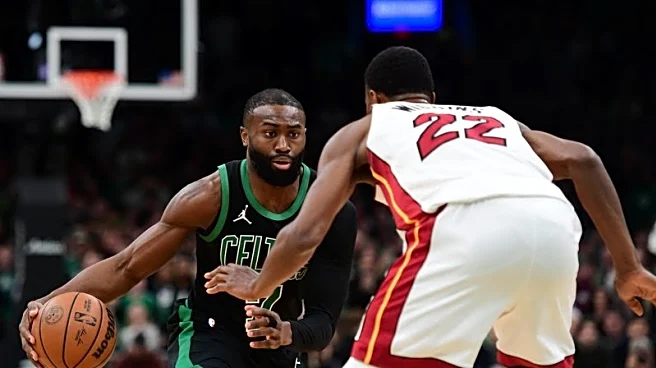
The Celtics started things off with their empty-side pick-and-roll, which makes sense because of the Nets’ switch coverage on this type of screen. With this action, Jaylen Brown gains a great position against the Nets rookie Drake Powell. The situation forces Nic Claxton
to overhelp in the paint, which leaves Michael Porter Jr. alone to defend Sam Hauser around the screen from Neemias Queta. And that’s an open three.
Wonderful – but the Nets weren’t going away that easily and quickly became more aggressive.
#2 – Short-roll against the Nets’ aggressive coverage
The Nets have lately become one of the best teams in the league at forcing turnovers thanks to aggressive pick-and-roll coverages. Instead of switching, they hedge and send a second player to the ball, forcing the ball-handler into a difficult situation. It slows down the play and can sometimes create turnovers. Anfernee Simons particularly struggled against that coverage, with three turnovers overall.
Yet, the Celtics quickly found an answer thanks to their ability to pass to the roll man around the two defenders on the short roll, exploiting the 4-vs-3 situation created by the aggressive coverage.
On the play above, Queta receives the ball in the paint while two players are focused on Brown. As the biggest shooting threat must be covered quickly, Baylor Scheierman quickly finds himself wide open from three. The action below is another example of the Celtics’ high IQ and adaptability. As Luka Garza sets a screen on Simons, the defense puts two players on the ball, but the ball can be swung to the roll man. However, Hugo Gonzalez is open and can act as the connector between Simons and Garza.
This coverage from the Nets forced the Celtics to move the ball a lot more than usual, and they adapted with their highest assist total of the season, finishing with 35.
#3 – Payton Pritchard second half explosion
As the game unfolded, the Brooklyn Nets added another coverage to their defensive strategy. Instead of sending two players to the ball straight out of the screen, they first switched and waited a second or two before sending the second defender. The goal of that approach was to force Brown to give the ball away without opening the short roll. But that opened another door: Payton Pritchard scoring.
Because of the Celtics’ willingness to look for mismatches, and the Nets’ strategy of doubling Jaylen to protect smaller defenders, it created space for Pritchard to drive and, of course, to shoot the ball.
In the last minute of the second overtime, this defensive strategy and Pritchard’s ability to exploit it gave the Celtics a four-point lead.
This strategy not only highlighted Payton’s ability to exploit space, it showed how much Jaylen was willing and able to move the ball for the better collective outcome.
#4 – JB making plays for his teammates
Per statmuse.com, this was only the seventh time Jaylen Brown recorded more than 10 assists in his career, but already the third time this season. Last night’s 12 assists were actually a career high (previously 11 against Cleveland in November).
The first one might be one of my favorites of the season. Not because it’s spectacular, but because he used his gravity as a scorer to find the best shot possible on the court while moving. Last season, we saw his post-up playmaking explode, but this season there are more assists coming from situations where he is on the move.
This other pass to Simons, which isn’t an assist but still, really showed early in the game that Brown was ready for the Nets’ aggressive coverage and that he knew it would open space for his teammates.
In this game, Jaylen Brown showed that his scoring can help a lot, even when he isn’t the one shooting.
#5 – Why the possession battle matters
With 109 field-goal attempts and 16 free-throw attempts, the Celtics generated a total of 116 “true shooting attempts,” while the Nets only created 110. These six extra opportunities to score, in a four-point game that went to double overtime, were vital for the Celtics.
But these extra possessions didn’t come from offensive rebounds this time. In fact, the Celtics were beaten quite a lot in the rebounding battle by the Nets. Yet, they were able to force 17 (!!!) turnovers while losing the ball only eight times despite the aggressive coverages.
By taking care of the ball, the Celtics had six more bullets in their pockets, which gave them the W in the end.
#6 – Hustle clip
These extra possessions came from a little extra hustle, a little extra “je ne sais quoi,” and this clip encapsulates it perfectly. First, Pritchard gives it everything to protect the possession and is able to score at the last second of the shot clock.
Then, Hugo reads the play perfectly and knows the ball will be swung to the wing after the screen. He anticipates it, goes for the layup, scores, and the Nets have to call a timeout.
#7 – Up 10 with 180 seconds to go
Despite a big heart, the Celtics’ collective brain froze a little in the last three minutes, and they threw away a 10-point lead right when it mattered most. First, on the defensive end, the help on this play came from the wrong player. Noah Clowney was placed in the corner for a reason, as he is a 45% shooter from that zone, and it didn’t flinch when Simons’ help left him open.
Defensively too, the Celtics piled up mistakes with fouls. Queta fouled out, and Brown reached on the offensive rebound from Clowney, sending the Nets player to the line. What sealed the deal and sent the game to overtime was the Celtics’ inability to protect the glass, as the Nets collected three offensive rebounds in the last three minutes and scored six points off those opportunities.
#8 – Joe Mazzulla’s masterclass
Well, even after some lapses in the final minutes of the fourth quarter, the Celtics were able to turn it around at the last second.
On the clip above, look at Joe Mazzulla understanding that the Nets went to a zone instead of their usual coverage. He asked the players to change their positions at first and then realized Amari Williams wouldn’t be impactful because of the zone. Therefore, he decided to add a better shooter on the floor and put Gonzalez in the game before the play started. And the rest is history.
#9 – Amari’s minutes
Even if Williams was on the bench during the biggest highlight of the game, his minutes were really impressive. He was used as a connector for a Payton Pritchard clutch triple, then scored an and-one, and capped this great stretch with a block on the French rookie Nolan Traoré.
He stayed ready while Queta and Garza fouled out and delivered exactly what the Celtics needed to close the game on the road – great stuff!
#10 – Let’s trade for Claxton (?)
Often, the Celtics try to attack the opponent’s center and put him on an island, going one-on-one with Jaylen Brown. Well, the Nets welcomed that and even put Claxton directly on Brown from time to time.
When he isn’t involved on the ball, Claxton provides great rim protection as a safety and keeps showing improvement with his hand-eye coordination and timing to deter shots. His touch and handle also seem to have improved, and he can punish a bit more when the defense doesn’t respect him.
On top of that, he remains one of the best short-roll passers in the league… so I’m wondering: could he be the missing piece for a solid big-man rotation the Celtics will need to compete for the NBA title?