

Looking at the Steelers roster, it’d be reasonable to call the edge defender group one of the strengths of the team. With a top three of TJ Watt, Alex Highsmith, and Nick Herbig — plus second-year player, Jack Sawyer, who managed 16 pressures and two sacks in 159 pass rush reps in 2025 — and you’d understand if the Steelers feel like they have other pressing needs in this year’s draft.
That would, however, be a short-sighted view. The best-run organizations take the long view with their roster building
and prepare for all situations. For these Steelers, there are several factors at play that would make investing one or more of their 12 picks into the position a worthwhile endeavor:
- Keeping everyone fresh. TJ Watt is showing signs of decline, and his 863 snaps in 2025 were ninth among edges, despite missing four games. Over the past two seasons, both Alex Highsmith (10 games) and Nick Herbig (6 games) have missed games with injuries, too. Adding to their edge depth could allow the Steelers to reduce wear-and-tear on their top guys and insure them better protection against injuries.
- Speaking of Herbig, unless the Steelers reach an agreement on an extension, Herbig will be a free agent after this season. Early speculation projects Herbig could blow past Alex Highsmith’s current average annual value of $17 million on the open market.
- Add that all together, and it’s unlikely the Steelers will have all three of Watt, Highsmith, and Herbig in 2027. The Steelers could save $16 million by cutting a 30-year-old Alex Highsmith ahead of 2027, or they could let Herbig walk. Watt is unlikely to be moved, as he would cost $52 million in dead cap in 2027, though that changes in 2028 when the Steelers could save $36 million by moving on. Regardless of what they do, having another promising edge already on the roster on a rookie contract would save Pittsburgh some headaches in an offseason where they are likely to need their top pick for a quarterback.
And beyond all that, when there is a draft class that is deep at a premium position, it’s good business to partake. We’ve all heard the adage “just take the best player available,” and there will likely be multiple times when that player is an edge while the Steelers are on the clock.
Should the Steelers agree, that makes edge a perfect fit for what this series is for. As always:
- Any player selected for this list cannot be commonly mocked as a 1st round pick
- I also avoid players who will have a profile written on BTSC. Paired with the previous rule, this year that disqualifies: Reuben Bain Jr., David Bailey, Keldric Faulk, Akheem Mesidor, Cashius Howell, TJ Parker, Zion Young, and R Mason Thomas.
- Because this list is meant to dig deep into the draft, I will try my best not to give you a majority of second-rounders, though I’m not excluding that tier of prospect entirely.
*IMPORTANT TERMINOLOGY*
True pass sets: I will refer to them several times in this article. True pass sets are a subset of passing plays that exclude screens, throws under 2.5 seconds, play action, rollouts, as well as plays where the defense sends three or fewer rushers. These plays are considered to be poor representations of a player’s true pass-rushing skill because they are designed specifically to scheme easier looks and matchups for the offensive line. True pass sets will include all other plays, and all data is taken from PFF’s charting.
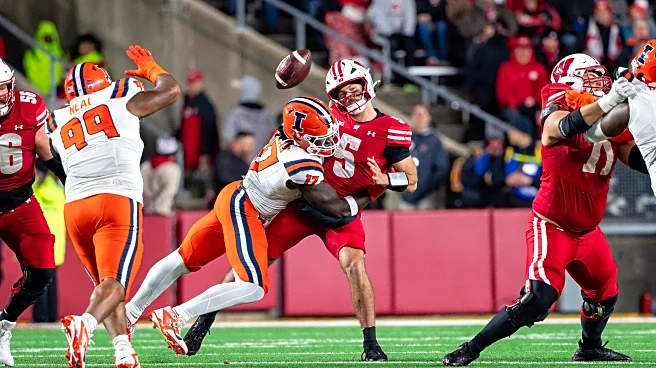
Gabe Jacas, Illinois

Age: 21 (05-27-2004)
Height/weight: 6’4, 260 pounds
Arm Length: 33” and 78 7/8” wingspan
RAS: N/A
I’m a simple man. I root for the Pittsburgh Steelers on Sundays. I like defense, and I like sacks. I like guys who hit hard and terrorize the quarterback. That’s why Jacas (pronounced Yak-us) is possibly my favorite player in the entire draft, regardless of position.
From a frame standpoint, Jacas is exactly what a prototypical Pittsburgh edge looks like. Tall, long limbs, and dense without appearing bulky. Comfortable putting his hand in the dirt or standing up, Jacas isn’t the twitchiest athlete, but he’s got enough speed to line up in the Wide-9 alignment the Steelers like to deploy. But what’s really intriguing about his game is the power. The more drafts I prepare for, the more I’m drawn to these power-rushing archetypes. I find they more reliably translate to the next level, and they tend to have longer careers, as this skillset rarely ages out as quickly as the speed guys do once they lose a step.
If I had just two words to describe Jacas’ game, I’d choose “violent” and “relentless.” The former Illini’s feet never stop moving, and when he gets to the quarterback, he makes it count. His draft profile on the NFL’s website suggests his pro comparison is former Raven Matthew Judon.
Jacas doesn’t have the most elaborate toolbag of pass rush moves, but he’s got the power and short area burst that suits any pass rusher well. In the reel above, Jacas shows some signs of having a rip move, a euro-step, a bull rush, and most importantly, violent hand fighting that keeps him in most plays when paired with his leg drive and ability to push the pocket. Get him in a room with Watt, Highsmith, and Herbig, and I’m confident he’ll pick up some more tricks, just as Herbig did during his first two seasons. My favorite rush in the reel above comes at the 1:15 mark. Jacas flashes his inside hand like he’s going to get it into the tackle’s chest. This causes the tackle to throw a punch with no one home, and by then, Jacas has gotten enough depth that the tackle panics and pivots his back foot, ending up with his hips pointing upfield. That’s a death sentence for a tackle in pass protection, and Jacas is able to dip his shoulder and quickly corner to the quarterback.
Jacas has been incredibly productive as well. He had 12 sacks on the season, recording at least one sack in eight out of 12 games. A four-year starter, Jacas produced 142 pressures, 28 sacks, 31 QB hits, and forced six forced fumbles. In 2025, Jacas had a 24.1% pass rush win rate per PFF against true pass sets. And each season, Jacas has forced more fumbles than the previous year, and he even showed off this skill at Senior Bowl practices in Mobile.
Malachi Lawrence, UCF

Age: Cannot find official DOB
Height/weight: 6’4, 253
Arm Length: 337/8”, 815/8” wingspan
RAS: 9.90
Lawrence has my vote for the most explosive pass rusher in this class. His get-off and motor are evident on tape, and the former UCF Knight demonstrated this further at the Combine, where he had 95-percentile or better results in the 40-yard dash, vertical jump, and broad jump, all indicators of an explosive lower body. His 1.59-second 10-yard split was also an 87-percentile mark.
Lawrence is also one of the better hand-fighters in the class, with a deep bag of counter moves. His speed-to-power ability could stand to improve some, but he was still highly productive in college, with 96 career pressures and 21 sacks. That included 40 pressures and seven sacks in 2025.
Lawrence broke out as a rotational runner in 2023, when he registered eight sacks on just 179 pass rush snaps. (4.5% sack rate). He took over as a starter in 2024, and while that rate, his raw sack totals were never quite as high, Lawrence produced more total pressures each season. His 34.7% pass rush win rate against true pass sets was also one of the top marks in this draft class, with only six notable 2026 prospects posting a higher mark: Nadame Tucker, David Bailey, Akeem Mesidor, Derrick Moore, R Mason Thomas, and Joshua Josephs.
When you size up Lawrence’s production and pair it with his athletic testing, he lands in some pretty decent company.
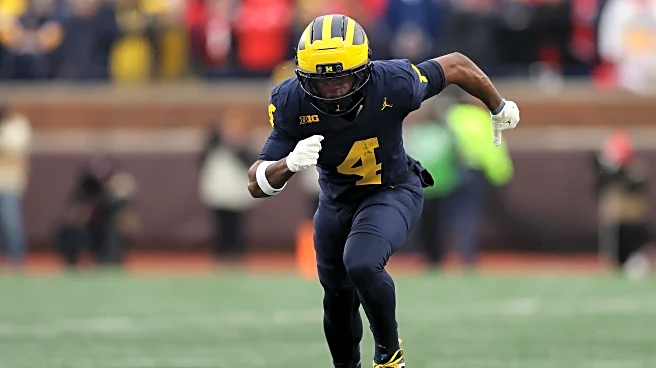
Derrick Moore, Michigan

Age: 23 (12-06-2002)
Height/weight: 6’4, 255 pounds
Arm Length: 333/8”, 811/4” wingspan
RAS: N/A
We head back to power rusher mode as we look at one of the few prospects that finished with a higher win rate than Lawrence in 2025 against true pass sets, Derrick Moore (36.0%).
Moore made a big impression at the Senior Bowl where he was one of the more dominant players during the week. He showed off his plus-power early with this rep against the 6’9 and 346-pound Markel Bell on the first day of practice.
That rep is a good demonstration of the pass rusher you’re getting in Moore. He doesn’t have a very deep bag of pass rush moves, relying mostly on his power with bull rushes and single arm stabs. He’ll likely need to diversify his plan at the NFL level, but when it comes to pass rushers, sometimes it’s better to have one or two elite moves than having several moves but none that you’ve mastered.
And it’s hard to argue with the results for Moore. He generated 37 pressures as a first-year starter in 2024, which is certainly disruptive, but only three sacks left you wanting more. He leveled up in that regard in 2025, generating 41 pressures and collecting 11 sacks. In four years, he has 118 pressures, 21 sacks, 23 QB hits, and two forced fumbles.
Moore could also improve as a run defender. He has the skill and strength to do it at the NFL level, but he doesn’t always play with the same urgency against the run and at times can struggle to shed blocks. Still, when you see reps like the one below, you come away thinking he could develop into a plus-run defender in time.
Joshua Josephs

Age: 22 (12/08/2003)
Height/weight: 6’3, 242 pounds
Arm Length: 341/4”, 837/8” wingspan
RAS: N/A
Get-off and length are the traits that jump off the screen while watching Josephs. Right now, he’s mostly a traitsy projection with a lot of pressures, but room to improve as a finisher. His underlying pass-rush metrics look tantalizing, but the Volunteers heavily rotate their defensive line, meaning that despite being a two-year starter, Josephs checks in with fewer career pass-rush snaps (617) than all but one of the prospects on my list. In 2025, he generated 32 pressures on just 184 rush snaps, posted a 34.8% win rate against true pass sets, but had only five sacks. For his career, Josephs has 81 pressures, 11 sacks, 14 QB hits, and six forced fumbles.
Josephs is a frenetic player, which can play to his favor at times, but he’s still fairly raw at this point in his development. At times, his hands and feet fail to work together. He also could stand to add some weight to his frame, as he lacks the power to hang in the run game consistently, despite showing flashes. These still-developing qualities are likely why Josephs is projected as a fringe top-100 player while having comparable highs to the other edges I’ve shared thus far. That could play into Pittsburgh’s favor if they’re unwilling to pick an edge defender with one of their first two or three picks.
Max Llewellyn, Iowa

Age: 23 (08-16-2002)
Height/weight: 6’6, 258 pounds
Arm Length: 321/4”, 78” wingspan
RAS: 7.73
I don’t know if I’ve unwittingly become an Iowa guy over the years, but I’ve had a “my guy” from Iowa each draft cycle dating back to Desmond King in the 2017 class — George Kittle was also in that class, but he wasn’t on my radar until the preseason that year. This year, that prospect is Max Llewellyn.
Llewellyn is a bit of an afterthought in a stacked class. He’s got the typical height and weight of an NFL edge, but he has slightly shorter arms. He’s athletic enough to hang at the NFL level, but he isn’t a freak athlete. He’s also a bit stiffer and upright compared to those I’ve presented to you previously. But as a projected fifth-round pick, that’s baked into his draft cost. While he might only be a part of a rotation as a pro, Llewellyn is effective enough against the run and the pass to find a spot on an NFL roster.
His pass-rush numbers are respectable, with 45 pressures, 6.5 sacks, 11 QB hits, and two forced fumbles in 2025 with a 24.5% win rate against true pass sets. For his career — which mostly consists of the past two seasons — Llewellyn produced 92 pressures, 14 sacks, and 20 QB hits.
Llewellyn also has a signature move, a fun spin move that he consistently finds success with.
Keyron Crawford, Auburn

Age: 22 (10-17-2003)
Height/weight: 6’4, 253 pounds
Arm Length: 32”, 791/8” wingspan
RAS: N/A
Crawford is a fun developmental prospect who didn’t start playing football until his senior year of high school. As a result, he started off his college career at Arkansas State. He earned the starting job in his second year, which facilitated a transfer to Auburn and the SEC, where he also spent his first year in a smaller role before becoming the full-time starter in 2025. He created 43 pressures this season and had a 27.0% win rate against true pass sets, but managed just five sacks.
Crawford’s instincts are still developing, and he’s much better as a high-energy pass rusher than he is setting an edge against the run at this point in his development. A year or two in an NFL weight program and learning from a good staff could unlock his potential, but he’ll be a project. That could make the Steelers a fit late in the draft, as Crawford wouldn’t be expected to start in Pittsburgh.
Jaishawn Barham, Michigan

Age: 22 (02-02-2004)
Height/weight: 6’3, 240 pounds
Arm Length: 301/4”, 801/8” wingspan
RAS: 8.72
Speaking of projection, Barham might be the biggest one in the 2025 draft with just 162 pass-rush snaps this past season, and only 424 in his college career. Our second Michigan edge on this list, Barham played primarily off-ball linebacker for the Wolverines the past two seasons — and for Maryland in 2022 and 2023 — but they began experimenting with him coming off the edge in 2025. He showed promise with a 20.0% win rate against true pass sets. However, Barham doubled his season pass rush snap total this year but still produced roughly the same amount of pressures (21) that he did on nearly half the reps he had in the three years prior. Barham had 82 pressures, 11 sacks, and 19 QB hits for his career.
Barham could be a versatile player for the Steelers should they select him. Pittsburgh has needs at off-ball linebacker, and if he could provide depth as a pass rusher, even better. PFF gave Barham a 90.4 run defense grade in 2025 and a grade of 87.2 in 2024. While I don’t think those grades are the best barometer for a players skill, it doesn quickly communicate what Barham’s role could be as an early down linebacker and passing down rusher for the Steelers.
Mason Reiger, Wisconsin

Age: 23 (08-19-2002)
Height/weight: 6’5, 251 pounds
Arm Length: 325/8”, 803/4” wingspan
RAS: 9.53
We’ll wrap up with a player that isn’t expected to be selected until late on Day 3, but hell, the Steelers have had luck drafting athletic edges from Wisconsin before (Watt, Herbig).
Reiger started his career at Louisville, redshirting in 2020. Between 2021-2023, Reiger was a rotational player for the Cardinals, generating 10 sacks and 42 pressures. A knee injury caused him to miss the entire 2024 season, and a transfer to Wisconsin followed. He would rise to a starter with the Badgers and created 45 pressures, six sacks, and seven QB hits in 2025, with a 23.0% win rate against true pass sets.
Not t0o dissimilarly from Herbig coming out of college, Reiger is more suited to be a situational pass rusher as a rookie. Reiger has a slender frame for an NFL edge, and he needs to add play strength to be able to set the edge against the run consistently. Still, he’s a twitchy athlete, demonstrated by his 1.61-second 10-yard split, 40” vertical, and 10’5 broad jump.
Time in an NFL weight training program, and a collection of great passing minds like the Steelers have, could turn Reiger into a disruptive force in a couple of seasons. He’s projected as a seventh-round pick, which would be an enticing use of one of the Steelers’ three picks in the final round.
What do you think of these Edge prospects? Would you like the Steelers to draft any of them? Who was your favorite? Did I leave one of your favorites out? Let us know in the comments!