



Basketball is a favorite sport for so many. But it goes beyond liking the way they like to dribble up and down the court.
Sometimes the game gives purpose, life, joy, a sense of identity and a sense of being, helping one chart pathways one couldn’t believe possible.
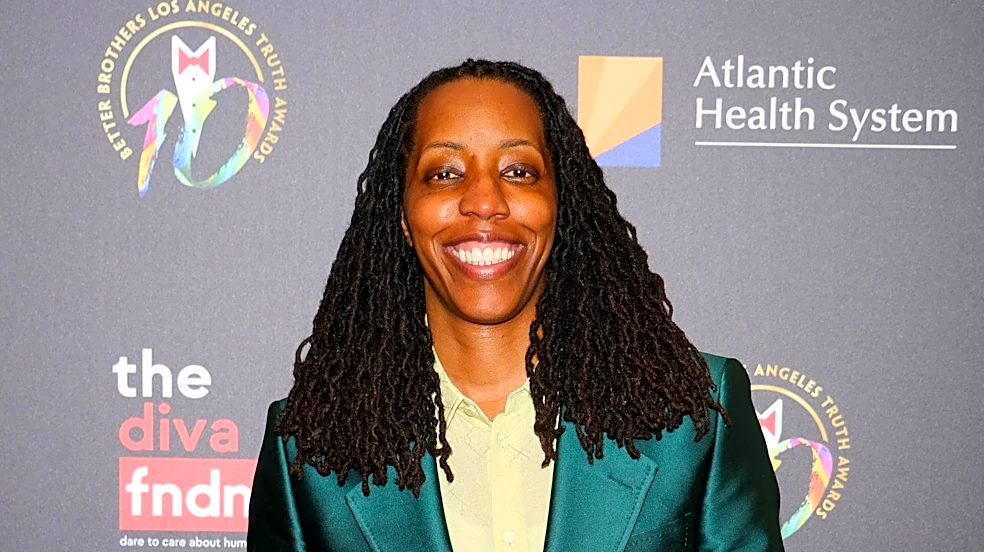
That describes Dr. Bettina Love’s relationship to the game.
Dr. Love, or “Tina” as she likes to be called, is one of the foremost experts on education in America. She is a former elementary school teacher turned professor and education advocate
who looks at the intersection of race, gender, class and social justice.
Dr. Love holds the title of William F. Russell Professor at Teachers College, Columbia University. She is also the Athletic Association Endowed Professor (and former Associate Professor of Educational Theory and Practice) at the University of Georgia.
A best-selling author, Dr. Love has published Hip Hop’s Li’l Sistas Speak: Negotiating Hip Hop Identities and Politics in the New South, We Want to Do More Than Survive: Abolitionist Teaching and the Pursuit of Educational Freedom and Punished for Dreaming: How School Reform Harms Black Children and How We Heal.
She is also the creator of GET FREE, which uses hip hop culture as a means to teach civic education.
Before all that, Dr. Love was ball player. She played at the University of Pittsburgh from 2000 to 2003 and prior that was at Old Dominion University, a program known for basketball prowess. While at Pittsburgh, she earned her BA in Liberal Studies in 2001 and a MEd in Elementary Education in 2002 before obtaining a PhD Educational Policy Studies at Georgia State in 2008.
It’s the game that she credits with leading her to where she is now. And that love and appreciation for the game comes out in her new children’s book Bettina and The Ball.
It’s an autobiographical tale of a young girl named Bettina who through the love of a devoted father channels a passion for the game to open the doors of possibility for her without limitations, constraints, and barriers.
In an interview with Swish Appeal, Dr. Love, a proud native of Rochester, NY, discusses the book, her father, the game and her hopes for the next generation.
You’ve written all sorts of books that tackle the education system. What made you want to write a children’s book where basketball is front and center?
Well, there are a few things that really inspired me about it. Number one, I’m a big fan of the bell hooks. And bell hooks also wrote children’s books. And she just didn’t leave her work to the grownups. She also wanted to say, “How can I impact these kids as early as possible?” And so I just was inspired by such a profound academic, a profound feminist who also wrote children’s books.
I have a beautiful story that I wanted to tell about my dad and I. I love basketball. I don’t know where I would be without basketball. So this is also a tribute to this sport that I just love and gave me so much. And this man who wasn’t an athlete—I don’t know if my father even watched sports—but he saw his daughter who loved this thing and he just poured into me. And I wanted to tell that story. I wanted to tell the story for the dads who have these little girls and these little girls have big dreams to be in this space that has been a male-dominated space.
And now you have this little daughter who wants to be in this male-dominated space. And how my father encouraged me, how he was proud of me, how he taught me patience and practice, patience and practice. So I just thought it was time, particularly with so much buzz around women’s sports, and particularly women’s basketball, that this was a great story to tell at this time about a daughter and a dad in love.
So your dad was a girl dad before being a girl dad became a thing.
Yes, my dad was a girl dad. I don’t know if my dad would call himself a feminist, but I lived in a household where everybody did everything.
So my dad cooked, my dad cleaned, my dad washed the dishes, my dad had two jobs. I didn’t know that was odd growing up. I just thought that’s what dads do. Like they wash clothes, they wash the dishes, they cook, they clean. I just grew up in that type of house. So if you were in the love house, you did it all. And nobody talked about that’s a woman’s role or a man’s role. It was, it needs to be done. So you do it. So I grew up in that type of house. So I don’t even know if he was a girl dad. He was just human…
And my dad let me, I used to wash…he had a baby blue Cadillac. Now, a Black man with a baby blue Cadillac in upstate New York was, that was big. And he used to let me do the low work. So I did the low work, he did the high work. So we would wash his car almost every weekend with the white walls, right? So he just, I say the thing about my dad that was so, for me, was so beautiful was that he raised the little girl that was in front of him. Not what the world told him this little girl was supposed to be. The little girl that was in front of him who wanted to play with GI Joes, who wanted to get nun chucks, who wanted to play basketball, who wanted to wear nothing, but never wanted to wear a dress, even with the Catholic school fighting every day to wear this dress.
He was just very, and my mother was just, very thoughtful about the little girl that was in front of him and never forcing me into any stereotype of what I was supposed to be. And I’m just really grateful for that.
You mentioned how the game gave you everything. How specifically did basketball give you everything and set you on the path that you are now?
So, I wasn’t a great student. I wasn’t, I don’t even know if I was a student. I don’t know what you’d call it. I was going to school every day. I really had amazing teachers who saw something in me, but I didn’t see it in myself. And then I picked up that basketball and that’s all I wanted to do. I was what you call a gym rat. I opened the gym. I closed the gym and it taught me discipline. I had coaches who poured into me discipline. That you finish, you go through the line. You do not, you don’t take any shortcuts. You go through the line. And I think that teaches you discipline. It teaches you commitment. It teaches you how to finish things. Like you finish. I learned how to take criticism. And if you’re going to be a basketball player you got to learn how to take criticism. I learned how to work with people and communicate and talk to other people.
So, the skills that I learned playing basketball with amazing coaches and amazing teammates, it really taught me how to be in this world and be productive and be helpful and be thoughtful and be a good listener, right? The skills you learn playing sports you can transfer those skills into almost every facet of your life and relationships that you have.
And so I’m just grateful for the game and it gave me an opportunity to go to college. I don’t know if I would have went to college without basketball. I can say for sure. I wasn’t going to college without basketball….I just didn’t, I didn’t see anything else for myself other than being a basketball player and getting a D1 scholarship. You know, I always tell the joke that I told everybody I was going D1. I didn’t know what D1 meant. I just know everybody said go D1, so I’m going D1. I had no clue. I had no actual clue what D1 meant. That’s how like competitive I was, and also naive I was at that time. So I don’t go to college without basketball. I don’t get to travel the world without basketball. I don’t meet all of these amazing professors who pour into me.
I go to the University of Old Dominion. They were number two in the country. Then, I transferred to the University of Pittsburgh. And that probably changed my life forever. I owe the University of Pittsburgh everything. I got there and the coach was named Tracy Waite. She was the coach at the time. Hard-nose coach from Georgia. And she told me that I’m going to be a student athlete, an actual student athlete. And I didn’t know what she meant. And she said, you got 10 hours of study hall. And if you miss a minute, you have to run a mile. And that’s cumulative for the team. So if everyone on the team misses a minute, you all have about 15 miles to run a week.
So we just studied, like, let’s just study. Let’s get about 11, 12 hours in because we don’t want no problems with the little people doing the study hall, that the thing. And I just studied. And I was like, “Oh my God, I can study. Oh my God, I can write.” And she really pushed me to graduate on time. Back then you had to wait out a year. It wouldn’t just go everywhere you wanted to go. So when I transferred, I had to sit a year, but I graduated in four years. And they allowed me and paid for me to get my master’s, my fifth year. So I played basketball. I got my master’s, my fifth year….And they paid for it, Pitt paid for it. And they got me hooked up on some like work-study scholarship thing with these two professors. And these two amazing professors, they would just have me read things and write things. And I didn’t really know what they were doing. And at the end of it, before I graduated, they said, “You should be a college professor.” I said, “Well, I don’t know any college professors. I’m a working class kid.”
My father went to eighth grade. My mother got a GED. So I don’t, like a professor? They’re like, “Yeah, you should be a professor.” I was like, “Well, what I gotta do?” Like, “Well, you love to read, you love to write and you love to talk shit. You could be a college professor.” And I thought about it, I thought for a while and then I wrote them and they wrote me letters of recommendation and that was it.
And so I don’t know my trajectory without basketball…..I don’t go to college. I don’t become a writer. I don’t become a professor. I don’t have multiple degrees paid for. Like I just, this doesn’t happen without basketball. So my life that I have, I owe it all to that game.
When you work with students, from when you were elementary school teacher to the work that you’re doing now as a college professor, what’s the response you get when you talk about your trajectory from basketball to where you are now? And, what are you hoping that they get out of this book, especially younger students?
I just hope they’re inspired. Not even if you don’t wanna play basketball or you do wanna play basketball. I think it’s a great story about perseverance. I think it’s a great story about finding joy in whatever you wanna do in life. I think it’s a great story about what happens when you find your joy and you just wanna keep going and keep pursuing.
It is nothing like seeing a kid realize what their thing is. There’s nothing like it. Like when I’m a teacher, if I’m teaching elementary kids or I’m teaching adults, it’s nothing like seeing a person realize that, “Oh, I love music. This is what I wanna do.” “Oh, I love journalism. This is what I wanna do,” or I love basketball or I wanna be a doctor. When that light goes off that they understand that this is what they wanna do in their lives and they gotta push, it’s a joy.
I think it’s a beautiful, also a love story. It’s a love story about me and my dad. It’s a love story about this little girl finding love through a ball. And there’s onomatopoeia in the book where it’s like, “ba-bum, ba-bum.” And that’s to say the ball bouncing is the same as my heart bouncing. Like that’s how much love I have for this basketball. And then learning how to take that love, and the end of the story is to say, “You can love whoever you love.” So we’re also trying to get this idea of love out in the world.
So I hope people see the joy. I hope parents are reading to their kids and teachers are reading to the kids and emphasizing the love and the joy and the passion.
But to do all that, you gotta be persistent. Trials are going to come. You gotta be persistent. You gotta, when somebody says you can’t do it, oh baby, you gotta keep going, right? So that’s what I want kids to get out of this book: is that if you love something, you’ve gotta keep going. No matter what happens, you’ve gotta keep going.
At this time, women’s basketball is surging in popularity and visibility in ways it hasn’t seen before, but, in addition to that, unfortunately, we’ve been seeing this palpable backlash with such toxicity. And obviously, that can have an effect on young kids who are just growing up in this time where they’re starting to pay attention to the game and grasp onto the game and love the game. Would you say that your book is as a way to push back on or even serve as a form of resistance against the toxicity.
I don’t think so. I don’t think my book is that. Because the reason why I say that is because that is too tall of a task for a children’s book. I want the people who are going to find my book to find my book. I want the people who are going to read about a little Black girl and her dad to read about a little Black girl and her dad and to see that it could be any Black girl. I mean, it could be any kid. It could be anybody, right?
Now, my other books, yeah, let’s go. My other books, I’ll stand 10 toes down to that argument. But a children’s book, no. I want it to just be in the world for the love and the joy it’s trying to build. Because I don’t want kids picking it up in this fight. I want kids picking it up in love and joy. And like I said, now, if you want to pick up anything else that I read, I mean, I’ve written. Oh, I go toe to toe when I call out names and I don’t play around with that.
But when it comes to this, I don’t want it in that space. I don’t think it’s deserving…that’s not a conversation that this book wants to be around.
It’s also just bringing it back to just letting kids be kids.
Yeah, I mean, I think the kids that we have now are dealing with so much. They gotta pick up something for joy. They just gotta pick up something for joy.