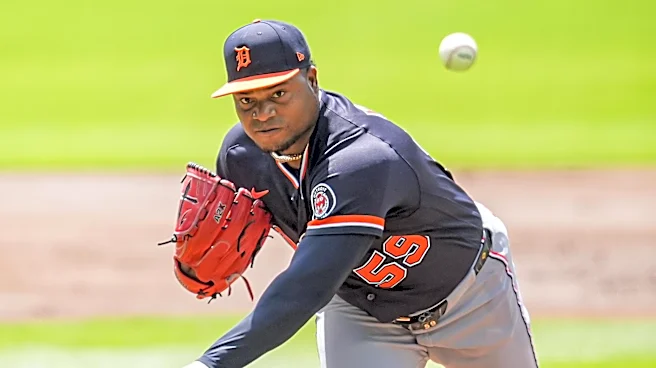



Like so much of the Detroit Tigers’ 2026 season, Framber Valdez hasn’t exactly worked out as planned. Signed to a backloaded 3 year, $115M deal with an opt out after 2027, Valdez was supposed to stabilize a rotation that had Reese Olson injured and Jack Flaherty a total wildcard coming into the season. More importantly, in the face of Casey Mize’s and Tarik Skubal’s upcoming free agency, Valdez was meant to anchor the 2027 rotation while reinforcements like Troy Melton and – eventually – Jackson
Jobe established themselves in the majors.
So far, Valdez has been more decent than great, and his struggles while Skubal and Mize have been injured of late have left the rotation without a dominant arm. His 4.39 ERA is his worst since he established himself as a capable postseason arm back in 2020, and his 18.3% strikeout rate is outright the lowest of his career. He’s not even compiling innings, as his 5.6 IP/game is his lowest since he joined the rotation full time. This is a meaningfully reduced version of Valdez at probably the most inopportune time.
What’s going wrong is pretty obvious, in part because Valdez is a very simple pitcher whose gameplan has never been a secret. He bullies opposing hitters with a bowling ball sinker, racks up league high groundball rates, strikes out about an average number, and is OK walking a few too many hitters or giving up some hard contact because all of those groundballs means a lot of double plays and quick innings. As they say, it’s hard to slug on the ground.
This year, though, that groundball rate is only 44%, which isn’t low in a league-wide context, but it’s very low when groundballs are the only way you’ve succeeded in 7 years as a major league pitcher. It’s especially low when all those hard groundballs get exchanged into hard fly balls, and well, now we know why 2026 Valdez has his highest HR/9 of the 2020s despite exchanging Minute Maid/Daikin for Comerica.
Why his groundball rate has dropped seems straightforward enough. Valdez is isn’t getting his sinker down enough. Seriously, here’s heatmaps of his 2022 sinker (which was, for my money, his best season) and his 2026 sinker. See how that cloud around the bottom of the zone and a bit below goes away in 2026 in the image on the right? That’s bad. Sinkers over the middle can work, but only if the batter thinks they’ll be at the bottom of the zone. Right now, Valdez isn’t giving hitters enough of a reason to worry about that sinker on the bottom rail, so they’re teeing off on the elevated ones.
That’s the bad news, obviously. Valdez is throwing a ton more hittable sinkers. The good news, however, is that other than the general location being a bit up, nothing’s all that different about the sinker. Valdez still throws the pitch about 50% of the time, gets about 25 inches of drop, and his average velocity is still exactly 93.9 mph. It isn’t working as well, but the pitch itself isn’t fundamentally broken. In theory, setting your sights 6 inchers lower could get the whole operation back on track.
The issue doesn’t appear to be his catchers either. He’s gotten more balls called strikes at the bottom of the zone than the reverse, and while Jake Rogers, who usually catches Valdez, grades out a -1 framing runs at the bottom of the zone, he doesn’t appear to be costing Valdez strikes specifically.
Of course, I’d be remiss to mention the edges of the strike zone and leave ABS out of the equation. Is a pitcher like Valdez, who generally relies on that bottom rail, getting burned by ABS?
The answer is seemingly a yes, but likely not how you expect. So far, Valdez isn’t a victim of challenges. Batters have only made 3 challenges against Valdez this year, and only one was overturned from a strike to a ball. If ABS is impacting Valdez, it isn’t because a hitters are challenging his fringe strikes and forcing him up in the zone. But ABS resulted in two major changes to how the strike zone works. One was by introducing challenges. Less advertised is that ABS also changed the zone that umpires are supposed to call.
By standardizing the minimum height, ABS made the zone smaller and raised the bottom higher off the ground. This is how ABS impacts Valdez, not challenges. Since the dimensions of last year’s strike zone are still remembered, sites like FanGraphs offer statistics about both the current and ‘Legacy’ strike zone. In 2026, 48.4% of Valdez’ pitches have been in the 2026 zone, but 50.4% would have been in the ‘Legacy’ zone. That means 2% of his pitches used to be strikes and now aren’t, and I have to imagine – I unfortunately don’t have the tools to prove this right now – that the majority are sinkers down in the zone.
So, we have a groundball, sinker pitcher whose sinker is doing all the same things, but not working how it should. And we have a strike zone that’s slightly smaller, especially at the bottom of the zone where Valdez needs it most. Put those together and we go from Framber Valdez: Borderline Ace to Framber Valdez: Just OK, which is not what Detroit invested in. To get back on track, he’ll have to adapt to this new zone and start pounding the real bottom rail again.