

If there is a single athlete who can be pointed out as having an excellent athletic career, it has to be receiver Paul Warfield.
He has three professional football championship rings with two different teams. Warfield was a college national champion. A track champion. Played for numerous exceptional head coaches. Was drafted by his childhood team in the first round. Is a roster member of the NFL’s only unbeaten and untied squad. Has been inducted into six different Halls of Fame. Became a member of the largest
sports contract ever. An All-American. Named to the NFL 100th Anniversary Team. And he was a first-ballot Pro Football Hall of Fame inductee.
RELATED: GARY COLLINS INTERVIEW: 1964 NFL CHAMPS MVP

Paul Warfield also bled orange. Sometimes it was for the Miami Dolphins, but mostly, it was because of the Cleveland Browns.
His childhood home was in Warren, Ohio, just a little over an hour drive southeast of Cleveland. Warfield grew up loving the Cleveland Indians and the Cleveland Browns. And he still does, despite being 83 years old.
Warfield attended Warren Harding High School, and sports kept him busy. He played basketball, baseball, and football, but was a star on the track team. He was a champion of the low hurdles, high jump, and one of the nation’s best broad jumpers. With this, he had Olympic aspirations.
He had his hopes on becoming a professional baseball player as a catcher. But what swayed him to football was the fact that many baseball players lingered in the minor league system. And some really great high school players remained in the minors for years and years. Warfield did not want to chance this and decided to focus on football. He also wanted an opportunity to pursue track in college.
Paul Warfield’s accolades in college:
- National champion (1961)
- First-team All-American (1963)
- Two-time First-team All-Big Ten (1962, 1963)
- Ohio State Varsity O Hall of Fame (1979)
Warfield had his choice of colleges after playing running back and defensive back in high school. His choice came down to Ohio State University and the University of Iowa. In the end, he decided to remain close to home and stay in Ohio.
He was drafted by the Browns with the #11 pick in Round 1 of the 1964 NFL draft. He was also selected in the fourth round of the American Football League (AFL) draft by the Buffalo Bills. The 1964 Bills would go on to win their first AFL championship.

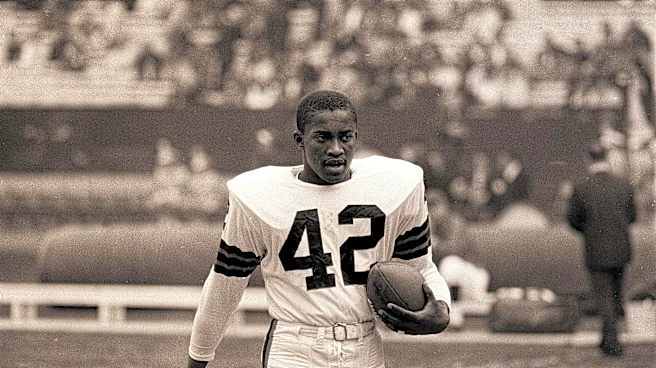
In Warfield’s first year with the Browns, he began as a defensive back, but head coach Blanton Collier switched him to receiver. Notice that Warfield wore #42. That is a running back and defensive back’s number. Back then, receivers wore digits in the 80s.
That 1964 season culminated with Cleveland defeating the league’s best ballclub, the high-scoring Baltimore Colts 27-0 in the 1964 “NFL Championship Game.”
In 1969, Browns GM Harold Sauerbrei traded Warfield to the Miami Dolphins for the third overall pick in the 1970 NFL draft. That was the first year that all 10 AFL teams would merge into the NFL. The Browns had lost the 1969 “NFL Championship Game” and were picking at the bottom of the first round. They wanted to get Purdue QB Mike Phipps and needed to get into the Top-5. Don Shula had just been named the new head coach of the Dolphins, an AFL expansion club.
Miami would go on to go to three consecutive Super Bowls, winning two, including the 1972 perfect season going 17-0-0.
Warfield played 13 years in the NFL and one in the World Football League (WFL). The breakdown is six years with the Browns, followed by five with Miami, in which the Dolphins went to three Super Bowls and won two. He then spent half a year with the Memphis Southmen of the WFL, and finally two seasons back in Cleveland.
In his eight years with Cleveland, he had 271 receptions for 5,210 yards and 52 touchdowns. What was his running style? Poetry in motion.
Paul Warfield’s accolades in the pros:
- NFL champion (1964)
- Two-time Super Bowl champion (VII, VIII)
- Two-time First-team All-Pro (1971, 1973)
- Three-time Second-team All-Pro (1968, 1970, 1972)
- Eight-time Pro Bowl (1964, 1968–1974)
- Two-time NFL receiving touchdowns leader (1968, 1971)
Warfield’s league and team accolades:
- Cleveland Browns Ring of Honor
- Miami Dolphins Honor Roll
- Dolphins Walk of Fame (2011)
- NFL 1970s All-Decade Team
- NFL 100th Anniversary All-Time Team
- Pro Football Hall of Fame (1983)
- Florida Sports Hall of Fame (1992)

In 1977, Warfield earned a master’s degree in telecommunications from Kent State University. After he hung up his cleats, he worked for WKYC in Cleveland as a sportscaster from 1977 to 1980. Then, from 1981 to 1987, he worked as director of player relations for the Browns. Later, he was senior adviser to the general manager for the team.
A life-size statue of Warfield was erected in 2013 outside the stadium at Warren Harding High School, with the label “Pride of Warren, Ohio.” They inducted him into their Warren Sports Hall of Fame in 1989.
Today, Warfield is officially retired and still has ties to the State of Ohio, but lives just east of Los Angeles. Dawgs by Nature staff writer Barry Shuck was able to catch up with Warfield to discuss that magical 1964 NFL season, where, as a rookie, Cleveland became NFL champions.
Shuck: While playing for Warren Harding High School, you played basketball and were a defensive back and a running back in football. You were a high jump champion and the broad jump champion, as well as a 180-yard low hurdles state champion. If you could relive any race you have done in the past, which one would it be?
Warfield: I was competing in what they called low hurdles and became the State Champion. I also competed in the 100-yard dash and the broad jump, in which I placed third in the State. I guess the one race that stands out was the final race I ran in the low hurdles, which was also my final race in scholastic competition, in the colors of Warren Harding High School. It was for the Ohio State Champion meet. I won the race and set a new state record at 18.9. Our school almost won the state championship but was a few points short.

Shuck: You played under the legendary Woody Hayes at Ohio State. What type of coach was he? And did you pick OSU because they would allow you to participate in track also?
Warfield: Coach Hayes was a great coach. I was recruited by quite a number of schools, and my decision boiled down to whether to attend a Big 10 conference school. My decision boiled down to Ohio State and also the University of Iowa. I chose, as a scholastic athlete, to remain in the State of Ohio. We analyzed the university so that I could continue my education, and I went around the university with my visit with the aides. Coach Hayes was a great, great coach, certainly. He knew football, and it was a great experience for me. And he had a format that he really stressed education for all of the athletes who were in the school. All of the schools that I talked to about attending knew I wanted to participate in track and field. So, I listened to the ones that were acceptable to that, like the University of Iowa.
Shuck: At one time, you had Olympic aspirations in track. Why did this change?
Warfield: Possibly because it was not going to be an Olympic year. The 1964 Summer Olympics were next, and I graduated that year. Basically, I had a decision to make. That competition comes once every four years, and I was drafted by the Cleveland Browns at the same time. I would have loved to have an opportunity to be a part of the United States track and field team, but what had more weight at the same time was that I was eligible to play professional football.
Shuck: In 1961, Ohio State finished 8-0-1, and Alabama ended its season 11-0-0. Two services named OSU National Champions, whereas all the rest voted for Alabama. Solve this right now: Who were the 1961 college champions?
Warfield: That’s a question that naturally I am going to say Ohio State. Of course I’m going to say my house. Alabama had a great football team that year led by Bear Bryant, who went 11 games without a loss. But we also didn’t have any losses in the 1961 college football season. There were some consistent winning seasons by both programs. We had an outstanding football team and were well-coached by Woodrow Hayes, so I’m going to be biased, obviously. You are talking to someone from Ohio and who went to Ohio State.

Shuck: The Browns took you with the 11th pick of the 1964 NFL draft. You grew up a Browns fan. What was your reaction to being taken by your childhood team?
Warfield: I had an opportunity to connect with another business near my hometown in Lancaster, Pennsylvania. I was paying close attention to the draft, being that I was draft-eligible. At the time, the Browns were one of the NFL’s greatest teams and, for the longest time, coached by a very scholastic coach in Paul Brown. He was one of the greatest professional coaches, as he skyrocketed Cleveland initially throughout the country as one of the top teams in the National Football League. He was a legend. But in 1964, he was no longer the head coach of the Browns. I was coming out of Ohio State University, and that was a wonderful thing that could happen for me to be drafted by my favorite football team. I was absolutely overwhelmed.
Shuck: What was your first training camp like?
Warfield: Training camp with my favorite team was only about 14 miles away from my hometown. Back then, training camps were in small towns. Ours was at Hiram College. So, it was close to my hometown area so that friends and family could go back and forth. I was quite comfortable in the surroundings, and we were able to focus on the playbook and football. It was a championship organization when I joined them. It was certainly in the era of Paul Brown, but now it was coached by Blanton Collier, who served under Paul Brown for many years. It was obviously an opportunity to join that organization and go compete against some great, great players in my first camp.
Shuck: In high school and at Ohio State, you were a running back and defensive back. When you got to Cleveland, it appeared that they were going to switch back to cornerback, but instead, you moved to receiver. This changed your life. Who did this, and why?
Warfield: I was drafted principally as a defensive back because of my speed. Ohio State was basically a run-oriented football team, but I had played wide receiver a little bit for several games in my senior year. Coming into Browns training camp, I was in the defensive back group. But one day they wanted me to spend some time with the offensive side. They had me running some patterns with the receivers. Coach Collier and our offensive coordinator, Dub Jones, watched me run some patterns. I made a few moves on my defensive backfield teammates, caught a few passes, and then Blanton told me I was now a receiver. I knew very little about the position. They gave me a tutor, Ray Renfro, who had played for the Browns and had just retired. He was a thinking player like me. He taught me insight into the position.

Shuck: What was Jim Brown like?
Warfield: He was Jim Brown. He was a great teammate and obviously the best running back ever to play the position. He was a great competitor. He was also very quiet, especially in the huddle. He rarely said anything in the huddle. We were a really good offense with Jim Brown.
Shuck: You were just a rookie, and now in a new position for the 1964 season. Jim Brown and Ernie Green were in the backfield with Frank Ryan playing QB. You started at split end, with Gary Collins playing flanker and Johnny Brewer at tight end. You were just 22 years old, green as you could be, and here you are starting on offense with some of the greatest Browns to play the game. You started the first home game against the St. Louis Cardinals in Week 2. What went through your mind coming out of the Indians’ locker room and onto the field?
Warfield: I was enormously happy about being drafted by my favorite team as a youngster. And I was happy to do whatever I was asked to do. There was cultural progress, and I was going to be a part of that organization. It was more than I could really ask for. And so I wanted to figure it out as best as I could. Jim Brown was probably going to become a legend, and he was still in the prime of his career. I would play with him for a piece of his last two seasons. So, it was a great, great experience for me. I wanted to be supportive and helpful to the Browns in every capacity. And I was enjoying the Browns; I can say it was perhaps the right thing for me from the standpoint that, again, now as an offensive player in here I had the opportunity to do some things that I could do well. So, it’s basically an absolute boon to the offensive team. The other teams were dedicated to stopping Jim Brown and allowed us receivers to improvise with the offense. I was just a rookie, so every new thing was a new memory. Being on the field that the Indians and the Browns played on was a great experience, as I had sat in the seats growing up watching, and now, here I am standing on the same ground as so many great, great players did.

Shuck: With the Browns in your rookie year, you had 52 receptions playing a new position. How did you handle that transition from college to the pros?
Warfield: I was being tutored and prepared. I was playing a relatively different position because I was primarily a running back at Ohio State. And most saw me as a defensive back. Blanton Collier, based on the fact that he saw things that I could bring to the table as a wide receiver. My tutor, the great Ray Renfro, was a personal teacher and mentor and got me ready to fight. Gary Collins was a great, great teammate, no question about that, and a great receiver. I could ask Gary anything, but Ray was there to be my special tutor and did a fantastic job.
Editor’s note: Ray Renfro played 12 seasons with the Browns, then coached eight years with four NFL clubs
Shuck: You had almost 1,000-yards as a rookie playing a brand-new position, and made the Pro Bowl in your first year. Was this because head coach Blanton Collier placed receivers in a position to transform?
Warfield: I was placed in a position to make a difference. I had a good tutor who got me prepared. And Blanton Collier was motivated to get all of the receivers involved into the offense so that when the defense had it all figured out how to stop the great Jim Brown, he could turn to us and start throwing the ball. The mission of the program was to win as many football games as we could. And that ended with another championship. The running game got us here, but in reality the passing game was the future.

Shuck: In the 1964 “NFL Championship Game,” the Baltimore Colts were 17-point favorites and had seven future Hall of Famers on their roster. It seemed the Browns were overmatched. What was the atmosphere like the week of that game?
Warfield: The Colts were certainly the top team and had only lost two games. We didn’t play them all year because they were in the other conference. They had an enormous amount of media coverage during the week of the game. The media had said we played in the easier conference. They had John Unitas, Lenny Moore, and the great Raymond Berry on their offensive side. They could score points. So, they were favored to win the championship. It was my first year, so I didn’t know what to expect. I guess I thought they were overrated. There’s no problem because we had the great Jim Brown that we could use to control games, as he had done for us all year. If our defense could hold that special offense, we felt like we had the offense, too, and we could score points. We were at home, so we wanted this game. But the Colts were expected to win.
Shuck: The halftime score was just 0-0. How did the Browns’ defense hold that high-flying Colts’ offense, and why was it so difficult for your offense to score?
Warfield: It was a great tribute to the defensive coordinator of the Browns, Howard Brinker, and his assistant coach Nick Skorich. He set up a good game plan to domino the Colts’ passing game and eliminate catches from Berry, who ended up with only three receptions. The plan was to have them have to run on us. Then we had some good running defense to support it. That basically took the passing attack out of the game. Then Jim Brown controlled the clock when we had the ball in the first half. It was a phenomenal job by our defensive coordinator. Our linebackers had career days with Vince Costello and Walter Beach at the cornerback position. The other Colts receiver, Jimmy Orr, had more balls thrown his way, but he didn’t have the good routes that Berry had, and he wasn’t equally talented. The Colts were used to having their way when they dropped back to pass, and we took that away by sticking to their receivers, and then we had two interceptions and two fumble recoveries.
Shuck: Your best season was in 1968 with Cleveland, when you had 50 catches for 1,067 yards and led the league in TD catches with an even dozen. Your quarterback was now Bill Nelsen. How was he different than QB Frank Ryan?
Warfield: Frank Ryan was an outstanding quarterback and a good processor of the game. Of course, he was a math genius. I worked with him very, very well. I enjoyed my relationship with Frank very, very, very well on and off the field. Bill Nelsen was very controlling in short passes and also an outstanding quarterback, and was Frank’s backup for several years, so I was already used to his throws. He was able to do well in terms of things I was actually doing, which is a combination of deep pattern learning, immediate pattern learning, and also short pattern learning. Both quarterbacks had very good accuracy.
Shuck: Was it special to play in the old Cleveland Municipal Stadium?
Warfield: Well, I am from the community that recognizes some Cleveland professional sports teams. I certainly could have played in that stadium with the possibility of professional baseball. There were great sports teams such as the 1955 Indians who were impressive and fought with the New York Yankees all the way to the end of their season. In the National Football League, it was the Cleveland Browns winning another championship. That was an ideal sports town, and that stadium saw a lot of games played there. And it was a very large stadium. The capacity was the largest in the country. Cleveland fans really supported their sports teams.

Shuck: You went to your third Pro Bowl in 1969, and then the Browns traded you to the Miami Dolphins for the third overall pick in the 1970 NFL draft. What was your reaction when you found out about the trade, and did you ever find out why Cleveland traded you?
Warfield: I was very, very disappointed. Very disappointing. I grew up as a Cleveland Browns fan and was proud to be playing for this team. I was going to play for the great Cleveland Browns organization until I was ready to stop playing. We had a fantastic history and had just won another championship. It was really a jolt, to be fair. I had just made my third Pro Bowl and second in a row. Art Modell told me personally about the trade. I was leaving one of the best teams in the National Football League and going to an expansion team of the American Football League as the two leagues were merging. Art told me he had regrets, but by getting Miami’s draft pick, they were drafting pretty high, and the Browns wanted to make sure they got the quarterback from Purdue, Mike Phipps. With Cleveland, we had just lost the NFL Championship Game to the Minnesota Vikings and would be picking almost last. Mike Phipps was considered a top quarterback in all of college football. The trade would allow the Browns to change positions in the draft because Bill Nelsen kept sustaining injuries. The Browns were doing well, and I was doing well. Going back to my childhood, it was always about Cleveland. This was two weeks before the consolidation of the two leagues, and the Dolphins were still considered an expansion team with just two seasons played. Miami was not a place I wanted to go.
Editor’s note: The 1969 Browns captured the Century Division with a 10-3-1 record, then defeated the 11-2-1 Dallas Cowboys 38-14, and met the 12-2-0 Minnesota Vikings in the final “NFL Championship Game.” The Vikings won 27-7 and played the Kansas City Chiefs in Super Bowl 4. The following season, the AFL and NFL merged with a new 26-team lineup.

Shuck: There have been several teams to go undefeated in pro football. That 1972 team is the only one to go unbeaten and untied in the NFL. What does it mean to be a part of that season?
Warfield: It is very special. There’s no question about that. It turned out to be certainly a great thing for me in my career, although I didn’t view that initially after the trade. And then in a matter of six weeks, it was announced that the great coach from the Baltimore Colts, Don Shula, was coming to coach the Miami Dolphins. I hadn’t even practiced yet with Miami, but that certainly brightened the picture as far as I was concerned. Because I believe he was a special coach in the National Football League and had been a champion. And right away he built one of the most formidable teams in the NFL. Before Shula showed up, Miami had won three games the year before in the AFL. Don Shula coming to the Dolphins was a big, big, big thing. His arrival there instantaneously changed things around. In my first year with the Dolphins, we won 10 games. He took an expansion team into the playoffs in his first year. We went to three Super Bowls in a row and won two, including the undefeated year.
Shuck: For the 1975 season, instead of staying with the Dolphins, you, Larry Csonka, and Jim Kiick signed the largest pro sports contract in history with team owner John Bassett to play for Memphis of the World Football League. Did Dolphins owner Joe Robbie try to sign you before you met Bassett?
Warfield: John Bassett was very persuasive to me, and I assumed to Larry and Jim also. At first it was to go play for the Toronto Northmen, but then there were some problems with placing a team in Canada, and so the team was moved to Memphis and became the Southmen. I went up to meet John Bassett in Toronto, and I didn’t even have the opportunity to meet with Joe Robbie because John Bassett gave all of us a very good offer for the time, and was very persuasive, very oppressive as far as my experience was concerned. He wanted the three of us very badly. I decided to sign, and I was enjoying that move at the time was supposed to be to Toronto.
Shuck: The three of you ended up on the cover of Sports Illustrated in a famous cover in WFL uniforms. Do you still have this mounted on a wall in your home?
Warfield: I don’t remember ever framing my copy. I think I have a copy of that issue. The decision to take that picture and put it on the cover was an agent’s decision that was being made. It was not being made politely, but nevertheless, it got an awful lot of attention.

Shuck: The WFL folded midway through that 1975 season. Did you think Memphis was going to be absorbed into the NFL after the collapse?
Warfield: That’s an interesting question. I was at my home in Cleveland after the season ended early. I had heard that Memphis was trying to get into the NFL, and later also heard that Birmingham was trying to get merged into the league. Off the top of my head, and presuming that is a question, I would probably say no. The World Football League had given the National Football League too many headaches, and they had no desire to reward any of its teams and bring them in.
Shuck: You finished your career back where you started – with the Browns. How did this all come about, and what was it that drew you back to Cleveland after all those years away?
Warfield: Well, Cleveland was still my home at the time. I had spent the majority of my life in Ohio. It was still my home state and felt very comfortable there.

Shuck: Were there other NFL teams interested, or was it always going to be a Cleveland homecoming?
Warfield: Well, that was a possibility. I don’t know how interested I really was or not. I had a residence in Cleveland, and my hometown was just a few miles east. It just made a lot of sense to go back.
Shuck: What were the differences between Blanton Collier and Don Shula?
Warfield: I don’t think there were any great differences between Blanton Collier and Don Shula. Both were great teachers, and both had history with the Cleveland Browns. There’s no question about each one’s ability to coach championship teams. I was very fortunate to play for two outstanding coaches. They had exciting offenses going back to when Shula was with Baltimore and losing the 1964 NFL title game. Then he took what was considered an old AFL team, and AFL players, and changed all aspects of turning things around immediately. He changed Miami from being a losing expansion team and then, once he got into the new league format, had us being a championship team. Both coaches were confident and knew how to teach players.

Shuck: Not many players are first ballot inductees into the Pro Football Hall of Fame. But you were. What are your best memories from the induction weekend?
Warfield: It was enormous to be in the upper part of the National Football League. I believe I was extremely fortunate to have played for two great organizations that hired two great coaches. I played with great players that were supportable being my career in every aspect from it and I feel like I just forced it to not only be a member of the Pro Football Hall of Fame, but it would be around so many great masters of the sport.
Shuck: What is your fondest moment of being a Cleveland Brown?
Warfield: I grew up in the Northeast Ohio community 50 miles east of Cleveland. There I became a fan of both the Indians and the Browns. I enormously loved the Cleveland Indians. I grew up as a young amateur athlete as a baseball player as well as a football player. And I was going to have an opportunity ultimately to play either sport. As it turned out, I was guided moving forward towards football and decided baseball that I would have to go to a minor league career – at least in minor league initiation – but I could go immediately into pro football. Nevertheless, the two teams that I idolized that identified as both were interested in my pursuing professionally a career in baseball and football. I idolized the Browns a little bit more so, so I was driven towards them. I was more so in awe of their great coaching and the legacy of great players like Otto Graham and Jim Brown. They had achieved at the highest levels in the last century. As I look back and we’re having this conversation, it’s been a lot of fond memories of the associations of the establishing staff, the will of players that I played with, and the things that we were able to accomplish certainly and we won a World Championship. That was a dream come true for me. It really was. And in the first year that I joined the National Football League.
Thomas Moore contributed to this article