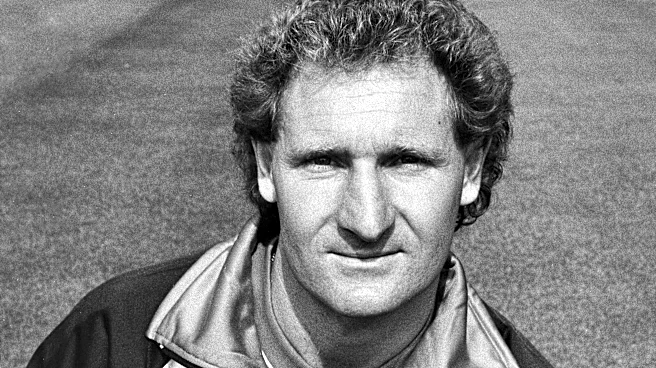











American Independence Day is also the birth date of one of our more intriguing past managers – Mr Malcolm Crosby. He was born in South Shields, and played most of his football at Aldershot, making 257 appearances for them between 1971 and 1980, scoring 21 goals.
He moved to York City in 1981 and was a vital part of their 1984 record-breaking fourth division title-winning team.
Crosby was already at York when a certain Denis Smith arrived in March of 1982 on a short-term loan from Stoke City, and shortly
after Smith was appointed as the club’s player-manager, anchoring the back line on the field, while Crosby pulled the strings in middle of the park. It was Malcolm’s relationship with Smith that was to have great repercussions for him at a later date.

Their relationship grew off the pitch, as well as on it, and Crosby became part of Smith’s coaching staff at York, before heading off to coach in the Middle East.
As fate would have it, Denis Smith arrived to manage Crosby’s boyhood club in 1987, and a year later, after securing our position back in Division Two, he offered Crosby the role of reserve team coach.
The history books will show that Smith was eventually sacked in December 1991 following relegation after one fortuitous season back in the top flight, and a slow start to the 1991/92 season. Crosby took over as caretaker, while chairman Bob Murray searched for Smith’s successor.
One of Crosby’s early games was an FA Cup Third Round match against Port Vale, which we convincingly won and which set the wheels in motion for a memorable cup run.
It has been noted (and mentioned in the excellent Haway The Podcast interview Chris Wynn did with Malcolm) that Neil Warnock was offered the Sunderland job during this time, but, due to his friendship with Crosby (Warnock was a team-mate of his from Aldershot), he turned the role down. He told Murray, ‘I’ll come when you’re out of the cup’, was Warnock’s message – he would later say that that was the biggest regret of his career.
While Sunderland found success in the cup, league form was harder to come by, and while we were never in real danger of relegation, a position only five points ahead of the relegated teams meant alarm bells could certainly be heard in the distance.
However, cup performances had been excellent, and with the FA Cup Final against Liverpool looming, Bob Murray wanted to avoid the ignominy of a caretaker manager leading his club out at Wembley, and duly made Crosby’s position permanent.
As Sir Bob quoted in his book, ‘I’d Do It All Again’:
Malcolm was a lovely man, but there was no way on God’s earth that I was ever thinking about him becoming the next full time manager of Sunderland. He was extremely popular, but wasn’t known for being a strong character, or for his deep technical thinking about formations. However, the whole matter would soon be taken out of my hands.

That thing – was an amazing FA Cup run. As Murray accepted in his book, the pressure on him to award Crosby the post was overwhelming. Despite being 21st in the table at that time, we had reached an FA Cup Final for the first time in nearly twenty years, and that was what mattered to the fans.
Murray realised he couldn’t let in criticism of him allowing a caretaker manager to lead the team out at Wembley. The public were behind Crosby for the FA Cup run, but against Murray for the league form in his eyes.
Although the cup run involved beating more top flight teams than in 1973, it didn’t quite have the fever of 1973.
But it was a fantastic distraction.
I was at the semi-final at Hillsborough when we beat Norwich City, and at Wembley for the defeat to Liverpool – the only game where John Byrne failed to score in the cup. I can remember being caught in that exact conundrum that Murray mentioned in his book. I thought Crosby should be rewarded, but deep down, I didn’t think he was the answer to our problems. Nevertheless – a great period, and one which still fills Malcolm with deserved pride.
Sure enough, Crosby was sacked the following season – infamously after a pools panel defeat to Tranmere – as yet again, The Lads narrowly avoided relegation into the third tier, with Terry Butcher now in charge.
Malcolm went on to have roles at clubs including Oxford, Northampton, Middlesbrough, Birmingham and Gateshead, and is still working in football as a scout for Exeter City.
If nothing else – thank you for those memories of 1992. A happy 72nd birthday Malcolm.