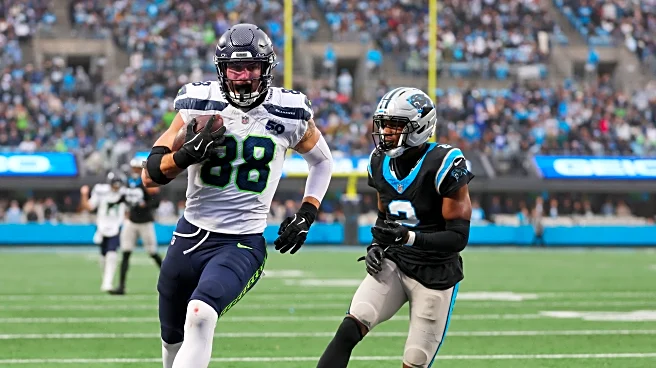

Not every comfortable win looks clean on the tape and the Seattle Seahawks’ game against the Carolina Panthers is a good example of that. The tape shows a Seahawks team that won through structure, discipline,
and concept execution more than overwhelming talent. The margins were controlled, mistakes were limited, and the plan — while conservative at times — worked exactly as intended.
The Good
Defensive structure against the run
Seattle’s run defense looks far better on tape than it has at various points earlier in the season, and the improvement starts with gap discipline. The Seahawks consistently played single-gap principles, rotating between even fronts and five-man spacing to prevent Carolina from generating downhill momentum preventing any run from advancing more than 11 yards.
On inside zone looks, the defensive tackles did a solid job of anchoring first and peeking second. Rather than shooting gaps recklessly, they absorbed double teams long enough for linebackers to stay clean and scrape to the ball.
Carolina runs inside zone. Seattle aligns in an even front with disciplined edge leverage. The play-side DT absorbs the double team instead of splitting it, forcing Chuba Hubbard to declare early. The linebacker stays patient, fills the correct gap, limits the run to a short gain and turns this in a turnover due to D-Law’s effort to make the play. This is run defense winning with technique and timing, not penetration.
Coverage discipline and spatial control on the back end
Seattle leaned heavily on Cover 3 match principles, mixing in quarters on longer down situations. The objective was clear: remove the first read, keep everything in front, and force late throws and checkdowns. Safeties played with controlled depth and patience, particularly against play action, trusting their keys instead of triggering downhill prematurely.
The defense shows a two-high shell pre-snap, rotating late into Cover 3 match. The strong safety drops into hook/curl as the free safety closes the post. The quarterback hesitates just long enough for the rush to matter.
Creative offensive concepts and stress-based design
Offensively, Seattle leaned into spacing concepts, layered route combinations, and defined reads rather than chasing explosive plays. Levels, shallow crossers, and flood concepts repeatedly stressed Carolina’s linebackers, especially when paired with play action. The tape reveals a clear effort to stress the defense horizontally and mentally through formation, motion, and route distribution.
The Seahawks call play action with a wide zone pass to one side of the field (it has the slight motion of the fullback) and this forces the defense to aggressively defend the running game, attacking the left side of the offense and leaving two of the three routes of the Flood concept open. Darnold connects with Barner, who benefits from a good block by Kupp to score the touchdown.
Flood is an offensive passing play designed to overwhelm one side of the field with three receivers running routes to different depths (short, intermediate, deep), forcing zone defenders to choose who to cover and leaving one area open for a big gain, often involving a flat route, a deep out/corner route, and a go/vertical route to attack all three levels of the defense.
The Bad
Pass rush still reliant on scheme-generated pressure
The biggest defensive concern on tape remains Seattle’s inability to generate consistent pressure with a four-man rush. When blitzes weren’t involved, the pocket often stayed intact longer than it should. This is both a personnel and technique issue. Edge rushers frequently attacked the same shoulder, lacked counter moves, and failed to convert speed to power.
Rushing four, Seattle has a favorable look. However, edges lose leverage at the top of the arc, fail to convert speed to power, and the interior does not collapse the pocket.
Second-level overpursuit and late-gap errors
While the run defense mostly held up, the tape reveals moments of overaggressive linebacker play, particularly against split-zone and misdirection looks.
A linebacker commits downhill too quickly on zone action, opening a backside lane. The front does its job, but the second level creates unnecessary stress. These are small errors that quietly add yardage.
The linebacker overflows toward the play-side, opening a backside gap. The running back cuts against the flow, turning a minimal gain into a solid one.
The defensive end closes inside too early, expecting second-level support that arrives late. The gap doesn’t fail at the snap — it fails a beat later.
Final Thoughts
The All-22 confirms what the scoreboard only hints at: this was a win built on discipline, structure, and situational awareness, not dominance. Seattle executed foundational football well — gap integrity, coverage spacing, and timing-based offense — while avoiding self-inflicted damage (even with Sam Darnold having some bad plays). The pass rush and second-level discipline still need refinement, but Carolina lacked the tools to exploit those flaws. And the tape shows a team that knows exactly how to win games like this.
The defense and special teams have been playing at a Super Bowl level. The biggest limiting factor for this team is the offense. Klint Kubiak has also made mistakes, but he has been trying to simplify things for Darnold, including avoiding long passes.