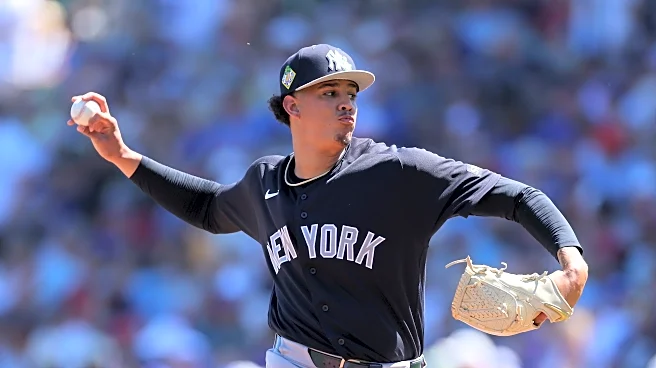

Carlos Lagrange is a fascinating prospect. The 22-year-old, owner of a slightly deceiving 4.96 Grapefruit League ERA, was amazing all spring despite that late stinker in which he allowed eight runs in 2.2 innings earlier this week. And we’re not just talking about his performance in games. Evidently, he put in the work in the offseason, and by the time training camp opened, he was already throwing triple-digit gas in Tampa. This is a pitcher who is not afraid to work on his craft and try to improve.
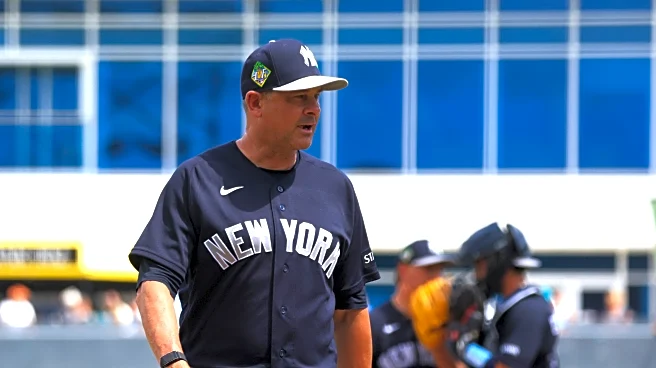
Lagrange pitched 16.1 innings in the Grapefruit League, and they left us plenty of takeaways. The first and most obvious one is that he can throw really hard, touching 103 mph on occasion. The second one is that he is more than just a fastball. “Honestly, you could pick any of the Lagrange pitches,” Yankees pitching coach Matt Blake recently told MLB.com. “Whether it’s the 103 mph fastball or the 94 mph slider or the 94 mph changeup – all of those are interesting.”
We shouldn’t overlook the fact that Lagrange’s walk rate in the 2026 Grapefruit League was a solid 8.7 percent. It’s a stark contrast to the 14.9 percent he had in 78.1 frames in Double-A after being promoted from High-A, where he had an amazing 7.1 percent. Still, 16.1 spring innings won’t tell us much. It’s important to understand that before baptizing Lagrange as the second coming of Jesus. The high expectations currently associated with him and his career progression might not be entirely fair.
Is he ready to be a solid major leaguer right now? Is he ready to be an asset for the Yankees? The answer couldn’t be simpler: let him prove it in the high minors first. Let him come down from all the spring hype and do it in the dog days of summer. Let him actually post an ERA that starts with a two or a three, but with a single-digit walk rate.
Lagrange opened last year in Hudson Valley and earned a promotion to Double-A with a 4.10 ERA in 41.2 innings, but with just 2.59 walks per nine frames and a whopping 13.82 K/9. Once he settled in at Somerset, his ERA was an improved 3.22, and the strikeouts remained steady, at 11.95 per nine. The walks, however, returned, as he gave away 5.74 bases on balls per nine innings.
Perhaps we should all pump the brakes with Lagrange, at least a bit. I might be guilty of that, because I often find myself assuming that not only will he make it to the majors this year, but he will also be highly successful in any role he gets. However, the kid still needs to prove he can consistently throw strikes against top competition. Double-A hitters are good, but not as good as those in Triple-A and, especially, the majors. And Lagrange still couldn’t consistently harness his stuff against them last year. Major league hitters will punish pitchers who beat themselves with walks.
Don’t get me wrong, I love Lagrange. I believe that, when he’s a finished product, he will be an asset as a frontline starter, or as an impactful reliever if he can’t make enough gains with his control. He has a bright future, but it might still be that: a future. The Yankees have solid pitching depth right now, and Gerrit Cole and Carlos Rodón are expected back soon. They can afford to let Lagrange and fellow top prospect Elmer Rodríguez get some much-needed experience in the International League. They should develop at their own pace, and that should be the Yanks’ plan. If he can show that his control won’t be an issue against the best hitters on the planet, the Yankees will welcome Lagrange in the major league pitching staff with open arms.