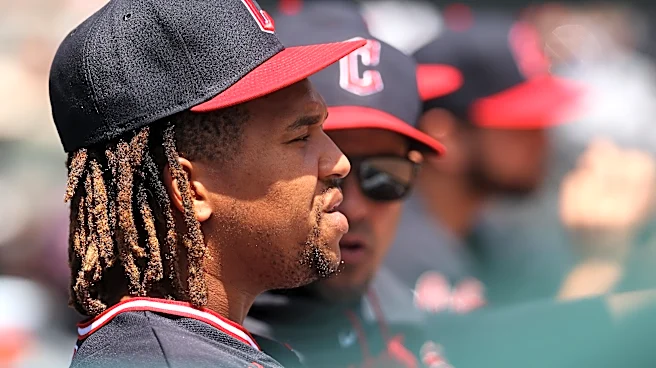



What on Earth is wrong with José Ramírez?! So far in 2026, he’s slashing .226/.343/.396 – that comes out to just a .739 OPS and a 108 wRC+. Definitely low for a hitter that’s been ~.850 OPS and ~130 wRC+ for a decade. So what’s going on? Is this the beginning of the end of José’s time as a perennial MVP candidate, or is it something else?
The first thing we want to take a look at when gauging if a hitter is on the decline is their plate discipline and contact data. Is the player still making good
swing decisions, and are they making contact with the ball when they do swing? Next, we want to look at the quality of that contact. Are they impacting the ball still, and if so, at what level? Is their contact in the optimal launch angle window, or are they popping the ball up or hitting it straight into the ground? Then, we look at luck indicators. Are they finding more gloves than average with their batted balls? I’ll be the first to tell you, as someone that spends a somewhat unhealthy amount of time pouring over baseball related data, the case of 2026 José Ramírez is a complicated but interesting one.
Has José’s plate discipline declined? For the purposes of this research, I decided to compare the data from 2026 so far with two other data sets: José’s career averages, and his 2024 season (since that is arguably his best most recent season). It’s important to keep in mind that when comparing to 2024, things being just a little below that is still keeping him in the top levels of offensive production for his career, because of how good that season was. Let’s look at some numbers. The first one is Chase % (how often he’s swinging at pitches outside the zone). José has a career average Chase % of 26, and so far in 2026 it’s been 29.5. So a little higher, but if we compare to 2024 he’s actually chasing a bit less, as in that season it was 31.6. When compared to the rest of the league this season, the 29.5 rate is actually right around league average. So while that might help him some, that difference really isn’t too significant when we bring in some context. José’s BB % for his career sits right around 10, in 2024 it was 7.9, and so far in 2026? It’s 14.8. This is a massive increase and a good indicator that his patience is still very much intact, especially when combined with the low change in Chase %. The biggest reason for this is pitchers just aren’t throwing him as many strikes. The % of pitches he’s seen in the ABS zone has gone from a career % of 47.4 (47.5 in 2024) to just 45.2 so far in 2026. So actually, this is a very positive sign. It shows a significant adjustment by José in response to changed league pitching strategy toward him.
This doesn’t explain everything though. So let’s look at the contact and contact quality next. His career Contact % is 86.8. In 2024 it was 86.4, and so far in 2026 it’s 86.2. These differences are so small that it could easily just be statistical noise, but that’s a good sign. There’s no meaningful difference in the number of swings and misses he’s having, but let’s narrow it down further. The contact that matters the most is contact on pitches in the zone, as those are the ones easiest for a hitter to drive. His Z-Contact % (The % of pitches in the zone he makes contact with when swinging) for his career is 91.7, in 2024 it was 92.2, and so far in 2026 it’s 93.3. This is another good sign, and it’s an example of still elite bat to ball skill. This is where we’d now want to get into the quality of the contact. After all, hitting the ball more means very little if those batted balls are more weak grounders and pop-ups.
The best place to start for quality of contact is exit velo and bat speed. This is where we see our first really interesting data point. José has never been a bat speed demon by any means, and in fact is usually around the bottom ⅓ or so in the league. His career average is 71 mph, and he averaged 71.6 in 2024. So far in 2026, he’s down to 70.1. This is a noticeable drop, but when we look at his average exit velocity, he’s gone from a career 88.8 and 89.2 in 2024 to 90 in 2026. Since José has never been reliant on bat speed in his career, the fact that the average exit velocity has stayed consistent (and even increased) is the more important factor here.
So what gives here? So far everything has been the same or better than before, right? Basically yeah. There’s 2 more major areas we need to look at, and it’s here where I believe our answer lies. The first data point I want to bring up is launch angle. To get the numbers out of the way early, his career average Launch Angle is 18. In 2024 it was 19.6, and so far in 2026 it’s 20.6. The magnitude of this change isn’t large, but there’s an important subset of his batted balls we want to look at – pulled fly balls. Pulling fly balls is how a lot of hitters generate their home run value, and few have done it better over the last several years than José Ramírez. According to Statcast, in his career, José has pulled the ball in the air 26.6% of the time. In 2024, it was 29.8, and so far in 2026 it’s 28.7. So we’re down a little bit from 2024, but honestly still a very elite level of pulled fly balls. But if we isolate to just the pulled fly ball outcomes and look at the average exit velocity and average launch angle, we have a career average of 35 LA and 94.3 EV, in 2024 it was 34 LA, and 97.1 EV, and in 2026 so far it’s 37 LA and 93.2 EV. These numbers are a small drop, but we can combine it with new Statcast bat tracking data to see José’s attack angle on his swing has increased slightly from 12 (in 2024 and his career average) to 13 so far in 2026. We also see a small jump in the infield fly ball rate – 12.2% for his career, only 10.9% in 2024, and is back up in 2026 so far to 12.5%. It looks like he’s just slightly undercutting the ball a bit, and making less consistent flush contact. We can look at Squared-Up% (or Squared-Up Swing% on Fangraphs) and see he’s squaring the ball up less. His career mark is 29.7, it was 28.5 in 2024, and so far in 2026 it’s 25.7. This is likely a major cause of a lot of the warning track fly balls we might be seeing, or some balls that might’ve been hits staying up just a little longer and being caught.
This brings us to our last major area we need to go over – luck. José is posting a .367 xwOBA so far in 2026. If that holds, it would be the 3rd best mark of his entire career, only falling short of 2020 and 2021. His actual wOBA though is .039 below the expected results, likely due to a few well struck balls ending up right at fielders, or maybe a few fielders making some nice running/jumping/diving catches to rob him of some hits, or even the wind knocking down a would be homerun on a cold windy day. A negative .039 xwOBA difference is pretty massive. It’s the equivalent of anywhere from a .040 to .070 OPS point drop all on its own. When you consider José’s excellent base running and ability to consistently stretch singles into doubles, he’s a player that often outperforms expected results with his outcomes, making the negative difference all the more devastating for translating into results. We can see this even more when we specifically look at the expected results on the pulled fly balls we broke down earlier. His career xwOBA on pulled fly balls sits at .560, in 2024 it was .646, and so far in 2026 it’s .557. So the batted quality of the fly balls is right at career average levels, but the results have lagged behind. The actual wOBA has been .824 for his career, .989 in 2024, but only .676 in 2026. Make no mistake – these numbers are still elite numbers all things considered, but the bad batted ball luck with the decrease in squared-up contact explains a large portion of the lower results we’re seeing.
Now that it seems we’ve isolated where the change is coming from, it brings up the question “is this correctable, or is this the beginning of the end?” Looking at the whole body of data, I would say he’s just in an unlucky stretch that’s compounded by it happening when he’s also just a little bit off with his contact. There is absolutely nothing here that screams career decline, or that he is suddenly a washed up hitter. While it certainly is possible that this could be the result of an aging hitter, the under the hood numbers suggest he’s making some of the best contact of his career, and just has nothing to show for it so far. It seems more likely he may just be a slight attack angle or timing adjustment away from being back to his reliable old self. So no need to press the panic button yet, and as we see the weather continue to heat up, I believe José will too.