

With the season moving forward at a breakneck pace, it can be difficult to find the bandwidth to focus on anything else. But for people like us, and hopefully many of you reading this, there’s no better time to appreciate the moments and players who got us to this place than when the planted seeds are finally bearing fruit.
And with Anthony Edwards’ explosive start to the season, where he placed third on the MVP ladder and was heading the scoring race before unfortunately being sidelined by injury,
there is no better place to start than with the Timberwolves’ sole MVP.

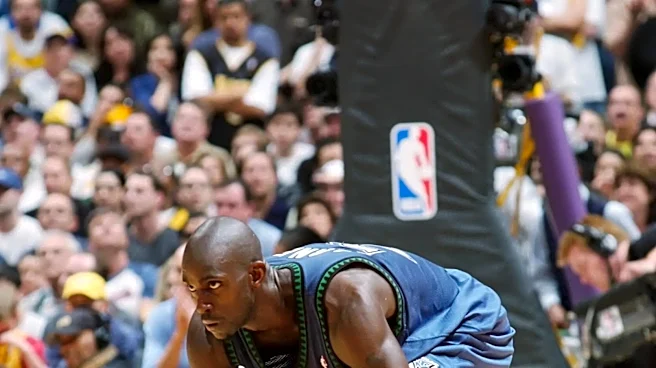
We think there has been some anger from fans recently about how Garnett seems to embrace his Boston Celtics career, but we believe that some love remains from older fans who remember how great KG really was.
On the other hand, there are likely newer fans who don’t understand the extent of KG’s dominance. In this article, we offer an impassioned defense of why Kevin Garnett peaked as the best player in the world and arguably a top-five player ever.
The easiest place to start is a catch-all. We find it the easiest heuristic to understand exactly what we are dealing with. Regularized Adjusted Plus-Minus (RAPM) uses on-off data adjusted across thousands of possessions to attempt to find how much value a player adds over a variety of lineups.
This is then converted into how many points of value a player adds over 100 possessions. Any guesses how much utility Garnett generated during his prime?
In that MVP season in 2003-04, Garnett added NINE POINT EIGHT points per 100, which ranked first in the league and second all time, only trailing 2016-17 LeBron James. This type of impact is easily understood when we look at the team context.
KG came into the NBA as a wiry high schooler, with extreme energy and length that would later make him one of the best defenders we’ve ever seen. But his feel is largely unappreciated, as he excelled as one of the best ancillary offensive weapons of the 21st century. He is one of the most multiplicative pieces in history, as represented by some truly tremendous lineup data.
In the 2003-04 season, Garnett was off the court for a total of 715 minutes. During those possessions, the Wolves — a 58-win team — put up a net rating 10.3 points below the league average. In the 3,235 minutes that KG played, the Wolves rocketed up to a relative net rating of +9.6.
The obvious response to this is that Garnett was boosted by playing with the starters. After all, the Wolves employed Sam Cassell at the time, a player who earned second-team All-NBA honors that season. And it is true that when Garnett and Cassell played together, the Wolves put up astounding numbers.
Minnesota put up an explosive +11.5 net rating in the 2,535 minutes — 4,760 possessions — that the duo spent together. When both of them were off the court in 403 minutes, the Wolves fell to a precarious -15.8. Similarly, in the 313 minutes Cassell was on without Garnett, the team sported a -4.4 net rating.
However, there were 700 minutes, or 1,288 possessions, if you’re picky, that KG played without Cassell. The team’s net rating during those minutes? +4.3.
No matter who was on the court during KG’s time at the top of the basketball world, they did little to stifle his ability to impact the game at a historic level. His defensive superpowers made him one of the greatest game-changers in the league, but also a team-building cheat code.
Although KG wouldn’t officially receive the DPOY honor until his later years in Boston, we refuse to allow this lack of an accolade to diminish how impactful he was at his best in Minny. KG was truly one-of-one, a reactive, processing octopus who would use his tentacles to reach out at any shot attempt and stamp it.
What is lost in KG having so much length is that he also had some of the most miraculous hand speed ever for someone his size. The way he snaps his arms up to block passes or shots looks like a glitch in the system sometimes.
Garnett’s intersection of reaction speed, length, and movement let him be one of the best rim protectors ever while being able to guard at the point of attack when switched onto guards or in space when put into the pick and roll.
One area where he struggled, and where his contemporaries, such as Tim Duncan, were able to pass him up, was in strength-based stoppage. I am not explicitly arguing KG over Duncan in this article, but I use Duncan as the other dominant figure at the power forward position in the NBA to illustrate Garnett’s strengths. While no one truly stopped the once-in-a-lifetime Shaquille O’Neal, there is a gap in the work Duncan was able to do over Garnett, with both being incredible defenders.
However, Garnett makes up ground through his ability to play in different schemes, compared to Duncan’s traditional drop coverage. For example, the greatest offensive engine of their era, Steve Nash, found success solving these coverages in 2007, although his team ultimately fell short.
It is hard to compare because we do not have any Phoenix Suns playoff series against Garnett to compare with, nor was Duncan at his peak when they played, but it is one signal that matches up with the eye test that Duncan’s main points he held over Garnett were strength-based, while Garnett held more movement and versatility advantages.

Garnett’s ability to move his feet, atypical for a big, allows for more aggressive and versatile coverages. For example, trapping or hedging toward the ball-handler is much easier when the center can recover quickly. It also enables switching and denies mismatch hunting.
These traits would translate incredibly well to the modern era, but that’s not to say he didn’t already put up monstrous defensive performances in his own time period. It is unfortunate that we do not get many playoff series from KG after 2004, but he puts up remarkable defensive signals in all of them.
Throughout his career, from 1997 to 2014, KG maintained an opponent-adjusted relative defensive rating of -6.4 when he was on the court, which is remarkable for someone who came into the league so early and left so late. If you isolate from 2004 onwards, he put up marks of:
- -5.6 (2008)
- -8.4 (2010)
- -6.8 (2011)
- -8.8 (2012)
- -13.5 (2013)
- -16.4 (2014)
Unfortunately, KG peaked in the pre-tracking era, so we don’t have many individual metrics that represent this impact, but the ones we have are extremely helpful. In his 2004 season, KG averaged five stocks per 100, split between three blocks and two steals. 67% of his blocks were recovered by his own team, which helped Garnett force 0.3 more turnovers per 100 than the league average, an 84th percentile mark.
Furthermore, KG had a 4% STOP% this season, with a stop being any action you take that causes a change in possession (eg. steals, blocks recovered, charges drawn), which ranked in the 97th percentile. Combine these stats with the holistic impact Garnett showed on his teams and the versatility that he could offer to any team that acquired him, and you get one of the best defenders to ever touch the hardwood, period.
Defense is based on three things: eliminating the offensive possession through forcing a turnover, Suppressing the offensive possession through forcing a hard look, and ending the offensive possession through a defensive rebound.
Garnett was one of the best ever at the first two, but adding in that last bit gives him a case for being the GOAT. From 2003 to 2007, KG led the league in defensive rebounds. For five straight years, his lowest defensive rebounding total was 9.2 per game, and in all four other years he maintained an average over ten.
The all-time defensive rebounding leader, with 11,453 in his career, didn’t play during the tracking era, but the signals we have from the end of his career are incredible. In his 2014 season, ten years past his peak, he had a 27.9% defensive rebound percentage, which was in the 100th percentile. 100th!!! 32.2% of those rebounds were contested.
He maintained that already ridiculous rate of 26.6% defensive rebound percentage in the playoffs, with a 45.6% contested rebound percentage. Even past his physical prime, KG was still a monster on the defensive glass.
While we already mentioned his portable qualities, Garnett was still a one-man army on defense. In his 2004 season, he carried a defense 2.4 points better than the league average (a 7.5-point swing compared to when he was off), which represents the level of defensive help his teammates provided.
DARKO, an all-in-one metric that combines the box score and lineup data to estimate a player’s performance, views the players put around Garnett as, on average, a -1 boost to his defense — in other words, they returned negative defensive value.
Garnett was simultaneously a wrecking crew by himself and one of the most multi-faceted, ecosystem-building defensive players ever.
Often, defenders come with warts on the other side of the ball, especially when it comes to big men. That is being seen with another one of these all-time defenders who resides in Minnesota right now, Rudy Gobert. Fans despair over the lack of an offensive game, but this was never the case with KG.
KG was, in the truest sense, a unicorn in both ability and responsibilities. This may be easily said about players of the past in retrospect, but KG’s abnormal offensive duties on his teams didn’t go unnoticed at the time either.
Chris Broussard, in his 2004 article for the New York Times (the headline of which really says it all), recounts Game 4 of the Western Conference Finals, in which KG, flanked by an injury-depleted and underperforming Wolves roster, was left to face down the Kobe-Shaq Lakers “virtually by himself”. He played a game-high 47 minutes, which he himself felt wasn’t enough. Broussard notes that with lead guard Sam Cassell out, KG had become a “7-foot point guard, igniting the offense, then attempting to be a low-post presence as well.”
The article quotes Wolves head coach Flip Saunders as saying: “We’ve never asked [KG] to do more than he’s doing right now.” And although this was true, it was a temporary exacerbation of a preexisting problem – KG, as a Timberwolf, was systematically overtasked on offense.
In 2004, KG carried a 29.6% usage rate (an estimate of the percentage of total team plays a player used). For comparison, Steph Curry, in his 2014-15 MVP campaign, posted a 28.9% usage rate. He put up 30.2 true shot attempts per 100 (basically how many offensive possessions did he end up taking a shot, combining field goal and free throw attempts), which was in the 98th percentile. And he did this with efficiency 2.9% better than league average — 91st percentile. He also averaged 6.8 assists per 100 – 99th percentile. Overall, he created 47.9 points per 100 – 100th percentile.

This was not a one-season phenomenon. From 2003 to 2005, for three seasons straight, KG was in the 100th percentile positionally in points created per game and in points created per 100. Nobody at his position was asked to create offense at a higher volume on a game-to-game or possession-to-possession basis. From 2001 to 2007, a seven-season stretch, the lowest he ever dropped was 97th percentile in either per-game or per-100 points created.
During that span, the highest offensive rating the Wolves posted in a single season was in 2001-02 – a 109 ORTG, good for fourth in the league. Their highest playoff ORTG during that span was in 2003: 106.2, good for ninth out of 16 playoff teams.
Across all games in that span, regular season and postseason, when KG was on the floor, the Wolves ORTG sat at 107.2, a mere 2.4 points above league average. When he went to the bench, however, the offense dropped to an abysmal 97.3, a 10-point swing that saw them plummet to 7.6 points below league average.
Certain fair criticisms can be levied against him, as a handful of limitations prevented him from carrying the Wolves to greater playoff heights on offense.
He lacked the dominant low-post game that many fetishize in older bigs, which suppressed his overall rim scoring. In his ‘04 MVP campaign, he put up 4.7 rim attempts per 75 (56th percentile positionally), shooting 67% on them. 6’2 Tyrese Maxey so far in the 2026-27 season is averaging 5.8 rim attempts per 75 and shooting 71.4% on them. To be fair to KG, he got his in the height of the dead-ball era.
Hindered by his comparative stringiness and higher center of gravity, his post-up possessions more often than not ended with a tough jumper instead of a layup or dunk. He looked almost anemic at times, trying to create quality looks against contact.
His jumper-heavy diet limited his free-throw rate. He peaked at 6.7 free-throw attempts per game in 2005, though a high conversion rate of 81.1%, especially for a big, stemmed the bleeding. It also reduced his offensive rebounding opportunities. And of course, his penchant for long twos instead of threes suppressed his scoring efficiency.

All this is true, and yet he remains one of the most unique, offensively impactful big men we’ve ever seen.
KG was ahead of his time. He possessed a genuine center’s frame with agility and ball-handling reminiscent of a wing, along with a silky, soft touch that led to some of the most prolific jump-shooting seasons we’ve ever seen from a big. If he played in today’s era, these qualities would no doubt translate beautifully.
In 2004, 74% of his field goal attempts came from either the long or short midrange, 42% from long midrange. Dirk Nowitzki, in the same season, shot 62% of his field goals from either the long or short midrange, and 46% from long midrange. They were similarly efficient.
KG was as versatile a scorer as any big ever. A capable play-finisher, he frequently scored on hard rolls, short rolls, pops, spot-ups, lobs, and other miscellaneous catches with layups, dunks, and jumpers.
Out of the low post and mid-post, although he could get his way to the rim, usually against smaller players, his bread and butter was a lethal midrange game. He could face up and just shoot it, but more often, he would turn and fade, from a variety of spots over both shoulders, off the catch or off the dribble, as he pleased and as the situation called for. He could also go to a hook shot over the top.
He had the stride length and quickness to drive by his man and take it to the rim with an open lane. He could also run the floor in transition or push the break himself off a rebound, which not only helped him score but also led to easy playmaking opportunities.
He was a tremendously gifted, versatile passer for a power forward. At his size, he could see above and pass over smaller defenders, and his ball handling, agility, and ability to process the floor let him pull the trigger quickly when an opportunity presented itself. He could ignite breaks with outlet passes off his rebounds. He could make passes off the dribble to shooters or streakers in transition. He could pass on the roll. He could spray it out of the post when he drew extra attention from help defense, even skipping it cross-court at times to the opposite corner or wing. He could zip it to a cutter or flashing big on the block for easy scores.
In each of the four seasons from 2002-05, KG was 100th percentile at his position in assists per game, and averaged just 2.7 turnovers per game and 5.5 APG over the whole stretch – doubling his assist-to-turnover ratio.
When he wasn’t doing the shooting, KG was cleaning up on the offensive glass, grabbing three per game from 2002 to 2005.
KG was a tremendous offensive player during his Wolves peak – not a flawless one, but extremely talented. He consistently found himself in the low-to-mid 20s PPG band, maybe only a tier or two below the upper echelon of big man scorers like Shaq or Dirk and in the same range as someone like Tim Duncan, while being a strong contender for the best big man passer on the planet.
Unfortunately (Wolves fans may not want to hear this), he wasted the better part of his prime on a subpar roster, forced into a suboptimal role. It is partially his fault for not being a dominant force in the low post and taking too many long twos, but he was also no doubt bogged down by the constraints of his teammates. Whatever the cause, he was routinely inefficient in the playoffs, and from 2001-2004, the Wolves never achieved even a +3 opponent-adjusted relative ORTG in the playoffs with him on the court.
Once he moved onto greener pastures in 2008, even though he had started to slip out of his physical peak and his creation volume dipped, his true shooting percentage reached near-career highs, from 53.9% in 2007 to 58.2%. Having more real shooters and playmakers alongside him replaced his tough post-up possessions with easier looks. His rim FG%, which was at 63.3% the year before, leaped to 71.2% on higher frequency. His short and long midrange FG%, which were at 46.1% and 43% respectively the year before, jumped to 49.8% and 47.7%.
There was improvement at the team level too. In 2008, the Boston Celtics posted nearly a +6 opposition-adjusted rORTG in the playoffs with him on the court. Evidently, KG is someone who, while capable of bringing poor offensive teams to somewhat competent heights as a first option, thrives when he is not tasked with being a primary creator for himself. And it seems his team thrives as a result.
Many may look back at the KG years with mixed emotions: They were never able to get over the hump, but it is one of the true exalting feelings of being a sports fan to have the best player in the world playing for your team.
In the same way, Garnett was much of a mixed bag. He lacked some of the things you’d like from a traditional 2000s big man. He didn’t have the size or the post game to assert his will on the game through physicality. But he made up for that and then some with a generational motor and other physical tools.
He was never able to carry his team to the championship as the number one option, but he demonstrated an ability to do so, while perhaps being better suited as the number two, pushing the Celtics team to historic heights.
But one thing is for certain if you are a fan of Minnesota. One of the best players to ever touch the rubber ball called this place home. Perhaps another is doing so right now. Sometimes, even with the new era roaring in your face, you can sit down and look at the fields of fruit in front of you and think about the one great tree that was here at the start.