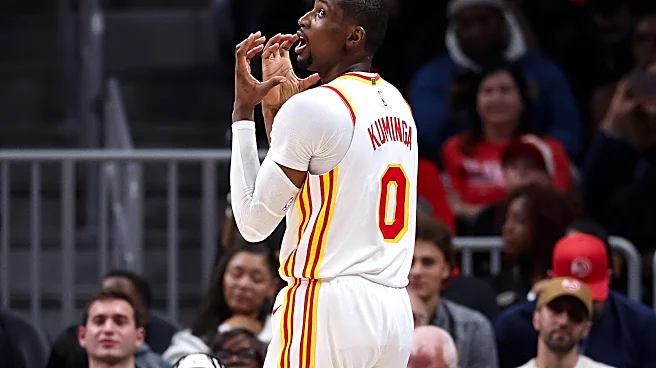



At long last, the Jonathan Kuminga Free Agent Saga 2: Electric Boogaloo is over. As ESPN’s Shams Charania first reported Wednesday, Kuminga agreed to sign a two-year, $12.4 million contract with the Minnesota Timberwolves.
Notably, he bypassed a far larger offer from the Lakers “to have more control of his future and possibly jump back in free agency next summer,” per ESPN’s Anthony Slater. The Lakers reportedly offered him a three-year deal worth $12 million-plus annually via sign-and-trade, according
to Charania.
This is shaping up as one of the bigger bag fumbles in recent NBA history, as the Golden State Warriors reportedly offered Kuminga a three-year, $75.2 million deal with a third-year team option during the 2025 offseason. Instead, Kuminga took a two-year, $46.8 million deal with a second-year team option, which was “designed for the Warriors—or another team if and when Kuminga is traded during the upcoming season—to rip up and complete a fresh new contract after the 2025-26 campaign,” according to Charania. (That’s an impressive level of agent-mouthpiecing even for Shams.)
Perhaps Kuminga has a career year in Minnesota, declines his player option next summer and cashes in as a free agent in 2027. But for now, it’s looking like Kuminga and his agent, Aaron Turner, misread his market for the second straight offseason.
The closed doors
Within the past two weeks, Peyton Watson joined the Cleveland Cavaliers via sign-and-trade, DeMar DeRozan signed a veteran-minimum contract with the Denver Nuggets and Klay Thompson secured a buyout from the Dallas Mavericks and joined the Miami Heat. Meanwhile, Jonathan Kuminga was still looking for his next NBA home.
Kuminga could have chosen to re-sign with the Atlanta Hawks, but that never appeared to be in the cards. Instead, he narrowed his choices down to the Lakers and Wolves, as NBA insider Jake Fischer reported during a Bleacher Report livestream Tuesday.
“Kuminga, I think, has seemed to prefer going to the Lakers. They’ve had the most opportunity to negotiate there. Minnesota is just limited to signing Kuminga to the taxpayer mid-level. He would walk into a starting job, I think, in both situations where Minnesota is thin at the forward spot, the Lakers have been selling him on this vision of having him start next to Luka. They’re going to have the spending power, in theory, to reward him next year if all goes to plan. That’s going to come to some type of conclusion here soon.”
How did Kuminga get to the point of an all-time bag fumble? Let’s walk through how his options dwindled throughout the offseason.
The closed doors
In late July, Michael Scotto of HoopsHype reported that Kuminga had “drawn sign-and-trade interest” from the Lakers, Cavs, Clippers and Bucks. A few of those doors had already closed by the time he chose to sign with the Wolves.
The Cavaliers kept their options open this offseason while waiting to see whether LeBron James would finish his career back home. When he chose to sign with the Philadelphia 76ers instead, Joe Vardon of The Athletic speculated that the Cavaliers could pivot to Kuminga, whom they “maintained contract” with throughout James’ free agency.
“Jonathan likes the Cavs, likes (coach) Kenny Atkinson, and (star) Donovan Mitchell likes him,” Kuminga’s agent, Aaron Turner, told Vardon. Turner added that Kuminga was “fond of Cleveland generally and spent two months training there last summer.”
Instead, they wound up landing Peyton Watson via sign-and-trade and inked him to a four-year, $88 million contract. They then agreed to re-sign James Harden to a three-year, $97 million deal (lol), which put them too close to their first-apron hard cap to offer Kuminga much more than a minimum contract.
The Clippers were also involved in the Watson sign-and-trade, as they took Max Strus from the Cleveland Cavaliers into their $17 million John Collins trade exception. They also spent nearly all of their non-taxpayer mid-level exception on Rui Hachimura, so the most they could have offered Kuminga outside of a sign-and-trade was their $5.5 million bi-annual exception.
The Heat didn’t have much need for Kuminga after landing Giannis Antetokounmpo this offseason, but that especially became a non-option after they landed Thompson. They split most of their non-taxpayer MLE between Thompson and Tim Hardaway Jr., so like the Clippers, they couldn’t have offered him more than the bi-annual exception outside of a sign-and-trade. They’re also hard-capped at the first apron and are only $4.8 million below it, so they couldn’t even offer Kuminga their full bi-annual.
Like the Heat, the Hawks are also hard-capped at the first apron. They have a bit more financial flexibility than Miami — they’re $11.6 million under it for now — but would it have made sense for them to gobble up the rest of that for Kuminga, especially when they already have 17 players on standard contracts? (No, no it would not.)
The remaining options
Kuminga’s remaining options were therefore essentially whittled down to the Lakers and the Wolves. The Bulls theoretically could give him their $9.4 million room exception, but Fischer reported Tuesday that Chicago was not “a viable suitor” for Kuminga.
“To my understanding, the Bulls checked in on both [Kuminga and Mathurin] just with some level of interest in signing a short-term deal in terms of guaranteed money,” Fischer added. However, “Chicago wasn’t really looking at something that would have really gotten Kuminga or Mathurin interested. It would have been more of a buy-low situation.”
The Lakers already spent all of their cap space, and they used their room mid-level exception on Collin Sexton, which means they would have had to acquire Kuminga via sign-and-trade. Earlier this summer, we explored what that might look like, but to recap: They could have offered him a starting salary as high as roughly $20 million if they were able to offload Jarred Vanderbilt as part of that deal.
A handful of teams had either large enough trade exceptions or their non-taxpayer MLE, which they could use to absorb Vanderbilt (along with additional compensation). The Lakers might have had to use one or both of the second-round picks that they acquired from Washington in the Deandre Ayton trade to swing that type of salary dump, though.
It’s unclear why the Lakers weren’t willing to push their offer higher than $12 million. But they’re now licking their wounds after losing him to Minnesota, while Kuminga is hoping that he can somehow avoid an entry into the Bag Fumble Hall of Fame.
Unless otherwise noted, all stats via NBA.com, PBPStats, Cleaning the Glass or Basketball Reference. All salary information via Spotrac and salary-cap information via RealGM.
Follow Bryan on Bluesky.