



The Rays gave up quite a bit to acquire Ben Williamson this offseason. They parted ways with a 4th OF profile in Colton Ledbetter and a Comp B pick. Coming into Spring Training, the expectation for Williamson seemed fairly straightforward: compete for a utility infielder role. That likely meant coming off the bench to spell whoever is starting at shortstop, taking the short side of a second base platoon with Gavin Lux, and occasionally giving Junior Caminero a rest day at third base.
That may still
be the most likely role for Williamson, but he has answered a few key questions about his defense so far this spring that suggest there may be a bit more upside in the profile than initially expected, although we probably shouldn’t read too much into it…..yet. Despite the strong production in a small spring sample, Williamson’s underlying offensive profile still looks largely similar to what he showed last season.
Defense at SS
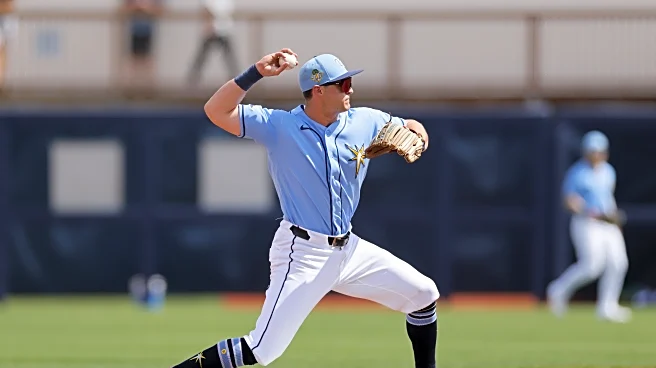
Williamson needed to show that he could handle shortstop at the major league level. He hadn’t played there regularly since college, but that lack of recent experience isn’t immediately obvious when watching him.
His arm strength translates well to the position, and both his range and lateral quickness look strong enough. At this point, he appears capable of providing above-average defense there, with the main area still developing being his work around the second base bag on double plays. That’s a detail that typically improves with repetition.
Williamson still projects as the third-best defensive shortstop on the Rays’ 40-man roster behind Taylor Walls and Carson Williams, but it’s clear he’s capable of filling in there when needed.
Defense at 2B
Second base is likely where Williamson would see the most playing time if he makes the Opening Day roster, and he has looked comfortable at the position so far.
The plays where he ranges to his right – toward the second base bag – are understandably less polished. But the underlying tools are evident. His range and arm strength both grade as clear positives, and with more reps his footwork around the bag should continue to improve.
Given those traits, there’s little reason to think his defense at second base won’t settle in as above average.
Impact potential
One of the more interesting developments this spring has been a small but notable increase in Williamson’s raw power indicators. His 90th percentile exit velocity currently sits at 104.9 mph, up from 103.7 mph across Triple-A and the majors last season.
That jump isn’t massive, but it does hint that Williamson may be tapping into average raw power rather than the below-average raw power he showed previously. It’s an encouraging sign, even if the spring sample is still far too small to draw firm conclusions.
Where things become more complicated is translating that raw power into game impact.
Last season, Williamson had some difficulty lifting and pulling the ball in ways that typically produce damage. He ran a 42.7% line drive plus fly ball rate and pulled the ball less than 30% of the time, both slightly below his minor league norms. His average hard-hit launch angles of 7° in Triple-A and just 2° in the majors suggest he had difficulty converting his raw power into optimal contact.
So far this spring, there are some positive signs. Williamson’s LD+FB rate has climbed to 50%, and he’s pulling the ball closer to 40% of the time. Those are the types of directional changes that could eventually help him unlock more offensive impact if they prove sustainable over a larger sample.
However, one number still stands out: his average hard-hit launch angle is just 3°. That suggests he may still be working toward consistently elevating the baseball when he squares it up. In other words, while the raw power indicators look slightly improved, it’s still uncertain how much of that power will show up in games over a full season.
Ignore the OPS and wRC+ for now; the spring performance is best viewed as progress rather than a definitive change in Williamson’s offensive profile.
Hit tool
What has consistently carried Williamson’s offensive profile is his bat-to-ball ability. He has posted plus contact rates at every level of professional baseball, and that trend has continued this spring.
His swing decisions have been a bit more uneven. Throughout most of his minor league career he showed roughly average swing decisions, but during his time in the majors last season he chased more often than expected and was somewhat passive in the strike zone. That combination of chasing too much while swinging too little at strikes can make it difficult to generate competitive at-bats.
So far this spring, he appears more comfortable controlling the strike zone. He’s chasing less frequently and showing a slightly better balance between patience and aggression, but he’s still relatively passive in-zone – which may continue to limit how much of that power shows up in games.
Overall outlook
When you put the pieces together, Williamson’s profile starts to make sense.
He brings defensive versatility, plus contact ability, and potentially average raw power. That combination can be quite valuable on a good roster, even if the offensive ceiling remains somewhat limited with his batted ball profile.
Even with the encouraging spring performance, Williamson’s overall profile still points toward a valuable utility role. If the changes to his batted-ball profile hold over a larger sample, there may be room for a bit more offensive impact than originally expected.
For now, though, the safest takeaway from Williamson’s spring is that he looks increasingly capable of filling an important supporting role on a contending team.