
In Major League Baseball, the one thing that every small market smart team has in common is a disproportionately large investment in analytics and player development. This class of teams generally includes
the Tampa Bay Rays (who employ about four times as many of what the industry refers to as “nerds” as any other team), the Cleveland Guardians, and of course, the Milwaukee Brewers and their now-famous pitching lab .
While these teams are often hesitant to spend big money free agents, medium-level free agents, or in the case of the Rays, cheap young talent that isn’t quite cheap enough, they will pony up for computers, coaches, and staff. And why is that exactly?
As with all businesses, this comes down to return on investment. If you buy a player (especially a good one), it will cost you tens of millions of dollars and improve one of the nine positions on the field, provided that player stays healthy and doesn’t hit his age-related decline. If you instead spend that same amount on a pitching lab like the Brewers, it turns every pitcher from an X-million-dollar pitcher into something like a 2X-million-dollar pitcher. The pitching lab creates value in EVERY pitcher who comes through it, and it allows the team to develop overlooked cheap talent that isn’t as highly valued by the rest of the league. It probably pays for itself ten times over. Many teams, including the Brewers, are doing similar work with hitting development, and while we don’t know every secret, we do know that Milwaukee’s focus on swing decisions turned former bust Andrew Vaughn into a fairly good first baseman, at least for half a season.
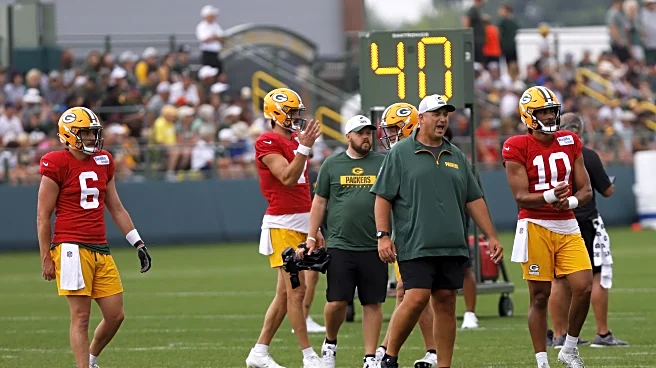
Although football is not baseball, coaching and development matter every bit as much in the NFL as they do in MLB, which makes the Packers’ apparent decision to save money on the coaching staff a poor one. Just as the Brewers realize gains on every pitcher due to investment in their lab and coaching staff, the Packers lose value on every player when they fail on basic execution during a game. In fact, they likely lose quite a bit more than a baseball team would due to leverage.
Leverage, in the context of sports is just a fancy word for importance. Any given baseball play is worth a single ball, strike, or out, in a single inning in a nine-inning game in a 162-game season. Any given football play can destroy a promising drive that (if you’re the Packers) is one of 7 to 11 offensive drives per game, in a short 17-game season. Botched execution on a single play in a football game is orders of magnitude more impactful, and so investments in preventing illegal formations, or having only ten men on the field for an extra point, or not maintaining lane integrity, or botching clock management, or wasting timeouts before the fourth quarter, matter a ton.
There is, of course, another huge reason to invest in your coaching and analytics staff: These investments are not constrained by the salary cap, and so they can provide a true competitive advantage, which may be part of the problem. For Jerry Jones, throwing money at coaching is a rounding error, but for the Packers, it’s not, and while the Packers have the ability to pay more than what they currently appear to pay, that cash has to come from revenue, not from a billionaire’s pocket.
I don’t know where the Packers will end up at defensive coordinator or with some of their position coaches, but my preferred target, Christian Parker, is already off the market with the Cowboys. I think Justis Mosqueda is fundamentally correct in the post he wrote on the Packers’ coaching staff and the front office’s philosophy on paying coaches. The Packers have been losing on the details for years now across all three phases of the game, and while you cannot possibly excel in everything, they could certainly stand to bolster this aspect of their organization.