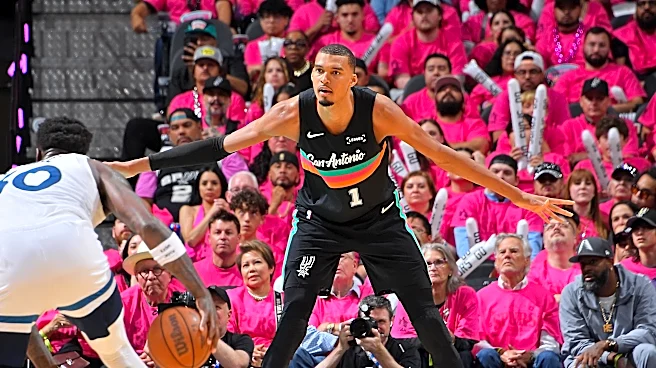








Now officially the Defensive Player of the Year, it is well known that Victor Wembanyama dominates the paint. His mere presence alone deters shots at the rim because of his length, poise, and instincts around the hoop.
But how does he manage to stay in the paint all game? The NBA, unlike FIBA, has a defensive three-second rule. It states: “Any defensive player, who is positioned in the 16-foot lane or the area extending 4 feet past the lane endline (this is the area from the backboard to the baseline)
must be actively guarding an opponent within three seconds.”
On its face, the rule is simple: a player can’t be in the paint and not guarding anyone for more than three seconds. But if you dive into the particulars, you quickly find that there ways to operate within the paint, within the rules.
Let’s look at some examples.
First off, what does “actively guarding” actually mean? Well, the league defines that for us as “being within arm’s length of an offensive player and in a guarding position.” That’s good news if your arms are a combined eight feet from fingertip to fingertip, like Wembanyama’s are.
Like in the clip here, Victor is in the painted area, sees Minnesota’s offense developing, but is fully aware of how long he has been there. Quickly, he moves over to within arm’s reach of Rudy Gobert, in a guarding position, and puts his arm out almost to tag him. With the count reset, he then moves back into the restricted area to contest the shot from Jaden McDaniels.
Naturally, the count also resets once the player fully clears the paint. Here, as the ball swings around the perimeter, you can see Wembanyama quickly place both feet outside the paint, clearing the count and getting back to the play.
But what about this? It looks like he’s just camped out and doesn’t clear both feet outside the paint. Again, he is marking Gobert, but he is nowhere near arm’s length from him.
This is where the exceptions come in. The rules clearly state that if the player the defender is guarding has the ball, the count is suspended. So in the above, while Gobert has the ball and is setting up for a dribble-hand-off to Anthony Edwards. Webmanayma is free to hang out in the paint, so long as Gobert has the ball.
The count is also suspended in several other, more obvious scenarios, such as a player being in the act of shooting or a team losing possession. But most interestingly, the final exception states when “it is imminent the defender will become legal.”
What does that mean? This can be interpreted in a number of ways if you want to get into the nitty-gritty details. The best example would be if a player is on their way to clear the paint, and, technically, they were in there for 3.01 seconds before getting both feet out. For that 0.01 seconds, it was imminent that they were becoming legal. Situations like that keep the calls from being too pedantic. It isn’t much, but it’s a little wiggle room that great players can use to their advantage if need be.
Subtly, this is how Wembanayama is able to seemingly stay in the paint all game. If you aren’t aware of it, or aren’t looking for it, you may not realize just how good he is at maintaining a legal position.