




Two years ago, the Sixers waltzed into the offseason with roughly $60 million of salary-cap space. Those days are long gone.
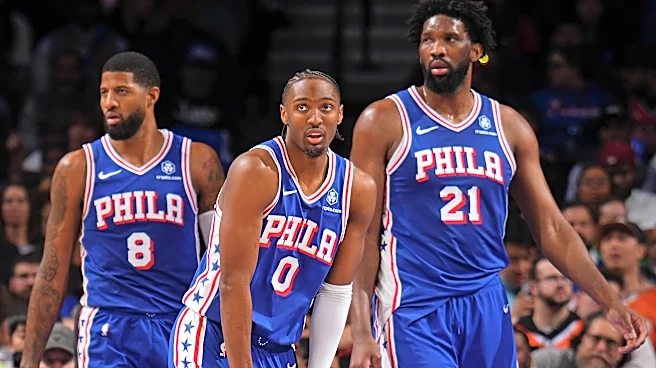
With Joel Embiid, Paul George and Tyrese Maxey all on max contracts, the Sixers already project to be over the 2026-27 salary cap even with only six players under guaranteed contracts. Once they fill out the rest of their roster, the luxury-tax line and the aprons will be their bigger concern.
The good news is that the Sixers do still have a fair bit of flexibility (for now)
under the tax line and aprons. The bad news is that it won’t take much to wipe that out, particularly with Kelly Oubre Jr. and Quentin Grimes both set to become unrestricted free agents.
With that in mind, here’s our primer on where the Sixers stand financially heading into the draft and free agency.
The Sixers’ current cap sheet
The three-year max extension that Embiid signed in September 2024 is set to begin this season. Until we know the exact salary-cap figure, we won’t know exactly how much he’ll earn on that contract.
Typically, a max extension for Embiid would begin at 35 percent of the 2026-27 salary cap, which is currently projected to be $165 million. That would put Embiid’s starting salary at $57.75 million, with 8 percent annual raises from there.
However, the maximum salary in the first season of a new contract is never less than 105 percent of the player’s previous salary. Since Embiid earned $55,224,526 this past season, his max salary would be no lower than $57,985,752, which is the figure we’ll use for now.
Beyond that, there isn’t much uncertainty about the Sixers’ financial picture heading into the offseason. They have team options on Dominick Barlow ($3.4 million), Trendon Watford ($2.8 million) and Dalen Terry ($2.6 million). Only $250,000 of Jabari Walker’s $2.6 million contract is guaranteed, and Adem Bona’s $2.3 million contract is fully non-guaranteed, although it’d be surprising if they waive him. A veteran-minimum contract for anyone with two or more years of NBA experience is projected to be $2.45 million, so the Sixers would save roughly $150,000 by keeping Bona around.
With that said, here’s their full cap sheet heading into the offseason, including the nearly $3.6 million cap hold for the No. 22 pick. We used their total guaranteed salary rather than their total salary while calculating their proximity to the tax line and aprons so you can see the maximum amount of flexibility that they could have this summer.
Having more than $28 million of wiggle room below the tax line might sound nice on the surface, but that’s with only seven players under contract (including the No. 22 overall pick). Even if the Sixers filled out the rest of the roster with players on minimum deals, that would add $19.6 million of salary to their books, putting them less than $10 million below the tax.
How do Oubre and Grimes fit in?
The Sixers have full Bird rights on both Oubre and Grimes, which means they can re-sign either one to anything up to a max deal even though they’re already over the cap. Their proximity to the tax line and aprons might determine which one (if either) they’re willing to bring back.
If the Sixers sign either Grimes or Oubre to a contract starting higher than $11.1 million, they’d be guaranteed to go over the tax line once they filled out all 15 roster spots. If they re-sign both of them, they could have a tough time staying under the first apron.
There are no team-building restrictions for crossing over the tax line. You shouldn’t care about the Sixers paying the tax unless you’re a member of the Harris or Blitzer family.
The aprons are the bigger concern.
Which MLE will they have?
As long as the Sixers are under the first apron, they’ll have access to the $15.0 million non-taxpayer mid-level exception and the $5.5 million bi-annual exception. Using either one of them would hard-cap the Sixers at the first apron, which is currently projected to be roughly $209 million.
If the Sixers cross the first apron, they’ll lose access to the non-taxpayer MLE and will instead have only the $6.1 million taxpayer MLE. If they cross the second apron, they won’t have a mid-level exception at all. They’d only be able to hand out minimum contracts to non-incumbent free agents.
The Sixers could enter the offseason with $36-plus million of breathing room below the first apron, but that’s before factoring in them potentially keeping Barlow (likely), Watford (maybe?), Terry (ehh…), Walker (duh) and Bona (double duh). That also doesn’t account for new contracts for Oubre and/or Grimes.
If the Sixers use the non-taxpayer MLE, it’ll likely signal that they’re moving on from both Oubre and Grimes. If they bring back both, there’s almost no way that they can use the non-taxpayer MLE and stay under their first-apron hard cap without moving one of Embiid, Maxey or George.
So, the short answer is that we don’t know which mid-level exception the Sixers will have this offseason or which one they’d even plan to use. They wound up using most of the taxpayer MLE last season, although they didn’t spend any of it during the offseason. They saved it to use in-season, which they mostly did on Barlow.
Under former team president Daryl Morey, the Sixers seemingly tried to avoid hard-capping themselves at the first apron over the past few years. It’s unclear whether they’ll immediately alter that approach under new team president Mike Gansey, although he’s coming from a Cleveland Cavaliers team that boasted the league’s most expensive payroll this past season. He has plenty of experience running pricey teams.
If both Oubre and Grimes sign elsewhere, the Sixers might not have a choice but to spend the non-taxpayer MLE in an effort to replace them. They’ll have to ask themselves which path gets them closer to a championship in both the short and long term and go with that.
Unless otherwise noted, all stats via NBA.com, PBPStats, Cleaning the Glass or Basketball Reference. All salary information via Spotrac and salary-cap information via RealGM.
Follow Bryan on Bluesky.