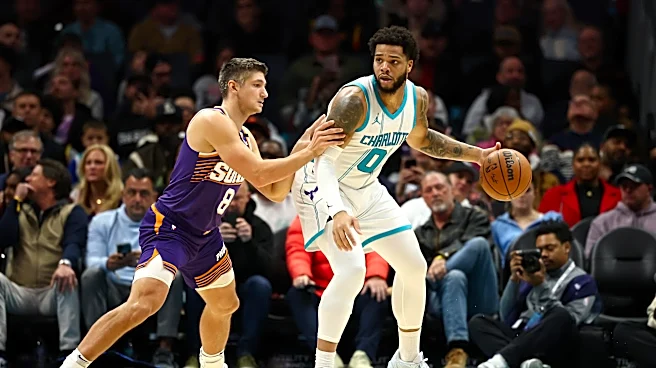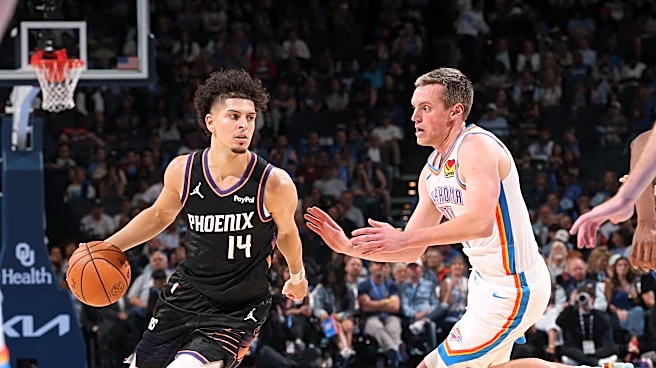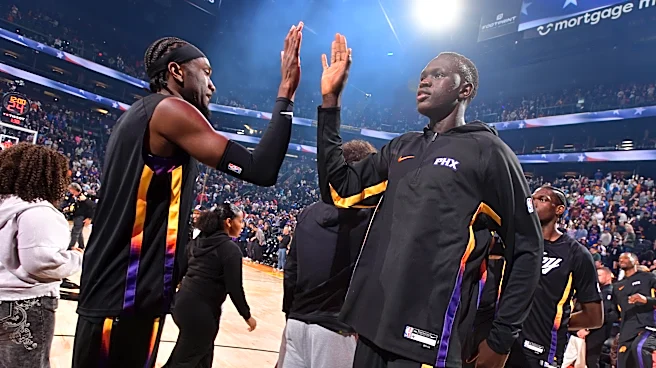






Yesterday was signing day for the Phoenix Suns as they officially welcomed back the key restricted and unrestricted free agents they retained this offseason. Ink was put to paper, and the organization completed an impressive offseason by bringing back Collin Gillespie, Jordan Goodwin, and Mark Williams for a combined $28.3 million in salary next season.
I tip my cap to the organization for executing its plan. The Suns retained players
who fit what they are building, reinforced continuity within the locker room, and did so on responsible contracts.
One of the most important signings was Mark Williams, who officially inked a three-year, $38 million fully guaranteed deal to remain in Phoenix. It’s an astute move for a couple of reasons. In the short term, it gives the Suns a starting-caliber center. In the long term, it provides the runway to continue developing Khaman Maluach, the 10th overall pick in the 2025 NBA Draft, on the organization’s preferred timeline.
It’s an interesting season that Khaman Maluach is entering. He’s still only 19 years old (20 when the season begins) and remains a very raw prospect, but he also carries the designation of being a lottery pick. That means something in Phoenix because, with the Suns having traded away so much of their own draft capital, the odds of landing another lottery pick this decade are slim. Yes, the Suns still have first-round picks in future drafts. But those selections are heavily protected or tied up in swap scenarios, leaving Phoenix with little control over where they ultimately land. More than likely, they’ll fall outside the lottery.
Because of that, Maluach, fairly or unfairly, carries a unique set of expectations. He’s viewed as someone who can eventually become the Suns’ starting center. The good news is that, by signing Mark Williams to a three-year contract, the organization has removed any immediate pressure for Maluach to take over that role. There is no expectation that he grabs the reins at this point in his career.
The expectation entering his second season is progression. Raw prospects take time to develop. They need time to grow, time to learn, and time to make mistakes. Development isn’t linear, and that’s part of the equation. At the end of the day, the goal for the 2026-27 season is simple. Show progress.
And that raises a valuable question. How do you create a development pathway for a player who appears buried on the depth chart? After all, Maluach currently sits behind both Mark Williams and Oso Ighodaro. So how is he expected to grow if most of his development takes place in the practice facility? The answer is fairly simple.
The Suns just signed Mark Williams to a three-year contract, and history tells us his minutes should be managed to maximize his availability. Health has consistently been the biggest question surrounding the center entering his fifth NBA season.
At the end of the day, Mark Williams is a solid, mid-tier starting center. And that’s perfectly fine, because that’s what Phoenix is paying him to be. Thankfully, the Suns aren’t paying him like Jakob Poeltl. Toronto extended Poeltl on a three-year, $84.1 million deal. When you put those contracts side by side, it’s clear Phoenix is operating from a much more reasonable financial position.

Part of the beauty of acquiring Mark Williams is understanding that, unfortunately, he will likely spend portions of the season recovering. We saw it last year when he routinely sat out the second night of back-to-backs. We’ll probably see something similar this season, whether it’s planned rest from the coaching staff or time missed due to injury.
That naturally opens the developmental door for Khaman Maluach to receive meaningful NBA minutes. Those opportunities are where growth happens, and that’s where the three-year timeline with Williams becomes so valuable. It gives the organization flexibility.
If Maluach doesn’t show the level of progression the Suns are hoping for this season, they can continue adjusting his development the following year. That doesn’t mean giving up on the prospect. It means continuing to put him in the best position possible to succeed. Having Williams on the roster is the definition of that. He gives Maluach something every young big man needs. Time.
I’ve seen some people suggest that, if Maluach is the center of the future, the Suns should simply start him now. And therefore, question why the team brings back Mark Williams?
Young centers need time to grow, and organizations need to allow that growth to happen without forcing them into situations that could ultimately hurt their confidence. That’s why having Mark Williams as the developmental buffer for Maluach is such an astute move by the organization. He provides starting caliber center minutes when he’s on the floor. And because of his injury history and expected workload management, he’ll naturally create opportunities for Maluach to develop when he’s off it.
It’s a balancing act, and the Suns appear to have found the right one. They’ve built a roster that can compete today without sacrificing tomorrow, giving Maluach the chance to earn his role instead of forcing him into it. That’s a far healthier development model than asking a 20-year-old lottery pick to solve problems before he’s ready. Sometimes the smartest move isn’t accelerating the timeline. It’s giving it room to unfold.