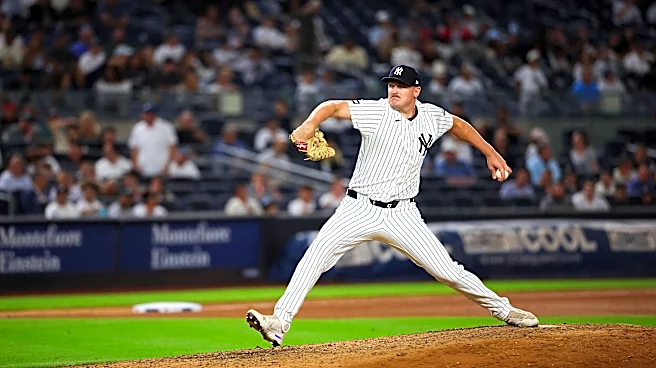

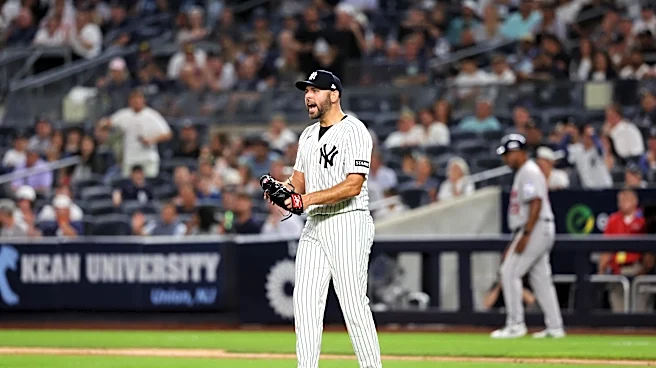
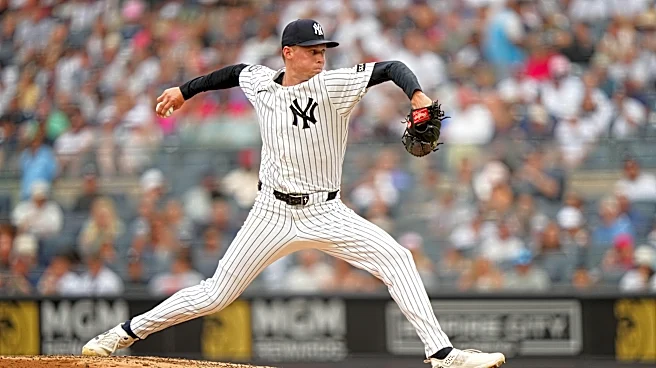
Though the Yankees have endured their fair share of misfortune this year – injuries to several key players come to mind – they’ve also enjoyed some positive surprises. Spencer Jones might be a viable big leaguer! Paul Goldschmidt wasn’t completely toast! Paul Blackburn’s running a sub-2.00 ERA! However, there’s one important development that I feel has flown under the radar at least a little bit, and that is Brent Headrick’s emergence as an elite reliever.
Those of you following this team closely
should need no reminder of how good Headrick has been, but his performance to date stands out even when compared to the rest of the league. Here’s how Brent’s key stats rank among all qualified MLB relievers.
fWAR: 5th (2.2, tied with Trevor Megill)
IP: 8th (73.1)
ERA: 11th (1.96)
ERA-: 11th (47)
FIP: 9th (2.31)
FIP-: 8th (54, tied with Mason Montgomery)
K-BB%: 16th (22.0%)
No matter how you slice it, Headrick’s 2026 performance to date has been nothing short of elite. However, I want to call attention to one stat in particular: his innings count. With about three weeks still remaining in the season, Headrick has already thrown 73.1 innings, the most he’s ever thrown in the majors by far. In fact, even when accounting for his minor league stats, his 2026 workload still stands out.
Headrick did throw 108.1 innings across High-A and Double-A in 2022, followed by 100.2 innings across Triple-A and the majors in 2023. However, that was when he was primarily a swingman, with 35 out of his 58 appearances during that time being starts. Having since moved to a full-time relief role, Headrick accumulated just 69.1 innings ]over 2024 and 2025 across the minors and the majors. In other words, 2026 Headrick has already thrown more innings than his previous two years combined. If I were him, I’d be asking for a hefty raise in the offseason if I wasn’t pre-arb.
With any pitcher — and perhaps doubly so for relievers, who are as a group inherently fickle — a marked increase in workload comes with two red flags: heightened injury risk, and potential decline in performance. I can’t speak on the former, as I’m not a medical professional. However, I can provide some assurance regarding the latter, as despite being worked harder than ever before, Headrick isn’t showing many signs of slowing down.
Yes, it’s true that Headrick’s ERA has risen a bit recently. From the start of the season through July, he posted a 1.30 ERA in 55.1 innings. Since then? A 4.00 mark across 18 innings. However, a look at Headrick’s underlying numbers suggests that this has more to do with bad luck than his workload catching up to him.
If Headrick was truly gassed, we’d expect that to show in several areas of his FanGraphs page. For example, if his stuff was diminished, we’d expect his strikeout rate to decrease and his walk rate to increase. But looking at his splits pre- and post-August, the opposite has happened. Headrick’s actually fanning batters at a higher rate since August 1st (32.2%) than before (29.4%), while his walk rate since (7.4%) is also slightly lower than before (7.8%), even including last night’s two-walk outing. If there has been a decline in Headrick’s stuff, it sure isn’t showing up here.
Of course, it might be that Headrick is allowing harder contact as he runs on fumes. However, the data doesn’t really support this hypothesis either. His hard contact rate was 26.4 percent from March-July, and from the start of August onward that has risen all the way to … 26.5 percent. His batted-ball mix is basically the same, too—he’s generated grounders and fly balls at roughly the same rates. The only difference is that recently more of his fly balls allowed have been leaving the park. His HR/FB rate was a miniscule 3.4 percent prior to August, but since then that’s jumped up to 10.5 percent. However, HR/FB has proven to be a fickle statistic, and very few pitchers have shown the ability to consistently suppress it. Given the fact that a 10.5 percent HR/FB is still below league average, I’m comfortable saying that this shouldn’t be cause for alarm.
The most likely culprit for Headrick’s heightened ERA seems to be worse luck on batted balls. Here’s his 15-game rolling BABIP, through the beginning of play yesterday:

If we superimpose his 15-game rolling ERA- trends on this graph, we can see how closely the two trends coincide:

And if we compare that to his FIP- trends, we can see how Headrick’s core skills have remained consistent despite fluctuations in his surface stats:

So, in my humble opinion, the fact that Headrick’s ERA has risen a bit of late shouldn’t scare you.
At Headrick’s core, he’s still the shutdown reliever he was earlier in the year; he’s just run into a patch of bad luck. Of course, this doesn’t preclude the possibility to Headrick’s workload catching up to him eventually, and we’d be remiss if we didn’t note that his average fastball velocity in September (93.2 mph) is lower than any previous month (below May’s 93.9 mph). It’s not an enormous dip and it’s possible that the adrenaline of the postseason could boost it back up in certain outings.
Nonetheless, Aaron Boone and Matt Blake should of course be monitoring his health closely; going into the playoffs without a fully functioning Headrick would be less than ideal, to say the least. As of now however, Headrick seems to be just fine, and that’s good news for the Yankees as they enter the most crucial part of the season.