



It still seems too early to engage in small sample size theater on the Cardinals season. If I’m going to do SSS, this is my choice of topic.
It seems like pre-Arbitration extensions are all the rage this year. Some people look at these deals as a little on the reckless side. They ask, “How can team sign a guy to a $100m guaranteed contract when he hasn’t even taken a single MLB at bat?”. Good question.
Yet, teams are doing these deals. Smart people are convincing rich owners that these investments
are good bets. Not just one or two rogue groups, either. What makes them think PreArb extensions are such a smart thing to do? As is my want, I dive into the numbers and see if I can discern what they’ve figured out.
Some notes about contracts
Contracts that guarantee money beyond one year pretty much come in three forms:
- True free agent contracts (think Soto, Ohtani, Harper, et. al.)
- Contract extensions during the arbitration years (think Garret Crochet, et. al.)
- Contract extensions during the pre-arb years (Griffin, McGonigle and company).
Each of these classes has their own pattern of contract. I am only looking at contract extensions for players that either haven’t been through the Arbitration process or haven’t signed a contract that avoids an Arbitration hearing. I got my data from Cots Contracts and double-checked with Sportrac. I limited my research to post-COVID, recognizing the evolving dynamics of baseball’s economy.
The economics of baseball – the value of WAR on the open market
One commonly discussed reference point is the notion that a WAR has a value of around $8m on the open market. It pops up frequently, although it is hard to find any concrete examples of 1 WAR players getting $8m contracts, so I’m a bit skeptical. A more up-to-date outline is found in a recent Fangraphs article by Ben Clemons. Highly summarizing a thorough article, he breaks this up into tiers:
Let’s compare and contrast two recent FA contracts using this rule of thumb. First, we have Shohei Ohtani’s mega-deal. $700m contract. 10 years. $70m AAV. If I apply the MLB approved discount factor of 4.43% to get the net present value of that $700m, and then peanut butter that NPV figure over the expected WAR the Dodgers could expect from Ohtani (with relevant decline factors appropriate for high WAR players), you end up a cool $10m per WAR (rounded). Interesting. Right between Tier 2 and Tier 3. I do not think of Ohtani as a player who fits between Tiers 2 and 3.
Second, we have Alex Bregman’s contract. $175m contract. 5 years. $35m AAV. Do all the same math with the same methods to get projected WAR and the NPV of the contract value and you end up with a annual per WAR cost of $14.2m rounded.
So, how does Ohtani getting $10m per WAR compare to Bregman getting $14.2m per WAR? Seems backwards in a way, given the players. And neither figure compares all that great with the Tier 3 amount of $12.8m per WAR.
An alternative way to compare contracts
A reference point I propose is that the open market cost of WAR is better expressed by the combination of contract length and the value of the contract in net present value terms (often very different than the headlines).
Try this, using the Bregman/Ohtani example:
- Ohtani 10yrs/$388m (NPV)
- Bregman 5yrs/$160m (NPV)
That seems more like it. This view will help us understand all these extension a fair bit better than looking at $ per WAR. At least, that is what I’m proposing.
Some more about baseball economics – net present value
One thing about that seemingly outrageous $700m Ohtani contract. It’s not really $700m in today’s terms. A lot of his money will be paid in the 2040’s. When you factor in the equivalent value of those dollars in today’s terms, his total contract value (in NPV) is more like $388m. That’s a bit different than $700m. Using NPV allows us to compare contracts, smoothing out the impact of deferrals, bonuses and different contract start and end dates.
Some complexity arises when trying to compare these FA contracts with PreArb Extensions
A key consideration in this analysis is that the pre-arb contracts players and teams are entering into aren’t really open market free agent contracts. There is no bidding, which ostensibly suppresses the contract values. I end up using the FA contracts as the end-points which help identify why teams do these pre-arb extensions.
Another challenge is that projectable WAR for a player who hasn’t taken a PA in the major leagues has a great deal more variability. Injury risk aside, Ohtani’s general WAR projection is remarkably stable looking when compared with, say, Colt Emerson. Ergo, per WAR $$ estimations are highly variable.
Are the number of Pre-Arb extensions unusual this year?
I’ve seen some folks speculate teams are doing these deals as some form of hedge against the upcoming CBA drama. Since 2021, I show teams have entered into 42 pre-arb extensions. Approximately 7 per year. How many have occurred this year? Seven, including the reported McGonigle deal. Not exactly a stampede, huh?
What do Pre-Arb deals look like?
As one looks across the spectrum of pre-Arb deals that have been done, they carry some pretty strikingly similar characteristics. Almost like there is a playbook on this.
- The most common age for signing is age 24.
- Position players get more of these than pitchers do by a 2:1 ratio.
- The pitchers that get these extensions tend to be at the higher end of the age range, and tend to get the lower end of the length of contract (and dollars).
- The usual baseball premiums apply. Uber-talented shortstops and heavy hitting outfielders make the coin. Relievers are the street sweepers.
- Most pre-arb extensions carry through 1 or 2 years of the players’ Free Agency eligibility (except pitchers).
- Most extensions come with 1 or 2 club options, with very minimal buyouts.
- Extensions with player options are reserved for the cream of the crop (JRod, Witt).
- Bonuses and deferrals are comparatively minor consideration is these contracts.

Interpreting the Chart
This chart displays both FA contracts and Pre-Arb Extensions. Each contract is a point on the chart. All values are NPV, so effectively in 2025 dollar terms. I omitted low dollar, low length FA contracts (think: Ramon Urias of the Cardinals). The comparison I’m after is top FA to top prospects getting PreArb extensions.
The red points are the FA contracts. Size of the dots represents the total NPV value of the contract. Ohtani and Soto get the biggest dots. They have the biggest contracts.
The blue points are PreArb extensions signed after 2020. Witt’s deal stands out. Good one?
The x-axis displays the guaranteed length of the contract (omits options) and the y-axis plots the AAV of said contract in NPV terms.
What is with that arc drawn in the middle?
This arc illustrates the natural break between outlier players and everyone else. FA contracts for Tucker, Soto, Guerrero Jr, and Ohtani. PreArb extensions for Witt, JRod, Tatis and Franco. Those are the outliers, both in terms of player and in terms of contracts.
Three common factors to consider with the outlier contracts:
- The contracts are for generational talents and are somewhat unique.
- The AAV of the PreArb Extension for similar outlier prospects is significantly lower than the FA deals.
- The length of contracts, however, are comparable.
In the end, what we see with this small sample is: PreArb extension allow the home team the opportunity to lock in years of a generational talent, without taking the financial hit or risk that comes with the FA contract. While the risk the player doesn’t meet those projected heights is present, the dollar risk is comparatively low. As you probably know without looking at FanGraphs, the teams that entered these 4 PreArb Extensions pretty much got it right, talent-wise.
What about inside the arc?
These contracts are for stars (or projected stars), but not generational talents. Hopefully, I don’t have to explain the difference.
When I look at the contracts in this group as a whole, without seeing names, I notice some similarities:
- The contracts inside the arc are not so unique. Almost cookie cutter.
- The AAV of the PreArb Extension is significantly lower than the deals for similar star free agents.
- The length of FA and PreArb contracts are comparable, with FA skewing a little shorter. This makes sense given FA contracts are paying for decline years.
What do these contracts accomplish?
For the team, the contracts introduce a notable cost reduction and additional years of control over an emerging star player.
The way I think of it is … for most situations, a team expects to have player control for 6 years. Three years at right around major league minimum at $780,000/yr. Three years will be arbitration awards based, either through hearings or negotiations. Then they lose the player to free agency. If they want to retain some value from the player, they end up trading him prior to the Free Agency, shortening the time they extract value, and the time they lose is often the most productive portion of that player’s career (ie. the prime years). Think of the Nats trading Soto at ~4.5 years of service time.
For a player with a pre-Arb extension, the team accelerates earnings for the player. First year payments (including bonus money) average around $3.5m, a fair bit more than MLB minimum. The contracts mirror the significant bumps for the years the player would be in Arbitration but remove the obstacle of going through the Arbitration process, which can be … divisive, and removes the whole “platform year” variable for both player and team. For the “bought out” FA years, the contract sees another bump, but typically not as astronomical as what Free Agents see between their last year of Arb and first year of Free Agency.
How do these contracts compare to normal Free Agent contracts?
If you think of the extreme examples (Soto, Ohtani), there is the simple reality that most teams can’t swim in this end of the pool. They don’t have either the capital or the stomach for the risk associated with that kind of contract. Even with less extreme examples (Tucker, Bregman, Bichette) teams are going to experience very high AAV or longer than desired length. Either way, the total out-go is too much for many teams to stomach, particularly as they look at the out-years and realize they will be paying premium dollars for a player well past his prime. How do we think Machado’s contract will look at age 39?
What makes these Pre-Arb contracts smart?
These represent the best alterative to keeping the best players without swimming in the deepest end of the risk pool called Free Agency.
For both FA and PreARb, pitchers and position players have different WAR ranges and get paid differently for that WAR. Of recent FA contracts, the highest position player contract runs just over $14m per expected WAR. That is for a 4-5 WAR player. Teams can buy down that high WAR figure by extending the contract. For example, Ohtani’s NPV $$ per WAR is slightly under $10m/WAR. But the Dodgers had to commit $700m to get to that figure. They did it with years.
The key is the AAV and length. $140m for 9 years (Griffin) is a fair bit different than $700m for 10 years (Ohtani), especially for those teams where $700m is unreachable. What the Pre-Arb deal does is give that small- or mid-market team access to a player they think might be that same top 10th or 20th percentile class as an Ohtani or Soto or Bregman or Tucker. Plus the term of the contract is generally aligned with the players ascension years, whereas a FA contract is generally aligned with a players decline years.
The risk, of course, is higher that Griffin will fail to perform as envisioned that it is Ohtani. We know what Ohtani is, even with projected decline.
A Pre-Arb extension to a guy like Konnor Griffin makes sense if a team thinks they can get at least 1-2 WAR out of him for the 9 years. 2 WAR * 9 years = 18 WAR * $8.5m per WAR = $153m. Thus, Griffins’ expected floor (and the guaranteed portion of his contract) would be right in line with open market costs per WAR for a 1-2 WAR player. The Pirates are paying for the equivalent of a 1-2 WAR player over the next 9 years, and they have a chance of getting much, much more. We call it “upside”. The money guys call it “surplus value”. Surplus value is what allows a team to assemble a competitive roster without a $300m payroll. That’s what makes it smart.
For the pump to be primed, a couple of factors must be in play.
First, a team has to have a player that can be realistically expected to produce star-level performance during their prime years. The contract needs to carry through most of the players peak years, as well, so that maximum value can be extracted from the player.
Second, the total outlay of the extension needs to accommodate the potential that the player may not meet that expectation. As with Griffin, the Pirates would certainly prefer the 4-5 WAR player they envision, but the contract would not be burdensome if he turned out to be 1.5 to 2.5 WAR.
Third, it is optimal if a team can get a year or two of team options to extend the contract if things are going well. This ensures the team can retain the player at an agreed upon amount without dealing with the wild-west aspect of the free agent bazaar to keep the player. And yet again avoids the decline years.
When is it not smart to do this?
Pitchers. They break. See Stridor, Spencer.
Older players. If a team can’t strike at the optimal time around age-24 (or earlier), then they probably are better off just working through the traditional process and letting that player go after 6 years, in which case many are already on the wrong side of 30 years old.
Low ceiling players. The teams’ ability to evaluate talent is crucial. They need to discern who really can reach star heights. There are no guarantees, but it can be easy to mistake a good and useful player for a possible star.
High risk players. Make-up, and the ability to evaluate it, may be just as crucial. A player may have star tools, but if they have high risk features, it may be smarter to roll the dice on the side of the traditional 6-year process. That may be the lesson of Wander Franco.
Who plays on this field?
Interestingly, most teams participate. In 6 years, 20 of the 30 MLB teams have done at least one pre-Arb Extension. Cleveland is the most prolific at 5 such deals.
The ten team that have not done a PreArb recently? They fit into 2 neat categories. Mega-market teams that don’t sweat risk and exposure, so they swim in the deep end of the FA pool: Dodgers, Yankees, Astros, Giants, Rangers, Mets. The rest are teams not known for their solid management chops or advanced thinking: Rockies, Angels, Marlins. The tenth team that doesn’t play? Our Cardinals. I suspect being in this list is more a reflection of the Cardinal talent pipeline the last 5-6 years than their management acumen.
Would they? Should they?
Masyn Winn and Ivan Herrera will not sign PreArb extensions. They are already under contract for 2026 and for both, this is their 3rd and final pre-arb year. If they sign an extension, it will be one to avoid Arbitration. Those contracts have a whole look and feel different than what I’ve enumerated above.
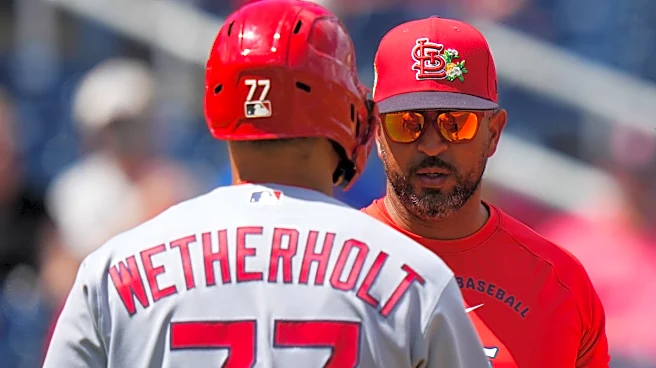
JJ Wetherholt, on the other hand, fits right into to the PreArb model. 23 years old. Projected star. Less than 1 year of service time. The cookie cutter approach to these contracts makes such an extension easy to imagine.
If you view JJW as a middle infielder, a star but not a generational talent, the Cardinals might be inclined to find Tovar and Wilson as SS comps and Rafaela and Keith as 2B comps and think in the range of 7-8 years, $50m-$70m in whatever combination that brings the AAV (non-discounted) at around $10 per year. His representation, of course, will seek to cast him in the same company as Griffin and McGonigle, closer to $15m/AAV (non-discounted). Therein lies the gap that Wetherholt’s representation and Cardinals management will have to bridge. Because of Wetherholt’s age, he is not likely to get the 9th year. As a second baseman, he’s not likely to get the $15m AAV that Griffin got, but maybe in the range of the $10m AAV that Wilson got. Or would the Cardinals be OK with paying Wetherholt as an elite Shortstop? Hard to say. That would be an interesting phenomenon to pay Wetherholt the way Winn would like to be paid for the position Winn plays. I’d guess the compromise would be in the range of 8 years, $100m. If that rings a bell, that would be a comp to Colt Emerson/Seattle.
If you want to consider the downside risk of such a deal, take a look at David Fletcher’s career. Would such an extension be an albatross if that happened? Is the risk/benefit trade-off worth it?