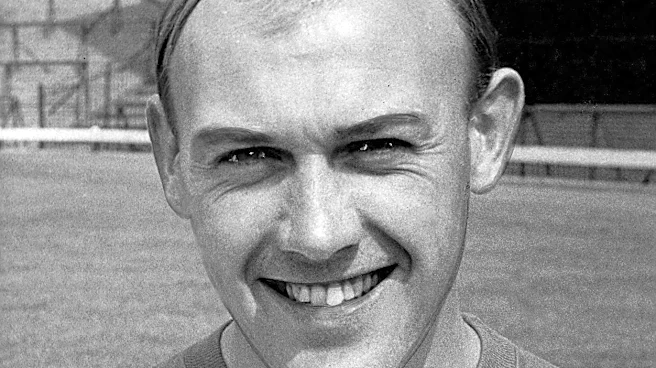




Cecil Irwin was a schoolboy prodigy, first playing representative football with East Northumberland Under – 11s Schools. He trod a familiar path for lads that had any football talent in that part of the region, representing ‘East North’ upon attending senior school. Approaching the end of his school days, he was on the radar of a number of professional clubs and went for a month’s trial at Burnley.
Alan Brown (the future Sunderland manager) had set up a second – to – none scouting system at Burnley
with the assistance of the legendary Charlie Ferguson. Burnley were to benefit from many fine players from the North East and it looked like Cecil Irwin was headed that way too.
However in 1957 Alan Brown was offered and accepted the Sunderland job in the wake of the Bank of England/Mr Smith scandal. One of Brown’s first decisions was to bring Charlie Ferguson with him to Roker Park and set about building a scouting network every bit as good as the one at Turf Moor.
In 1958 Cecil Irwin signed amateur forms with Sunderland. In April 1959 he signed professional forms, but not before he had made his debut at right-back on 20 September 1958 against Ipswich at Roker Park in front of almost 27,000 fans. An injury to long-standing cultured full-back Jack Hedley afforded him his opportunity and Cec’ as he was affectionately known played well in the two goals to nil defeat.
Making their debut alongside Irwin was nineteen-year-old left-back Lennie Ashurst and eighteen-year-old half-back Jim McNab.

The scouting system appeared to be showing early signs of succeeding if the three debutants were any measure. Ashurst was a seven-times England Youth cap, McNab was a two-time Scottish schoolboy cap and Irwin had eight England Youth caps (and played along – side Geoff Hurst and Nobby Stiles).
Irwin was just 16 years and 165 days old when he made his debut. He is our youngest ever debutant defender and our fourth youngest debutant ever.
The game against Alf Ramsey’s Ipswich was to be Irwin’s only game that season. Alan Brown had another youngster, four years older than Irwin, who would provide more than adequate cover at right-back, in Colin Nelson. Brown could afford to let Irwin learn his trade and mature in the reserves, especially as Sunderland were still finding their feet in the second tier following their first ever relegation.
Over the next two seasons Irwin played just nine games (two of these at left back) as Colin Nelson established himself as first choice at right back. His fellow debutants Ashurst and McNab were firmly established in the team when season 1961/62 commenced, with Nelson (despite the fact he was playing under a part-time contract as he finished his pharmacology degree) first choice at right back. Then eleven games into the season Irwin got another opportunity in a game against Bury at Roker Park. Sunderland had finished sixth the season before this one and were beginning to look like promotion contenders.
Almost 40,000 saw the game that day as a Brian Clough hat-trick won the points and Cecil Irwin played well enough to keep his place in the team, playing forty games along – side Len Ashurst at right-back, and a half-back formation of Stan Anderson, Charlie Hurley and Jim McNab. With Jimmy Montgomery joining the club and winning the number one jersey from Peter Wakeham Sunderland were a tough, skilful and competent outfit but could only finish third behind Liverpool and Orient that season.
Cec’ was beginning to display his trademark rampaging runs forward and at over six foot, weighing in at nearly thirteen and a half stone he took some stopping when he got going. He had a hard tackle and put his height to good use in the air as he developed into one of the division’s best right-backs.
Season 1962/63 would see another heart-breaking third-place finish on goal difference. But hearts were not the only thing to break. Twelve games into the season and playing well, Cec broke his wrist. It would be late March before he was fit enough to return to action. He was not the only one who suffered injury in this season, promising young inside forward Willie McPheat and Brian Clough sustained injuries that would ultimately end their careers. The injuries derailed the promotion effort to a degree, but the arrival of George Mulhall and Johnny Crossan fuelled hope that next season might bring the reward of promotion for Alan Brown and his team.

1963/64 was an historic season for Sunderland. Promotion was gained after six years of trying. Cec’ played all bar three of the league campaign and played in every cup game, including the unforgettable three FA Cup ties against Man Utd, racking up forty-six games in all. With Martin Harvey taking over from Stan Anderson at right-half, Sunderland’s defence of Montgomery, Irwin, Ashurst, Harvey, Hurley and McNab became Alan Brown’s first-choice defensive unit, with only thirty-nine goals against in the league and twenty-one shut-outs to their credit.
The next six seasons would be spent in the top tier of English football, where we got used to seeing Cec’ charging down his wing, long before the term ‘wing-back’ had been invented. He developed an uncanny ability to provide a variety of accurate crosses and was so good at these that when I first saw him play against Everton in the last game of the 1965/66 season, I thought he was a winger in my youthful ignorance.
It is fair to say that the 1960s saw Cec’ Irwin and Lennie Ashurst rack up a lot of games together at full-back. Their pairing was such that they were blessed with a chant of their own, celebrating the two of them. “Cec’ and Len the flowerpot men” was lifted from a very popular children’s TV show called The Flowerpot Men and always amused me when sung as its source seemed at odds with the hard rugged characters they both were on the pitch.
Cec saw off the challenge of a very handy versatile defender in Northern Irish international John Parke to average over thirty games a season till 1971/72.
He could fill in at left-back when required and never curbed his attacking tendencies even when formations changed to what we now recognise as four – four – two!
I was lucky enough to witness his solitary goal for Sunderland, which came against Nottingham Forest in 1968/69. I had gone to this game imagining the talking point would be the return of ‘Slim Jim’ Baxter, whom Sunderland had sold for £100,000 in December of the previous season.
Forest had ex-Newcastle keeper Gordon Marshall in goal as well as ex-Toon player Dave Hilley playing. They also had a smashing young player Ian Storey-Moore in their ranks as well as future Sunderland player Joe Baker, which along with Baxter would have been enough to help the game stick in my memory. However I also got some help from Cec’ on this day as he scored an almost unbelievable long-range thunder-ball to register the only goal he ever scored for Sunderland. In typical understated fashion Cec’ himself claimed he received a pass from Charlie Hurley and moved into the opposition half. Spotting no-one to pass to he smashed the ball as hard as he could in the direction of the goal. The strong wind blowing from the Fulwell End caught the ball and caught Marshall off his line to sail into the net from nigh on forty yards out. If you are only going to score one goal, you might as well make it a worldie eh!
Cecil Irwin’s career spanned fourteen seasons at Sunderland. He played six of those seasons in the top tier, largely fighting relegation. Barring three and a half seasons when George Hardwick and Ian McColl managed Sunderland, Alan ‘Bomber’ Brown was his manager (in two separate spells). Cec’ was one of that rare breed of player who spent all his top-flight league career at Sunderland appearing in 352 games (including three substitute appearances) between 01 July 1958 and 16 June 1972.
Dick Malone’s signing in October 1970 should have seen Cec’ ease out gradually, but Dick unfortunately sustained an injury in his first game and by the time he was fit to resume, Cec’ reverted to left-back to cover a gap there and ended up playing thirty-seven games that season (70/71).
Cec’ started the 1971/72 season at left-back but played his last game for Sunderland in a 3-1 loss at Bristol Rovers in the League Cup on the 7th of September 1971, as Youth team captain Keith Coleman moved into the left-back position and Dick Malone occupied the right. Cec provided the cover for the remainder of the season, but was never called upon.
In June 1972 he broke his long association with Sunderland and took up the position of player/manager with Yeovil Town in the Southern Premier League. He stayed there till 1975, returning to the North East to run a popular newsagents in Ashington and a player/manager spell with his local club in the Northern League.
He returned to manage ‘the Colliers’ twice more from 1996-98 and to promotion from the Northern League 2nd division in 2000-02.
He regularly attended Sunderland games up until the Covid pandemic and was a popular figure at the Stadium of Light.
Cec’ had a lively sense of humour according to those that knew him well and was said to have many good anecdotes concerning the team of 1963/64 and Charlie Hurley whom he respected as a player and person.
Cecil Irwin passed away on Easter Monday 21 April 2025. He was a popular and respected full-back, who seemed an “essential part of the furniture” to this young fan throughout the 1960s. When anyone mentions his name, I cannot help but think of him careering down his right flank looking to ping a cross into that corridor of uncertainty all goalkeepers hate.