
We’re back with another daily question, and today’s question is: How will MLB’s new ABS challenge system change baseball?
After an ongoing conversation that has seemingly lasted for a decade, MLB’s automated
ball-strike (ABS) challenge system is officially here. The new system, which has been tested in the minor leagues since 2022 and made an appearance in MLB spring training last season, was approved last year to make it to the bigs in 2026.
Widely seen as a happy middle ground between so-called “robot umps” and the current human-run system, the ABS Challenge System monitors the exact location of each pitch, relative to the specific batter’s zone.
A few FAQs on the system, helpfully compiled by MLB:
- How many challenges does each team receive?
- Each team starts the game with two challenges apiece.
- Do teams get an extra challenge in extra innings?
- Yes, because teams are initially managing their challenges under the assumption that the game will be nine innings, not longer. If a game goes into extra innings, any team that starts the extra inning out of challenges will get one challenge for the 10th inning. If they exhaust that challenge, they will then get another challenge for the 11th, and so on. If a team has challenges remaining at the start of the 10th inning, they will not get an additional challenge for that inning, though they will for any subsequent inning if they are out of challenges at the start of the inning.
- Will the ABS Challenge System be in use for every MLB game at every ballpark?
- It will be used in every game at an MLB ballpark, however, there are a few exceptions. The Mexico City Series (Diamondbacks vs. Padres, April 25-26), the Field of Dreams game (Twins vs. Phillies, Aug. 13) and the Little League Classic (Brewers vs. Braves, Aug. 23) will all be played in non-MLB stadiums, meaning they don’t have the infrastructure to support the system.
- Will it be in use during the postseason?
- Yes
- Who can issue a challenge?
- The batter, the pitcher or the catcher can challenge an umpire’s call. No one else — no, not even the manager — may do so. Challenges must be made immediately after the umpire’s call, without assistance from the dugout or other players. Notably, MLB has reported that some teams have already indicated that they will forbid their pitchers from challenging, preferring they defer to the catcher’s vantage point.
- How is a challenge issued?
- The player taps his cap or helmet to alert the umpire to his desire to challenge the call. Players are also encouraged to verbalize their challenge, to leave nothing to doubt, but the cap/helmet tap represents the official challenge.
- How is a call reviewed?
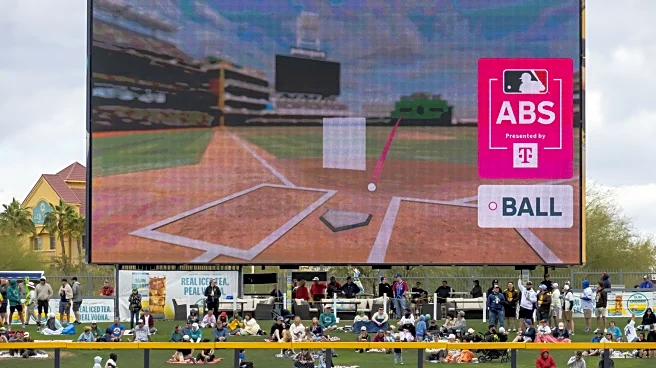
- An animated pitch result graphic is shown to those in attendance via the video board and to home viewers via the broadcast. If you’ve ever watched tennis on TV, it’s similar to the Hawk-Eye technology they use.
- Are successful challenges retained?
- Yes. A team only loses its challenge if the umpire’s call is confirmed. Because challenges can be lost, it is incumbent upon the player to be judicious about asking for a challenge (i.e., not “wasting” it in a low-leverage spot so that it is available to his team in a high-leverage spot). So in that sense, the ABS Challenge System adds strategy to the sport.
- How long do players have to issue a challenge?
- Immediately after the pitch (roughly within two seconds). If there is an ensuing play (such as a checked-swing appeal or a play involving a runner), the challenge may be made at the conclusion of the play.
- Can an umpire disallow a challenge?
- Yes, if the umpire determines that the players’ decision to challenge was aided by other defenders, runners or the dugout, the request will be denied (with the team retaining its challenge). Same goes if the challenge was not requested in a timely manner.
- Are there any scenarios in which a pitch may not be challenged?
- When a position player is pitching, challenges are not permitted. Also, challenges are not permitted after replay reviews, so as to avoid a complex series of challenges. If there is potential for a replay review after an ABS challenge, umpires will check to see if either manager wants to initiate a replay review before restarting the pitch clock. (If a challenge and a replay review are requested simultaneously, the ABS challenge will be accepted first.)
- How much time does the review add to the game?
- In 288 games with the ABS Challenge System during Spring Training 2025, there were an average of 4.1 challenges per game, and those challenges took an average of 13.8 seconds. In total, the average game saw about 57 seconds of added time, effectively “giving back” only a small portion of the 26 minutes that the average game time was reduced from 2022 (the last MLB season without the pitch clock) to 2025.
- Does the system lead to more pitches per plate appearance?
- No, according to the data from testing. In Triple-A, there were an average of 3.92 pitches per plate appearance before ABS and 3.9 afterward. In MLB Spring Training games, the average was static at 3.92.
- Can challenges affect runner placement?
- Yes. Inevitably, there will be instances in which teams want to challenge a pitch that was called during a play while other things happened on the field. So the umpires will determine whether that call on the field had an impact on the subsequent behavior of the defenders and baserunners. The umpires will let stand any calls unaffected by the incorrect call. As an example, say there is a runner at second with none out, and the batter is in a full count. The 3-2 pitch is thrown and called a ball, while the runner attempts to steal third. The runner beats the throw from the catcher and is called safe at third, but then the catcher challenges the ball call. Upon review, the pitch is revealed to be a strike. Rather than send the runner back to second base, the runner gets to remain at third, because the initial ball/strike call did not impact the catcher’s ability to try to throw him out. The batter is now out, but the runner is still safe. Also note that if a catcher drops a pitch that is initially ruled a ball but is overturned for strike three, the batter is out without requiring the batter or first base to be tagged (as would be required in the event of a traditional dropped third strike).
- How often are challenges successful?
- During Spring Training, players challenged 2.6% of all called pitches, and the overturn rate was 52.2%. This was higher than the 50% overturn rate at Triple-A last year. Interestingly, during Spring Training, defensive players (pitchers and catchers) were more successful in their challenges (54.4%) than hitters (50.0%). Also, as was the case in MiLB, the overturn rate generally tended to decline as the game went on – from 60% in innings one through three to 51% in innings four through six to 43% in innings seven and eight to 46% in inning nine.
- How is the ABS strike zone measured?
- Like the plate, it is 17 inches wide. The top end of the zone is at 53.5% of the player’s height, while the bottom is at 27% of the player’s height. The depth of the zone is 8.5 inches from both the front and back of the plate to its center. This means players like Aaron Judge will have a different strike zone than players like Jose Altuve. (Extra note on player heights: All position players in Spring Training camps have their heights measured by a team of independent testers conducting manual measurements and by representatives from a research institute using biomechanical analysis to confirm the manual measurements and safeguard against potential manipulation. Players are measured standing straight up without cleats.)
- How does this compare to the human umpire zone?
- The umpire-called zone has generally been more rounded and more lenient to pitchers, with a 55.6% max up top and 24.2% minimum at the bottom.
- Will challenge statistics be kept for individual players?
- Yes. Baseball Savant will add this information to its treasure trove of data. So you’ll be able to see, for instance, which catchers are most successful not just at framing pitches but challenging calls.
Note: This is not the full FAQ list from MLB, as there are several questions on there that I wouldn’t really consider “frequently asked.” That being said, you can view the full list here.
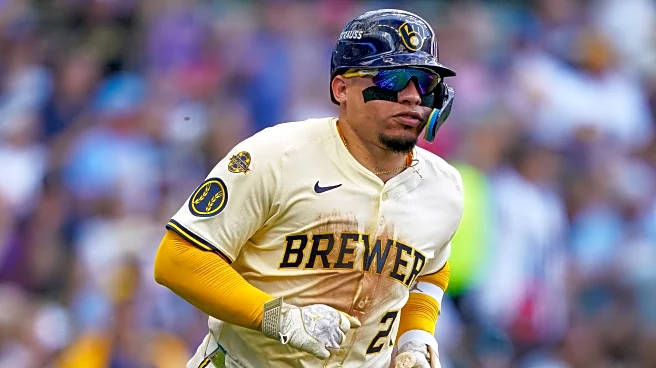
In my view, the new system is ideal for a team like the Brewers. While William Contreras is a pretty good catcher, he’s nowhere near one of the best (he ranked 21 out of 57 in framing among semi-regular catchers last season), and in theory, the ABS system eliminates framing. It’s also a positive for players who have fairly keen eyes at the plate, perhaps most notably Tyler Black, who is Joey Votto-esque in terms of his ability to draw walks.
What do you think? Will the new system be a net positive or net negative for the Brewers and baseball?
Weigh in in the comments, and join us throughout the month as we keep these conversations rolling into spring training. Have a question you’d like to ask in a future BCB Daily Question? Drop one in the comments, and we may use it later this month.