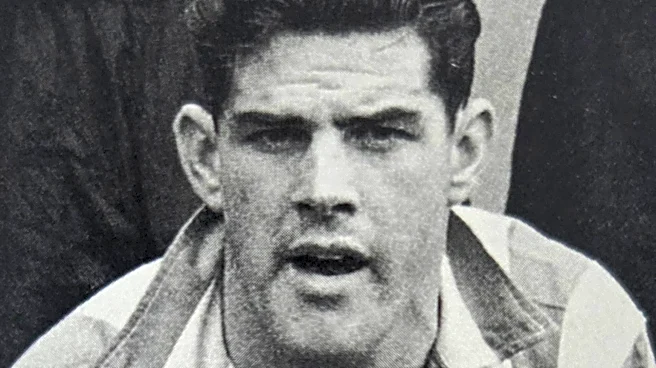




With the 1950/1951 campaign about to start, Tommy Wright should have been looking to build on a successful first full season at Roker Park, yet the capture from Partick Thistle was far from comfortable and, rather than readying himself for the big kick-off, he had gone back home – and had made it known that he had no intention of coming back to Sunderland.
Since joining in March 1949 and immediately being brought in for his first-team debut two days later, Wright had become a mainstay for the Lads.
He was an ever-present during 1949/1950, making forty-two appearances in Division One and playing in both FA Cup ties, whilst the thirteen league goals he notched were only bettered by Dickie Davis.
Scoring in a 0-3 win at Fulham in April on the day Sunderland hit top spot, it looked for a while like he would be picking up a championship winners’ medal for his troubles too, and whilst the squad’s title charge fell agonisingly short, Wright could still look back on a string of impressive individual showings.
Few observers, therefore, would have expected that he would then find himself being dropped for the opening match of the following season, but after an unexpected period of hesitation, the Sunderland hierarchy were left with very little option but to give Wright’s regular shirt to veteran Len Duns come 19 August, with Derby County arriving.
Named on the club’s retained list by club secretary George Crow in May, and with things going well on the pitch for him, it had been expected that the versatile forward would re-sign upon his return to training in July, as was common practice in this era. However, it then transpired that there had been a hitch, and on this day, The Sunderland Echo reported that the star had instead returned to his family base in Fife.
When commenting for their editions, Wright intimated that he was hoping to remain north of the border permanently, as there he “would feel much happier, among my own folk”.
The main issue, though, had not been a failure to settle in the North East, but apparently the general cost of living in England, which was higher than he had been used to. Although offered £12 a week by the club – roughly double the national average for a manual worker at the time – he claimed his outgoings as a single man were still significantly harder to meet, prompting him to pack up his things and leave.

There was to be no obvious solution in the days that followed, as, having proposed ‘full terms’ to Wright, rules meant that Sunderland were under no obligation to transfer-list him, nor would the Football Association be able to register him with another club anyway.
The Echo, who backed the board for not wanting to be seen to be “running about seeking him”, had little sympathy for Wright’s predicament, and it wasn’t until the seventeenth that things concluded, when the player accepted the position he was in and relented.
He duly signed back on at Roker Park, telling close friends that he was otherwise happy there and that his issue was not with the club itself, but more the wider wage restrictions in the sport, although the shift was too late for him to be involved in the opener against the Rams.
Manager Bill Murray had already been planning without Wright, and Duns remained part of an XI that was to win 1-0 thanks to a strike from Len Shackleton.
Wright then regained his place for the following fixture at Aston Villa, and whilst obviously lacking match sharpness in his first games back, his form soon picked up and he once again ended the campaign as Sunderland’s joint-second top scorer in the league.
He then remained a player on Wearside until early 1955 and would appear to have come to terms with the economic situation in the region, for he settled back in the city in his retirement and was living at a retirement home in Ashbrooke when he passed away in 2011.