

Well, as the coaches kick off Boston College week, we take a final look at the Maryland game, and take a grade pulse for the next third of the season. The Hokies are 3-0 to open 2026, and that’s unusual in itself. Amplifying the good, addressing the issues, and fixing the broken things becomes even more important.
The High-Altitude Look Down
There has to be a good reason to have both “doubts” and “optimism” about any program’s potential success. Well, “good” might be an adjective that is a bit stronger than needed, but both emotions
really should be grounded in something other than pure cynicism or homerism. In the case of the 2026 Virginia Tech Hokie football season, healthy skepticism is merited but it can, now be balanced with a decent measure of sunny hope.
The first road trip of the season meant something this year. In many seasons past, the team often opened the season as a woeful underdog setting up the following games as do or crash sorts of situations. The year, the scheduling folks managed a gradual ramp up in opponent capability.
The Ramp Up Instead of a Block Wall
Nobody was fooling anybody about VMI’s chances for the opener. The game was always intended to help out VMI monetarily and provide a live scrimmage for the Hokies. The success of the result was not in the win, but in the performance in getting to the final whistle.
The ODU game was different in that the Hokies have had a struggle bus relationship with that program for the last decade. The first was that Ricky Rahne has actually put together a program that can routinely challenge for the Sun Belt Conference championship, and the second was the disaster of the first trip to the 757 back in the Fuente Era, and then the total collapse of the 2025 team, at home. ODU was both a mental challenge as well as a serious step up in the quality of the competition, without it being a P4 opponent.
The question was, then, “did the ramp up work or did it give false hope”? This Maryland weekend didn’t necessarily answer that question completely, but it certainly did go a long way to erase some cynicism and firm up the basis for real hope for a solid performance in 2026.
The Biggest Change
So, of the things that worked (the list isn’t much different from last week’s) what seems to be the most interesting and relevant to the 3-0 start that if trends hold might end up at 4-0 as we recalculate the risks for the remainder of the season? There is definitely a bow to the talent on the field (we’ll cover that) but in what looks to be a real, permanent, change in offensive philosophy coming from the coaching staff. From the first snap of the Maryland game, until the final blast of the 4th quarter that iced the cake, OC Ty Howle called a game that has been completely unfamiliar to Hokie Nation. He was flexible, moved downfield quickly, executed quickly, and gave his personnel the best possible chances to make plays.
Yes, there were some head scratchers, and some of that might have been execution issues more than play choices, but at no time during the contest did an observant fan get the impression that Howle was going to give up and punt. Even in obvious passing third down and long situations (which there just weren’t that many) the defense could not be completely sure of what the offense was going to do. If you add that to the reality that Grunkemeyer actually pre-snap reads and continues to read downfield as the play is unfolding it becomes clear that this offense is fundamentally different than in the past several decades. It’s not a run-first-pass-in-emergencies sort of football. We see a developing “do what works, regardless” sort of attitude.
Still Sorting
The Brits use the colloquialism “sorted” (no “out” added) in regard to organizing and setting up processes. There are still a few things that need to be sorted, and we’ll go over those in a few, but from the looks of things, Brent Pry is building some defensive momentum. For the Maryland game, it was obvious that getting the quarterback on the ground before passing the ball wasn’t going to work well, so the approach seemed to have changed. That was interesting not because of the change in emphasis but in that there was a change. Pry seems to have accepted the Howle challenge and maybe a bit of the magic from the old Bud Foster Lunch Pail in making meaningful adjustments to his defenses on the fly instead of waiting for some magic halftime moment. There was still an element of Pry’s signature “Bend but Don’t Break” but there seemed to be a more tactical approach to the strategic goals for the game.
Some people might not agree with the result of the choices, but in the end the Hokies walked away with a win, and opening the first three games without a loss is not a bad way to start the season off.
What Worked in this One?
The Offensive Line showed up and adjusted to adversity. Let’s not talk about the thinness at certain positions just yet. The loss of Johnn Garrett for the season was a real blow to the depth available, especially because Garrett could play inside and outside. The loss of a left Tackle Justin Terry to a really ugly looking roll up, could have completely wrecked the offensive line situation. Matt Moore sent in Logan Howland to take over for Terry, and after a few plays and a series to knock out the butterflies, and get the internal signaling and timing going, Howland held his own, threw some really quality blocks on running plays, and contributed to Ethan Grunkemeyer being sacked only once in the game. Howle’s use of movement in the pocket and roll outs (Grunkemeyer is a surprisingly accurate passer on the move) definitely did something that we haven’t seen in quite a while. He gave his offensive line some serious help with his play calling choices and flexibility.
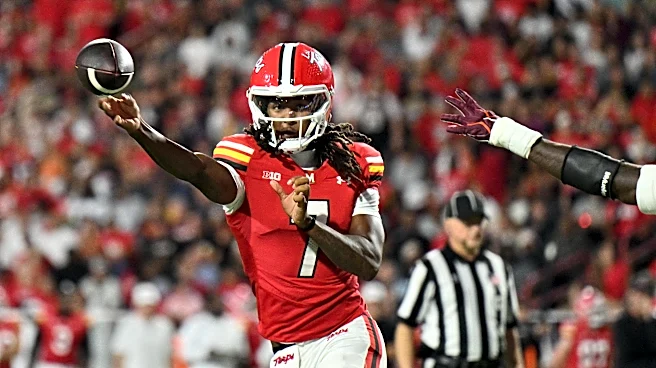
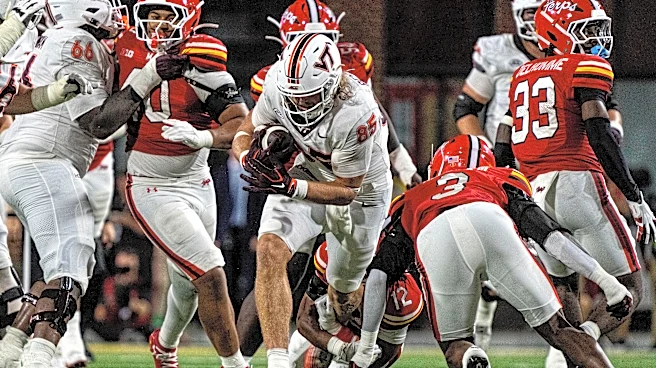
The Defensive Line might get some smacks from some fans for not getting huge numbers of sacks. There were only two for a total of six yards. What the line did was almost completely shut down any hope of Maryland running the ball effectively. The Terps only gained a net of 64 yards on the ground. Without a ground game Maryland was forced to pass. Granted, they are a pass first sort of offense with Malik Washington’s live arm, but that unbalanced equation means that the number of the types of plays the defense must react to is reduced. With the run effectively stopped, the pass rush could be tuned to keep Washington in the pocket and away from leading fast field chopping drives that could make up for Tech’s 2 to 3 score margin. Yes, it would have been a good thing to get to him a shade faster to disrupt the passing more, but ultimately the balanced pressure kept him from running too much and certainly made his passing choices less advantageous.
Having an actual offense made all the difference in the world for this contest. There is an old saying that goes “the best defense is a good offense” and that really applies in football. The more a team burns clock, and scores points, the less their opponents can do the same. This new-look Virginia Tech offense is something that Hokie Nation will have to get used to. Saturday night, the Hokies scored first, and methodically on a long drive that burned clock. Then they repeated the feat to go up two scores on the Terps. Then when Maryland finally started to get going, the Tech offense turned it up and repeated the drive and burn clock effort. Tech scored five touchdowns on five long drives that took nearly 37 minutes off of the clock. But more importantly, put enough distance between the team and their opponents that eventually the Terps just didn’t have enough clock to use to score on slow developing offensive drives. The magic from the Lunch Pail was the calculation that time of possession is important defensively.
The Balance between the pass and the run has been missing for a decade or more. Whether it was a player issue, or a coaching issue – usually a combination of both – the Hokies haven’t generated much balance in their offensive approach before this season.
This past weekend we saw something fresh (not new, but a return since the close of the Tyrod Taylor era) for a change. We saw real balance between the run game and the passing game. Tech gained 314 yards in the air at an average of over 8 yards per attempt but with 2 extra for each completion. Ethan Grunkemeyer was ripping off 10 yards a pass and put the ball in the air 39 times (completing 31 of them).
The balance comes in with the run game. Tech’s backs were handed the ball 28 times. Grunkemeyer stunned the defense with that big 18-yard scramble for a touchdown. But both Marcellous Hawkins and Jeffrey Overton averaged over 4 yards a carry (Hawkins – 4.7, Overton – 4.1) Overton scored a touchdown. It was the epitome of balance in the context of a modern football game. What is interesting is that it was relatively quiet. The effect was in looking at the games stats was “wow, the run game actually worked pretty well…”
The Personnel is just better. Let’s just wrap the “what worked” section with the observation that just seems alien to Hokie Nation as the 2026 team attempts to slam the door on recent history. What a difference talent makes! Ethan Grunkemeyer is attracting attention and could have pro potential. Luke Reynolds is going to play on Sunday and maybe from the 1st round. (Please let them play out their eligibility, here, first.) Hawkins and Overton are a perfect combination that reminds me of a few Tech combos of the past glory days. In the offensive line there might actually be some high draft picks. Kyle Altuner is proving to be a critical leader, and he’ll show up on Sunday, somewhere, too.
The defense is still forming a character, and we’ll talk about that, but this defensive line squad is really becoming a menace to running backs, and depending on the game strategy chosen might actually be the first 2-deep to actually challenge running quarterbacks. It remains to be seen but there is a serious level of developing talent there.
The honorable mentions go to the punt team… which only made three appearances, all in the 2nd half in the game and the kickoff crew, specifically specialist Cole Byrd, who buried six kickoffs and all 6 going for touchbacks.
What Didn’t Work Out So Well
The Pass Defense struggled. You could potentially observe that the pass defense was some sort of attempt at a “semi-prevent” that kept Malik Washington’s receivers in front of them and forced Maryland into extended drives that burned more clock than they could afford to burn. You could. This analyst is not so sure, however. It wasn’t that they were terrible, as much as they could be really good, and then suddenly really bad within a play or two. A team with a consistently bad secondary doesn’t last long in this game. The coaching staff will have loads of film to show the busted coverages, the one-on-one coverage errors, like not turning your head around to spot the ball in the air so you don’t get flagged for PI in tight situations (more later…)
The problem was frustrating because of the level good play in the inconsistency continuum. One play was superior, followed by another one where a wide-open receiver was left out in the deep flat that erased the prior good effort. Granted, quite a bit of those coverage busts came from breaking back to cover a scrambling quarterback, but that’s all in the offensive scheme with a quarterback the caliber and style of Washington. The secondary needed to realize that and not play so loosely that they lose track of that critical receiver. That happened more than several times in the game, and it cost the Hokies points. Sometimes you can depend on the offense to bail you out, and sometimes the offense is as clueless as you are. Thankfully the latter condition was not in effect for this contest.
Pry is going to have to get with his secondary coaches and figure out a better way to cover in quarterback scramble or movement situations. This defensive secondary is fast, and talented… but it’s also very young and inexperienced. It does show signs of getting better, but it needs to get better faster.
The Pass Rush could have been more effective. Yeah, they kept Washington in a box that really prevented him from breaking out and gashing the defense, but with an arm as live as his, and a release to go with it, the defensive players were still a beat behind the motion and the throw. It’s true that Maryland’s luck at getting to Grunkemeyer wasn’t any better (1 sack worse for their troubles), but it would have been preferred to see more direct pressure, both in the pocket and downfield, put on Washington. Neither team turned the ball over… though Tech did get a punchout downfield, but the ball trickled out of bounds before someone in a white jersey could fall on it.
The Blocked PAT puts the Special Teams lineman in the doghouse. A blocked extra point happens now and again, but it’s embarrassing. What’s kind of unfair is that it will be dropped into John Love’s stats pile, but it’s really the fault of the line blocking for him. It didn’t happen again, and the Hokies did pull off a 2-point conversion to make up the difference, but there will be film on that attempt, and every special teams coach that the Hokies are going to face is going to be looking to exploit whatever occurred to allow that crush to happen. Other than PATs though, the Special Teams really didn’t get much of a workout. All of the Hokies scoring attempts were touchdowns and eventually the blocked PAT came to much of nothing. The big potential negative was a slight hitch in the momentum factor. That glaring 13 instead of 14 on the scoreboard was a reminder of what happened.
Now We Visit the Chronically Broken
The Penalty Situation is becoming so much of a pattern that the Hokies are going to have to take some personal responsibility over it, regardless of how hard the coaches bang on the problem. Tech had 8 penalties for a total of 76 yards, but 2 of those flags meant -13 points. On came on a beautiful catch and run touchdown pass to Jeffrey Overton that got called back, and the other was on a PI on a 4th and goal pass into the endzone. That would have been a turnover on downs and eventually resulted in a touchdown. Maryland failed to get the 2-point conversion, but the foul cost Tech six points and breathing room late in the game.
We won’t talk about the officiating to loudly, because the penalties were doled out fairly evenly between the teams, and for the most part, it was an evenly called contest. We won’t complain too bitterly about that freebee 4th down and 20 yards to go miracle pass from Washington that deflected off one player and ended up in the hands of another player for serious yardage… the whole pass was possible due to an absolutely blatant hold by #76 for Maryland. It should have been flagged, but it wasn’t. That’s the breaks, and eventually Tech took the W back to Blacksburg to prepare for BC.
So far, this is the only chronic issue to remain, the secondary was really not challenged too much in games one and two, but with the Maryland offense the pass defense was pushed very hard. To not be a “Dun Busted” trend, the coaches are going to have to figure out how to help a fast and talented secondary step up and perform in pressure situations, especially when the play breaks down and receivers are heading for open space. Blown coverages underneath and in the seams of the zones can be a one game thing, or they can be chronic. We’ll have to wait and see if the problem persists with BC before hanging the “Dun Busted” sign on that machine.
Time for Grades
Let’s look at the grade chart for the Maryland game. It was a win, and that’s the most important grade in any contest.
The win was against a peer team, with a good defense, an excellent quarterback, and good overall performance numbers for the beginning of the season. It was a rare P4 non-conference win for the Hokies who have struggled against P4 teams over the last decade, especially early in the season.
Next Up!
The Team travels to Chestnut Hill and Alumni Stadium to take on the Boston College Eagles in a Big East Grudge Match. The Hokies are two touchdown early favorites, but the Eagles are unlikely to just let that slight slide much. It’s a noon kickoff for the last game of September and the first game of the Fall of 2026.