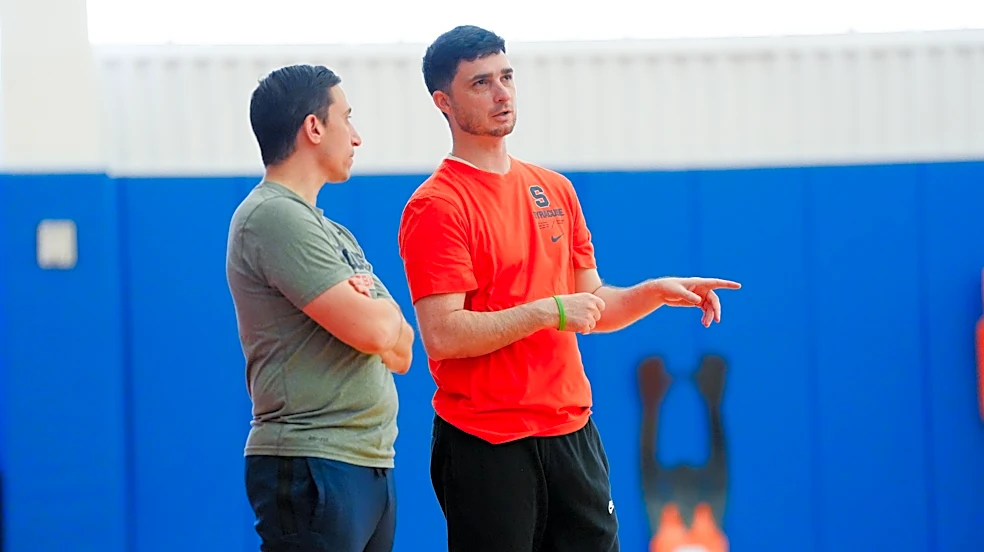






SYRACUSE, N.Y. — Anybody who knows Syracuse men’s basketball general manager Greg Fahey knows his love for pizza and chicken cutlets. He’s an unapologetic New Jerseyan with a discerning taste for some of the staples of that state’s cuisine. Though since moving to Syracuse from Hampton, Virginia where he worked as an assistant coach and GM for the Hampton University program, he’s found himself eating healthier.
“I got my blood work back last week,” he said on Syracuse media day on October 9. “My cholesterol
is a little high, so I’ve been slowing on the pizza and the fried foods.”
But he still claims that Mario and Salvo’s has a solid slice, and that Swallow’s and Change of Pace have good wings. Even if he’s been trying to stick to CoreLife. He’s says he’s still open for recommendations though.
His job however, is not to test out all of the different pizza places in the 315. It’s to help Syracuse’s men’s basketball program in a variety of ways off the court. But arriving after the roster was mostly constructed, what has his role looked like?
In college basketball, the term “general manager” is about as vague as it gets. Most high-major programs somebody with a front office-type job title. Even many mid-major programs have gotten in on naming GMs, as evidenced by Fahey coming from Hampton.
“Ther’s a couple of common threads,” Fahey said. “But there’s GMs that are coaching in practice. There’s GMs that are running a team in practice. There’s GMs that don’t have to work in fundraising at all. I got boys in the SEC, I got boys in different conferences, and I think one consistent is just trying to support your assistant and head coaches and try to be elite at that, and then just understand how the basketball machine works yet.”
“It’s not quite the NBA yet,” he said. “They want to say it’s professional sports, they want to say all that stuff, I get it. But it’s not at that level yet. You still gotta understand how to help your assistants in a recruiting battle, or what relationships you can bring to the table.”
As far as Fahey’s responsibilities, he’s no longer on the court. He says that the biggest difference since coming over from Hampton is that he’s not an assistant coach, which was an additional tag alongside general manager for that program.
He defines his role in a “couple of different buckets.”
One of those buckets, he says, is to simply be an extension of the coaching staff and help out wherever they need it. That can come in recruiting battles, or simply in institutional knowledge from his time as an assistant coach. He’s also crucial in executing McNamara’s vision for the future of the program.
“(We’re) trying to define a process that GMac (and the staff) wants for evaluating players,” Fahey said. “They’ve done a great job. They did a great job at Siena; they got to the tournament, so I’m just the new guy here, I’m trying to support them in the best way that I can.”
Other responsibilities deal with more specialized tasks. He says that he works closely with men’s basketball associate A.D. and former assistant coach Peter Corasaniti on contracts. That includes working with NIL Go, a platform operated by Deloitte and the College Sports Commission to report third-party name, image, and likeness deals for athletes.
Then, there’s the other side of the financial angle.
“It’s fundraising,” Fahey said. “Being creative with different ways to generate stuff with (the ‘Cuse Athletics Fund) and administration.”
Syracuse men’s basketball also hired a former data intern, 2026 graduate Aidan Flood, as a full-time data analyst over the offseason. Even with the nascency of the general manager role, college sports is expanding beyond it. Football programs are starting to put together entire front office staffsto support the general manager.
Fahey thinks that basketball is still a few years away from getting there, and he hasn’t thought about what that might look like.
“I haven’t put a ton of thought into that,” he said. “Like a whole GM staff, I don’t think it has made its way to basketball yet. Basketball is always a couple of years behind football. Football definitely is setting a trend on that. High-major (basketball) staffs are so big already. Will it get there? Maybe. But right now, I don’t know.”
SU’s roster was all but complete by the time that Fahey arrived in May. He did help the staff recruit Amarri Monroe — like much of this staff, Fahey has ties to Monroe’s AAU program, Albany City Rocks, having coached there himself — but his fingerprints aren’t all over this roster. He’ll have to wait until next year for his first full transfer portal and high school recruiting cycle with the Orange.