

The story of the man who has led Michigan to the 2026 Final Four almost didn’t start.
To get here, Yaxel Lendeborg — the Wolverines’ 6-foot-9, do-everything, superstar forward — took the path less traveled, to say the least. Academically ineligible throughout most of his high school career, Lendeborg only played 11 games of varsity ball in his hometown of Pennsauken, New Jersey. His collegiate career began at JUCO Arizona Western College, in the middle of the COVID-19 pandemic. The idea that anyone
playing at Arizona Western, let alone an unsure, inexperienced kid from New Jersey, would one day make front-page, nationwide headlines was a far-fetched one.
But Lendeborg did it. And his roots — the roots of Michigan’s national championship hopes and dreams — draw their nourishment deep underneath the national topsoil.
In every way, Lendeborg’s journey was improbable, if not borderline impossible. Yaxel, who moved from Puerto Rico to Cincinnati to Pennsauken, all before his ninth birthday, barely played at the high school level. Academic problems got him kicked off the team as a freshman, nullified his sophomore and junior years, and only let up when he finally kicked himself into gear midway through his senior year.
Those 11 games were enough to earn Lendeborg, who is Dominican, a spot at an event in New York City aimed at promoting Dominican players. He played well, by all accounts; well enough to earn the attention of a friend of Kyle Isaacs, then an assistant coach at Arizona Western.
“We [at Arizona Western] got a text message [in November] from a good friend of ours saying ‘hey, here’s a 6-foot-8 kid,’” Isaacs told Mid-Major Madness. “We had an additional scholarship available. I think [Lendeborg] maybe had 60 seconds of clips, and it was just, yeah, we need a kid with size.”
That was enough for Lendeborg, or at least for his mother, Yissel Raposo. Raposo forced an uneasy Lendeborg onto the plane, and just like that, he was off to Yuma, Arizona.
Times were strange, as you may remember in November 2020. Lendeborg’s freshman year got underway with thirty minute, social-distanced practices (“one of the weirdest times for everybody”, per Isaacs), and stringent off-court restrictions. But Lendeborg kept his grades above water, and developed game-by-game. His best game that year, as Isaacs remembers it, came in the playoffs. Arizona Western lost, but Lendeborg stood out.
“You didn’t really start to see that there was going to be something more than just a regular 6-foot-8 kid until maybe the last game of the year,” Isaacs said. “We played on the road. [Lendeborg] had his best game. He got a bunch of rebounds, played really tough.”
Rebounding had been Lendeborg’s calling card since high school, and that trend continued into year two, when he led his conference in rebounds. Isaacs, though, had bigger plans for his 6-foot-9 forward.
In Lendeborg’s freshman year, the Matadors ran a system where their point guard often played in the five spot. Isaacs, and Arizona Western, wanted their best ballhandler in position to grab defensive rebounds; that way, they could get out in transition right away, without taking precious seconds getting the ball to their floor general.
Isaacs, now elevated to head coach in Lendeborg’s sophomore campaign, took that idea and tweaked it. In order to encourage him to both crash the boards and keep himself involved on offense, Isaacs told Lendeborg that anytime he got a defensive rebound, he’d play the point guard.
“[Lendeborg] loved that idea,” remarked Isaacs. “Which was great, because he could do it. We put our point guard down at the five, and both of them had a good knack for basketball… [that] made us really, really hard to guard.”
Off the court, Lendeborg was growing into himself, too. Again, the grades were high enough, and his unselfish play on the court translated to the locker room, where teammates gravitated towards both his “team-first” mentality and his “big joker” personality. At times, Isaacs actually had to beg Lendeborg to be more selfish scoring-wise, a theme that reoccurred later in his career. All in all, it was a straight-line development year that earned Lendeborg Arizona Community College Athletic Conference (ACCAC) Player of the Year and National Junior College Athletic Association (NJCAA) All-American honors.
Year three was more of the same. Lendeborg averaged 17.2 points and 13 rebounds per game, with the latter mark leading the entire NJCAA. Again, Yaxel was an All-American, ACCAC Player of the Year, and finished out the season atop the all-time NJCAA leaderboard in total rebounds.
“[Arizona Western] is a program focused on trying to get 1% better every day,” Isaacs said. “It was a great experience [having him here].”
Unsurprisingly, Lendeborg’s growing JUCO pedigree attracted the attention of NCAA D-I programs. In November of 2022, midway through his third year with Arizona Western, he signed a National Letter of Intent to head much closer to home, joining St. John’s and then-coach Mike Anderson for the 2023-24 season.
Of course, it didn’t work out that way. St. John’s had an underwhelming season, fired Anderson in March, and handed the legendary Rick Pitino a six-year contract to take over as head coach. After Pitino’s assistants informed him his role wouldn’t be as Anderson had promised, Lendeborg decommitted from St. John’s and reopened his recruitment.
“When he was coming out of JUCO, we tried to get involved,” University of Alabama at Birmingham (UAB) head coach Andy Kennedy told Mid-Major Madness. “We saw him in a showcase in the summer. Didn’t get to first base.
“[Once Lendeborg decommitted from St. John’s], he opened his recruitment. We knew a guy that knew a guy, and we got involved. We got him on campus, and we convinced him that this was the best place for him to start his Division One journey.”
That convincing took both some work and a stroke of luck. In 2023, at the time of Lendeborg’s recruitment, NCAA rules limited athlete visits, even after a coach got fired. Lendeborg choosing UAB as one of his few visits increased their odds substantially, and when Kennedy and staff got the family on campus, things improved even further.
“We struck a chord with him, his mom, his dad, and just sold him on the vision,” Kennedy said. “We’d had some success with JUCO players in the past, and we felt it was the right level for him to come in and really get acclimated to D-I.”
UAB had their man. Even so, Lendeborg didn’t get off to a great start with the Blazers. His November was miserable, punctuated by a home loss to Bradley in the season opener. Lendeborg didn’t make a field goal, scoring just three points in 21 minutes. Four nights later, against Clemson, Lendeborg scored six points, but fouled out in just 15 minutes.
“Initially, Lendeborg got to [UAB] and said this multiple times: he didn’t know if he could be a D-I player. We said ‘son, trust us, you can be a D-I player, and you could be a good D-I player.’”
As Kennedy remembers it, the turning point came in a late November win over Furman. Lendeborg had 19 points, grabbed 10 boards, and, per Kennedy, “started going from there.”
That’s putting it lightly. Lendeborg exploded, earning American Athletic Conference (AAC) Defensive Player of the Year, All-AAC First Team, and AAC Tournament MVP honors in his first year as a Blazer. UAB, of course, rode his breakout year to a monster season, ripping through the AAC and taking No. 5 seeded San Diego State to the wire in the NCAA Tournament.
“[Winning the AAC Tournament] was the culmination of all his dreams and hard work,” Kennedy said. “The way he performed throughout the course of that first year, that gave him the confidence. You could see each and every game, each and every week… [Lendeborg] took on more responsibility [and started] to have internal belief, which was the goal.
“Once he started believing that he could do it, then he started doing it in a big way. A record-setting way.”
That record-setting way came in Lendeborg’s second season as a Blazer. The now wizened forward led the NCAA with 26 double-doubles, became UAB’s all-time single season rebounding leader, and joined Larry Bird as the only D-I players to ever notch 600 points, 400 rebounds, and 150 assists in a single season. Even as UAB didn’t return to the NCAA Tournament — a loss to No. 16 Memphis in the AAC Championship dashed those dreams — Lendeborg leveled up.
“Right away [when Lendeborg got to UAB], his physical tools were undeniable,” Kennedy said. “He’s a legit 6-foot-9. He’s 240 pounds. He’s got great length, big hands, moves fluidly. He’s one of those guys that if you’re not careful, you watch and say he’s not playing hard… the game comes so easily to him.”
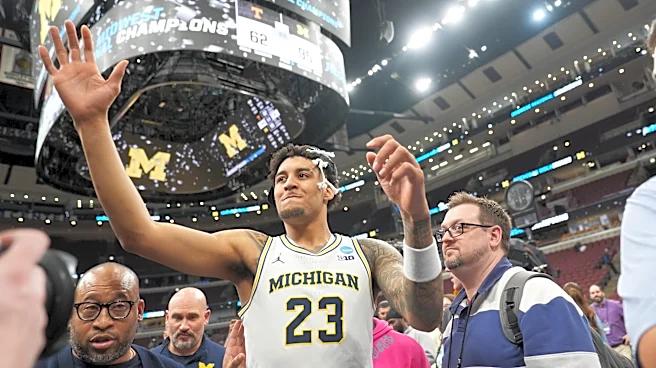
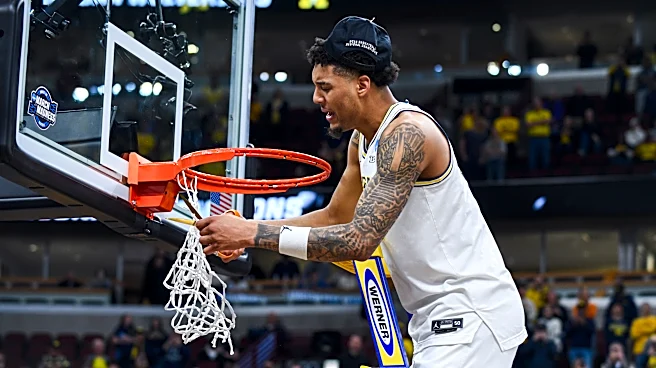
Those physical tools combined with Lendeborg’s production made him an alluring target, and when he entered the transfer portal (and the NBA Draft!) at the end of the year, he was a consensus top-three recruit. You know the rest of the story; Lendeborg turned down the draft, chose Michigan, won Big Ten Player of the Year, ended up a First-Team All American, and, most recently, became the Midwest Region MVP as Michigan advanced all the way to the Final Four.
“I saw him score 30 points, grab 20 rebounds, and block multiple shots in a conference tournament game,” Kennedy said. “I always knew what he was capable of.”
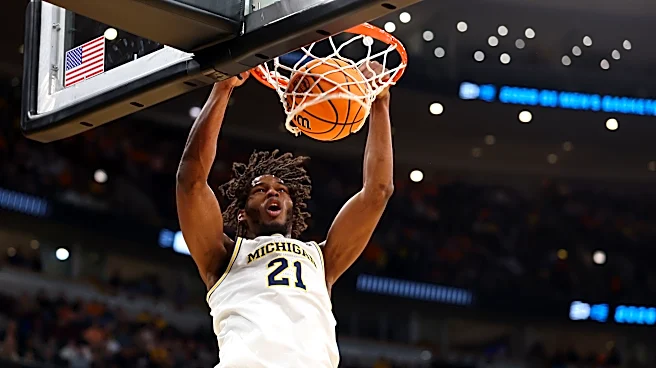
Isaacs won’t claim that he saw this coming. Nobody could have, he says. Arizona Western has never had a player go on to play in the Final Four. But, he sees some things from Lendeborg’s time with the Matadors that’ve carried over. The rebounding, for one. The unselfishness. The defensive rebounding that morphs into a 6-foot-9, 240 pound point guard leading the break. Even the play that went viral from Michigan’s Elite Eight clash with Tennessee — where Lendeborg, with his team up by 30, let the ball roll for nearly 15 seconds to wind time off the clock — Isaacs says has been an Arizona Western staple, dating back even before Yaxel’s time in Yuma, Arizona.
That’s how Yaxel Lendeborg, and by extension, the mighty Michigan Wolverines, have gotten to this point. They wouldn’t be here without those 11 fateful high school games. Without a nerve-wracking move nearly 3000 miles from home. Without St. John’s timely firing of their head coach. Without the brilliant coaching staffs and development teams in Yuma, Arizona, and Birmingham, Alabama.
The spotlight shines at the top. That’s the way it always has been, and that’s the way it’ll always be. But, the mere idea that Arizona Western College and UAB can play key roles in Michigan’s title aspirations is why we love college sports. There are cathedrals everywhere — at every level — for those with the eyes to see.
“I’m like a proud uncle now,” Kennedy said.
His proverbial nephew — the boy who could barely play high school basketball — is two games away from a national championship. On Saturday, when Michigan and Arizona tip off, it’ll be the latest peak for Lendeborg on a mountain that just keeps growing taller and taller.
Pennsauken. Yuma. Birmingham. Ann Arbor.
And now, Indianapolis.