




While the Steelers have their eyes set on a Super Bowl, or at least, a playoff win, entering 2026, this offseason has still had more of a long term planning feel to it. Pittsburgh made 10 draft picks, none of whom are guaranteed to start right away, and has started work on extending its young core of players.
So, while Pittsburgh’s short term goals remain as obvious as ever, it’s more fun to look at 10 long term goals for the team. This year, what should the Steelers look to accomplish to set up future
seasons for success?
1. Establish a top-10 offensive line
When you have three first-round tackles, a pair of Day 2 guards, and a second-round, likely future All-Pro at center (plus a slew of quality backups in Dylan Cook, Brock Hoffman, etc.), you’re doing something wrong if you can’t figure out an above-average starting five.
With fairness to new offensive line coach James Campen, it will take time. There’s a lot of youth, position switching, and still-developing chemistry up front. Don’t panic if the group doesn’t gel immediately.
But by the season’s end, it’s important — and should be expected — that the Pittsburgh offensive line looks like the unit it was drafted to be. The Steelers are concerned not just with keeping the aging Aaron Rodgers upright, but also giving the team’s eventual young quarterback of the future good protection while learning the ropes in the NFL.
2. The defensive line builds a long term core
Cam Heyward’s ageless excellence has covered up a multitude of sins on the Steelers’ defense over the years, but he won’t stay elite forever. Still, a strong defensive line remains one of the most important aspects of a successful NFL roster.
After spending a first-round pick on Derrick Harmon in 2025, the Steelers took a major step towards addressing life after Heyward. Harmon showed plenty of promise as a rookie but still needs to take a leap in 2026, while Keeanu Benton and Yahya Black remain potential long term pieces. What’s promising is that the Steelers’ new coaching staff seems to be interested in finding better position fits for both.
3. Mike McCarthy brings innovation, consistency on offense
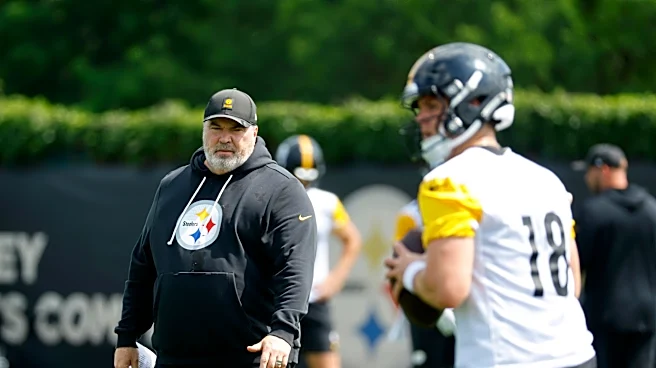
A list like this would be incomplete without mentioning the Steelers’ new head coach, for whom you could probably create a hefty list of goals. The main interest will be on the offensive side of the ball, however, where McCarthy’s specialty lies. He’ll be the team’s play caller in 2026.
McCarthy has well-earned respect as an offensive mind in the NFL, even leading multiple top-five offenses as recently as his stint with the Dallas Cowboys. But as a 63-year-old coach with a number of past stops, he wasn’t one of the flashier, up-and-coming names available in the recent coaching cycle. Will he be able to keep up with the rapidly evolving offensive schemes and defensive responses in the NFL, or at least bring in assistants who can stay on that cutting edge?
Consistency is the other big question. Former Steelers coordinator Arthur Smith had his moments of innovation, crafting a unique offense in 2025 that made Pittsburgh one of the leaders in an increase in jumbo package usage across the NFL. But some Sundays, the offense would score seven points, and the next, they’d score 27.
The expectation is that McCarthy can raise the ceiling of the Steelers’ offense, but he also needs to raise the floor.
4. Patrick Graham maximizes talent
A common complaint regarding the Steelers defense under Teryl Austin was that it rarely lived up to its highly-paid status. Players underperformed, sure, but the scheme didn’t always put them in positions to succeed, making answers all too easy for opposing quarterbacks.
Graham, on the other hand, comes with a reputation of getting the most out of who he has available. An increase in two-high shells is expected, and hopefully it comes with more complex, modern coverages with the necessary communication to make it work. And up front, Graham will be tasked with moving around the rushers at his disposal to create pressure in more ways.
Pittsburgh has shown a willingness to invest on the defensive side of the ball under general manager Omar Khan, but that’s only half the battle. If Graham can build a strong schematic foundation in 2026, it should set up his defense for long term success.
5. The Steelers extend the right players
Omar Khan has already extended two members of his successful 2023 draft class in Nick Herbig and Darnell Washington, also giving kicker Chris Boswell a new deal. Cornerback Joey Porter Jr. and defensive lineman Keeanu Benton appear to be next in line, but Steelers insider Gerry Dulac noted last week that the team didn’t expect to be able to sign all five players entering the offseason. But whether the team gets every contract done or not, it’s a lot of money being added to the team’s future expenses.
What’s key is extending the right players. The Herbig and Washington deals look smart, but both players have unique skill sets that need to be used correctly, especially since both are now getting paid starter salaries despite not being full-time players beforehand. And the Steelers still haven’t reached an agreement with Porter — the most promising player from that 2023 class — and a new contract isn’t a guarantee given how expensive the cornerback market has become.
It’s so far, so good when it comes to Khan’s decision-making process with extensions. Having lots of young players up for a new contract is a great problem to have. But Pittsburgh will need to give the right players the right extensions to set the team up best for future seasons.
6. TJ Watt returns to elite-ish territory
This might seem like more of a short term goal, but odds are that Watt will be a Steeler for life, and his contract remains one of the most expensive for a defensive player in the NFL. But in 2025, Watt notched just 7.5 sacks in 14 games. And in 2024, he had 11.5 in 17. Even though Watt’s run defense performance remains better than many realize, you want more production for that kind of money.
Now 31, Watt is still capable of producing double-digit sack seasons, especially if he can continue to expand his game beyond his speed rushing specialty, adding more power, moves, and becoming open to moving around the defensive front. If Watt can rebound after a disappointing 2025 by his standards and prove he can remain a high-end edge rusher through his mid-30s, it’ll make Pittsburgh’s investment look better and keep the outside linebacker position as a team strength for a while.
7. Payton Wilson takes a Year 3 leap
Inside linebacker is not a high-value position in the NFL, but poor play in the middle of a defense can lead to catastrophic issues against the run and in coverage. Wilson was at the center of some of those problems in 2025. Despite his high-end athleticism, his coverage feel and chemistry with Patrick Queen was lacking, and his lean frame for a linebacker led to struggles going up against blocks in the run game. As a result, he started losing playing time to Malik Harrison, who didn’t have a great 2025 season himself.
Still, Wilson’s potential is through the roof, and inside linebacker is a position that can take several seasons to master in the NFL. Especially under the coaching of Patrick Graham, who has been known to get strong seasons out of his off-ball linebackers, it’s not out of the question that Wilson could take a step forward in 2025.
That would be an important development for the Pittsburgh defense. After offseason trade rumors, Patrick Queen probably won’t be getting a second contract with the Steelers, and the team doesn’t have many other promising long term options in the inside linebacker room. The team could definitely address the position in future drafts, but Wilson developing into an every-down starter would be the easiest answer.
8. Germie Bernard looks like a long term WR2
The Steelers traded up in the second round of the 2026 draft to select Bernard, giving the team some much-needed depth in its wide receiver room. The one-liner on Bernard coming out of Alabama was that he’s a solid all-around pass catcher who should be able to contribute immediately, but he lacks high-end upside. He should be able to see snaps immediately as a WR3 for Pittsburgh, assuming he stays on Aaron Rodgers’ good side.
However, the goal is that Bernard can be more than that in future seasons. DK Metcalf and Michael Pittman Jr. are both in their late 20s, on decent-sized contracts, and might not remain as the Steelers’ receiving duo long term. Expecting Bernard to be a WR1 down the road might be too big of an ask, but if he can develop into a high-end second option, that would give the Steelers a cheap, young playmaker to build around in the passing game moving forward.
9. Future answers in the secondary
A strong secondary has become a key piece of many contending NFL teams, and the Steelers have seemingly realized that as well, investing plenty in its cornerback and safety rooms over the past few seasons. Still, even if Pittsburgh’s group lives up to expectations in 2026, the room isn’t exactly built to last in its current state.
Joey Porter Jr. still hasn’t been extended. Jamel Dean, Jalen Ramsey, and DeShon Elliott are all at or near their 30s. Asante Samuel Jr. and Jaquan Brisker are on short term contracts.
Rookie fourth-rounder Daylen Everette’s development, even if he doesn’t play much in 2026, is an important storyline long term. The Steelers will want to have some future options lined up in the secondary by the end of the upcoming season.
10. A light at the end of the quarterback tunnel
This is the big one. And odds are, the answer won’t be clear from the outside in 2026. Even if Drew Allar does supersede expectations in his rookie year, the Steelers probably won’t be playing him much outside of the preseason. But developing passers is another one of the reasons Pittsburgh was drawn to Mike McCarthy, and over the next few seasons that ability will be paramount.
Again, it’ll be tough for Pittsburgh to definitively answer the quarterback question in 2026. But it remains the most important goal for the team moving forward regardless.