


Michigan Hockey remains one of the premier blue blood programs in the nation. Whether it be the Wolverines’ continual standing near or atop the Big Ten, deep postseason runs or a flood of NHL talent, Ann Arbor is still a top destination.
However, Michigan has not won a national championship since 1998, and until it does, the when question will linger. This is not to say the Wolverines have underwhelmed. Since 2022, they have reached the Frozen Four four times (minus a 2025 campaign in which they did
not qualify for the NCAA Tournament) and three of those semifinal losses (2022 Denver, 2023 Quinnipiac, 2026 Denver) came to eventual champions.
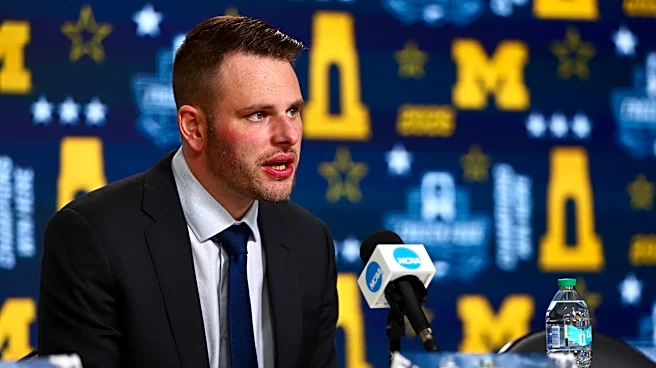
Perhaps the most recent loss stung the most, as this 2025-26 team felt different from years past. It defended at a high level and had a deep blue line, Jack Ivankovic was the best goalie head coach Brandon Naurato has had at Michigan, and the likes of T.J. Hughes, Michael Hage, Will Horcoff and Jayden Perron maintained a seemingly perpetually strong forwards group.
Was this team good enough to win it all? Certainly. But the Pioneers’ Johnny Hicks made 49 saves, and Denver once again found a way to eliminate the Wolverines. We now enter the offseason with the same question: Why not Michigan?
The Denver problem
Regardless of who head coach David Carle has in his lineup, regardless of who graduated or departed to the pros or sustained injury, the Pioneers have been right in the mix all decade.
No, they are not the sole reason behind the Wolverines’ playoff letdowns. But we have seen the same story over and over when they face in a do-or-die situation, with Denver coming out victorious in all of the recent meetings.
Michigan is never going to be like Denver. The Wolverines’ outrageous NIL money and proximity to the USNTDP create different boundaries than the Colorado school, which relies on recruiting student-athletes that are committed to the full experience and buy into Carle’s message.
This is not to say Naurato does not have a grip on the culture — far from it. Yet, the Pioneers are the standard in college hockey in large part because of their culture. Every team should want to emulate them, but what can the Wolverines steal from their counterparts?
Too much talent?
What is Michigan’s relationship with the NHL like? Take the 2022 draft for example. Owen Power went No. 1, Matty Beniers was No. 2, Luke Hughes was No. 4 and Kent Johnson was No. 5. None of them made it past their sophomore years in Ann Arbor.
While few programs would deny such tantalizing and productive players, it is difficult to sustain success with so much turnover. In the last couple years alone, the Wolverines have sent those four, along with players like Adam Fantilli, Frank Nazar III, Gavin Brindley, Seamus Casey, Rutger McGroarty, Cam York and more to the NHL.
Sure, other schools face this problem, too, but while they are not quite on the 2010s Kentucky or modern Duke Basketball stage of one-and-dones, they are probably the closest thing in college hockey. Would Naurato be better-suited looking for players that fit a heavier, older style better designed to win a title?
Yes. However, a complete overhaul in evaluating talent is easier said than done.
Winning ugly
Playoff hockey is all about dominating below the goal line, stymying your opponent in the neutral zone and great goaltending. Michigan has had some or all at times during this Naurato run, just not quite to Denver or Western Michigan or Quinnipiac’s abilities during their championship seasons.
Again, that is what made this most recent demise so frustrating is that it finally felt like the Wolverines could win in all three categories. Maybe this is a turning point season where Naurato and company better understand the demands of the NCAA Tournament and can use that experience to avoid a similar fate next spring. But until it happens, Naurato and the program will always have that trophy dangling above their heads.