


It’s easy to look at the Eagles scoring 24 points, averaging six yards per play, and conclude the offense played well in the first game of the season. Unfortunately, I don’t think it did.
The Eagles generated 318 yards, but 180 of them came on four plays. They finished with only 10 first downs, punted seven times, and had six possessions without earning a single first down. They also went three-and-out on three consecutive drives in the third quarter. Elite players made enough elite plays to win the game,
but they showed little consistency. We saw this at times last season. The Eagles won games despite the offense failing to establish any rhythm, and the result often disguised the performance. That is not sustainable.
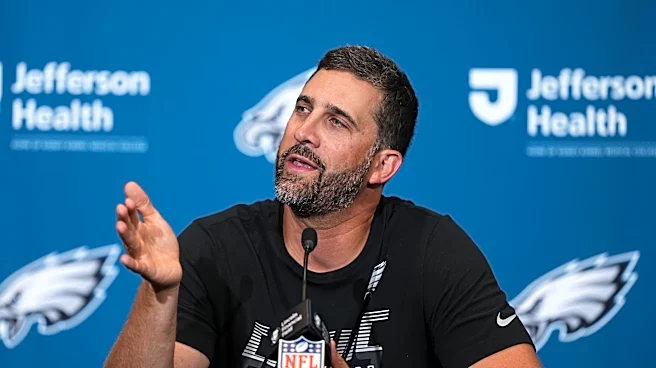
However, it is Week 1. Sean Mannion is a brand-new offensive coordinator, and the Eagles are still working out what this offense should look like. I’m not panicking after one game. The important thing is whether Mannion recognizes the problems and adapts. Let’s get into the film. We are back, baby!
Offense
The contrast between the Eagles’ different personnel groupings was significant in this one. They rushed for 118 yards on 14 attempts from 11 personnel, compared with only 18 yards on 11 attempts from 12 personnel. Those figures include Hurts’ rushing production and are heavily influenced by Barkley’s 42-yard run, so they require some context. Still, Washington consistently matched 12 personnel with its base defense, and the Eagles repeatedly ran into condensed, crowded fronts. We saw this exact issue last year. A lot of teams run well out of condensed formations, but I’ve yet to see the Eagles do it well.
This counter run was a bad early sign. Dallas Goedert’s positioning makes the pull predictable, there is no real misdirection, and Washington can attack downhill without hesitation. I hoped we would see more misdirection in the run game. The Eagles ran counter only once, and I was surprised that we didn’t see more duo. The run game was overwhelmingly zone-based, which isn’t a shock considering Mannion’s background, but I’m still a little concerned about how it fits our personnel.
Individual execution was a problem, but the structure did not provide enough help at times. Running repeatedly from heavy personnel into stacked boxes is making life unnecessarily difficult.
Right, just a heads up. I posted the original thread online before Landon Dickerson acknowledged that he had been playing hurt and was subsequently placed on injured reserve. My immediate reaction to the film was that his movement looked completely wrong. We now know why. I didn’t want to kill him in the review, but I could have posted 30 clips of him looking bad. It was probably the worst offensive line film I’ve watched from an individual.
Dickerson played all 55 offensive snaps despite clearly being unable to move properly. He was charged with four pressures, including a sack. I am not blaming Dickerson for that performance. The coaches deserve criticism for letting an obviously compromised player stay on the field for the entire game. I can’t just ignore Dickerson in this review because his play made it really hard to run the offense. But, just be aware I’m not blaming him for this.
You can see the physical limitation here. Dickerson cannot adjust his feet or redirect with the defender. This isn’t normal poor technique from a player losing an isolated rep. His body won’t let him execute the assignment. The guy could barely move. The Eagles put both Dickerson and the rest of the offense in a terrible position by asking him to play through it.
This was one of the Eagles’ better outside-zone runs, and it highlights the importance of personnel. Johnny Mundt does an excellent job controlling the edge, allowing Barkley to press the run before getting outside. The issue with Mundt is when he’s on the field, the Eagles’ offense can become predictable. They must find a way to get him involved as a receiver at times.
The Eagles do not have many receivers who can consistently move defenders from condensed formations. Makai Lemon and DeVonta Smith aren’t big receivers, so a blocking tight end matters. Mundt creates an edge here that the Eagles struggled to establish on several other outside-zone attempts.
I’m still concerned about the Eagles leaning too heavily on outside zone. If it is going to become a foundational concept, they must choose their moments more effectively and connect it to the passing game. After showing Washington this look, I expected to see more play-action bootlegs or movement passes building from the same action. Instead, the run and pass games often felt disconnected. Which was a shame, considering everything we have read about Mannion.
Here is another example of Dickerson’s injury affecting the offense. Once again, forget the outcome and focus on his lower body. His feet are in no position to make contact, and he cannot generate any power or control because his base has collapsed.
This is the first of the explosive plays that carried the offense. The under center running game struggled, but the Eagles must keep developing it because it enables throws like this. The Eagles use play action and a three-level stretch concept. Based on the design, the ball should go to Goedert, but Hurts likes the matchup downfield and makes an extremely aggressive throw to Dontayvion Wicks. The velocity and placement are outstanding. Hurts’ deep-ball accuracy remains one of the offense’s cheat codes.
Wicks deserves enormous credit, too. He runs the clear-out route, but he runs it hard and stays ready for the football. We have seen far too many clear-out routes over the years where a receiver (who might currently be on the Patriots…) slows down or never expects the pass. Wicks stays engaged throughout the whole rep, locates the ball, and finishes the play for a big gain. If you are running a route, you always have to believe the ball might come your way. This is excellent.
Hurts followed that explosive with another outstanding throw later on. Washington attempts to disguise the coverage, but Hurts reads the safety’s movement toward the middle of the field and immediately recognizes that Goedert will be available on four verticals.
This is excellent quarterback play. Hurts processes the rotation and delivers a perfect strike. An underrated part of his game is how catchable his passes are when he is throwing with rhythm. The placement allows Goedert to make the catch without breaking stride.
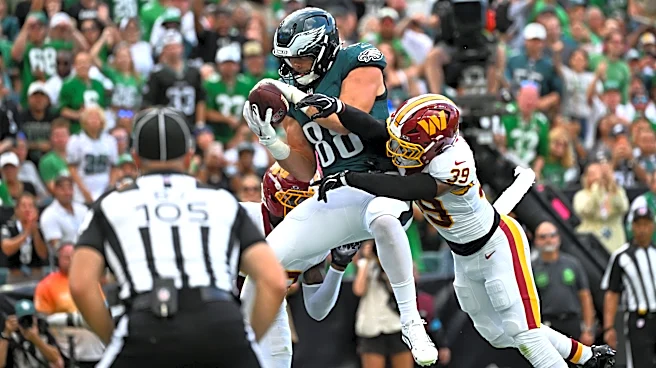
Goedert was outstanding as a receiver. With A.J. Brown unavailable, the Eagles needed someone else to provide explosive production. Goedert and Wicks combined for six catches, 150 yards, and three touchdowns. They were the difference in this game.
I had problems with several of the Eagles’ designs. This is Week 1 in a new offense, so I’m not expecting perfection, but too many plays looked doomed before they had a chance to develop. There were some clunky-looking screens. Again, I’m not hitting the panic button or saying we are screwed. I’m just commenting on what I see!
On the play above, the offensive line slides to the right and leaves Barkley responsible for the unblocked edge defender. We saw quite a lot of this in this game, which led to running backs being heavily involved in pass protection. This isn’t a huge surprise against this defense, considering Brian Flores’ influence. On the second play, the Eagles use the same basic approach despite adding play action. Barkley’s fake takes him away from the unblocked defender, leaving him with no realistic chance of getting across the formation to make the block.
The design appears to rely on the run action holding the edge defender. When he ignores the fake and crashes toward Hurts, the play has no answer. Whether this should have been changed at the line or was simply a poor call against the look, the result is a free rusher and another wasted early down. These plays matter because the Eagles never established any rhythm. Negative plays on first down repeatedly pushed them behind schedule and limited Mannion’s ability to sequence concepts. An offense cannot build toward anything when it is constantly facing second-and-long.
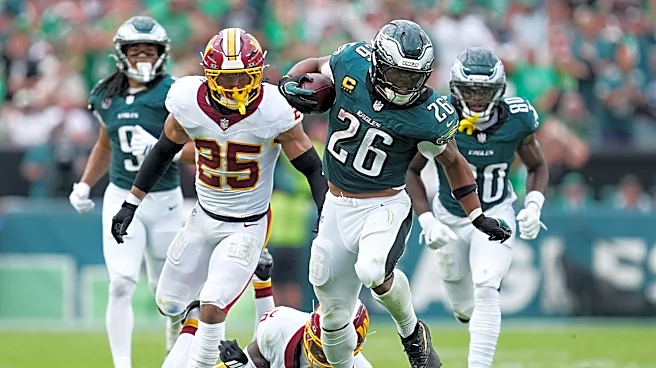
Sometimes, great players make the scheme look better than it is. Barkley stays square to the line of scrimmage for as long as possible, forces the linebacker to commit, and then explodes through the opening. His combination of patience, balance, power, and acceleration remains ridiculous. He doesn’t need much space to turn a routine run into an explosive.
The shotgun alignment helps because Washington must account for Hurts as a runner. Without that threat holding the edge defender, the play probably gets shut down. This is why I still prefer building the core running game from shotgun when you have a quarterback with Hurts’ mobility. A lot of fans think running from under center is the real benefit of the rise of under center formations we have seen of late, but I would argue passing from under center is what really matters.
However, this play also distorts the overall rushing numbers. Barkley finished with 83 yards on 15 carries, but 42 came on this run. His other 14 attempts produced only 41 yards. This was an incredible individual play, not evidence of a consistently functioning running game. We’ve been here before…
This was better from Hurts than I realized when watching live. The Eagles create confusion in Washington’s secondary and manufacture leverage for Wicks on the deep out. Unfortunately, the protection breaks down again because the injured Dickerson cannot move his feet and ends up blocking nobody.
Tank Bigsby does a fantastic job identifying and picking up a rusher. Hurts also deserves credit for drifting away from the pressure, buying as much time as possible, and delivering another accurate ball. The Eagles struggled badly against the blitz at times. Hurts completed only four of nine attempts for 26 yards, took three sacks, and averaged minus-0.57 EPA per play when Washington sent pressure. Without the blitz, he went 10-of-16 for 156 yards, took no sacks, and averaged +0.30 EPA per play. That’s a big difference.
Hurts wasn’t perfect, but I thought he looked decisive in his first game in a new offense. He made the difficult throws required to win despite operating behind a compromised interior offensive line.
Washington appeared to have a strong read on when the Eagles wanted to run outside zone. This is something I mentioned earlier. Their second-level defenders repeatedly attacked downhill and disrupted the concept before Barkley had anywhere to go.
This is not simply an offensive lineman losing an individual matchup. It is a schematic problem. Every defense in the league regularly faces outside zone. Just look at the coaching trees around the league right now. If the formation, alignment, or motion gives away the call, linebackers can trigger immediately and beat blockers to their landmarks.
The Eagles need more disguise and misdirection. They could use motion to alter the defensive front, run play action from the same looks, or add concepts that punish linebackers for flowing aggressively toward the outside-zone action. More bootlegs next week, please!
This is much better from a design perspective. Although it was inconsistent, this game also had some really good designs. Lemon’s motion creates a switch release with Smith, who runs the deep out against a cornerback playing with inside leverage due to the switch release. Watch how the defensive back’s leverage changes because of the motion. This is the kind of schematic help I wanted to see more consistently.
Unfortunately, the concept never gets a fair opportunity because Dickerson is beaten immediately. Hurts escapes, but this should have been a clean opportunity for an explosive completion.
This clip sums up much of the game. There were flashes of interesting ideas, especially when the Eagles used motion to manipulate coverage, but execution and protection kept the offense from building momentum. Hurts’ mobility repeatedly prevented broken plays from becoming sacks or drive-ending disasters.
What a throw and catch! I don’t like the receivers running Mesh running into each other, as I have criticized the Eagles’ lack of detail in the past. However, Smith’s vertical shot saves the day. Hurts delivers another strike with excellent velocity and ball placement, but the catch is every bit as good.
Barkley also recognizes the problem in protection and helps Dickerson with his assignment. It felt like the offense was trying to survive around a player who should never have been asked to play every snap in that condition. I’m unsure why they didn’t just pull him out of the game. I would be quite mad if we had ended up losing…
Hurts made some ridiculous plays with his legs. He looked quicker and more agile than last season, and he consistently protected himself rather than seeking unnecessary contact.
This third-and-18 scramble was one of the biggest plays of the game. The Eagles had just lost yardage on consecutive plays and were in danger of wasting another possession. Hurts recognizes the space, accelerates through the middle, and gains 22 yards to extend the drive. Not many QBs can make this play. Goedert scored the winning touchdown three plays later.
Hurts will occasionally leave a pocket too early and miss an available throw. That is part of the package. He isn’t perfect. However, he finished this game without a turnover-worthy play, made several outstanding throws, and repeatedly rescued the offense with his legs. There is a reason he wins so many games.
The Eagles finish with their third touchdown, and this one is all about Goedert’s awareness and movement. Hurts attacks the middle of the field, as he did very well in this game, and Goedert recognizes the open space before accelerating away from the defense.
Goedert makes this look effortless for a big man. The Eagles needed him to become a featured receiver without AJ Brown, and he delivered. This was a big Dallas Goedert game. We needed it!
Final Thoughts
This was not a great offensive performance. Hurts, Barkley, Goedert, Wicks, and Smith made enough exceptional plays to win. That matters. Elite talent raises an offense’s floor and means the team can still score points when not playing particularly well. But the Eagles learned last season that repeatedly winning without playing well does not make the underlying problems disappear. Ten first downs will not cut it most weeks.
The Dickerson situation also cannot happen again. He was clearly injured and physically unable to execute his assignments. Dickerson should not receive the blame for trying to compete while hurt.
Still, it is Week 1. Mannion is installing a new offense, and there were flashes of concepts worth developing. The important question is how the Eagles’ offense learns from this game. Can the Eagles connect the run game to their play action package better? Can they disguise outside zone more effectively? Can they improve their answers against pressure and stop wasting early downs?
The performance wasn’t good enough. The response will tell us much more about this offense than one uneven Week 1 win. I’m still excited about this offense, and I’m hoping to see some progress next week.
Thank you for reading! I’d love to hear your thoughts, so feel free to comment below and ask any questions. If you would like to support me further, please check out my Patreon here!