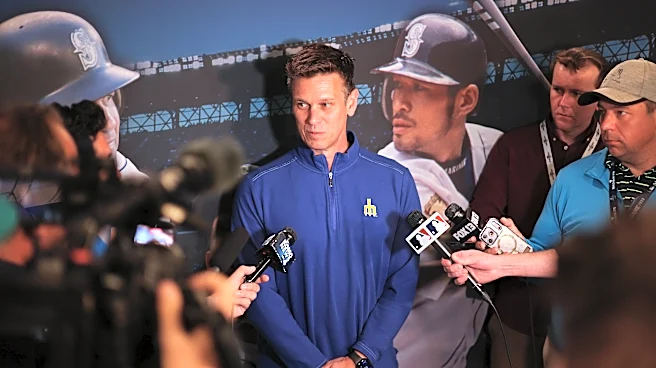


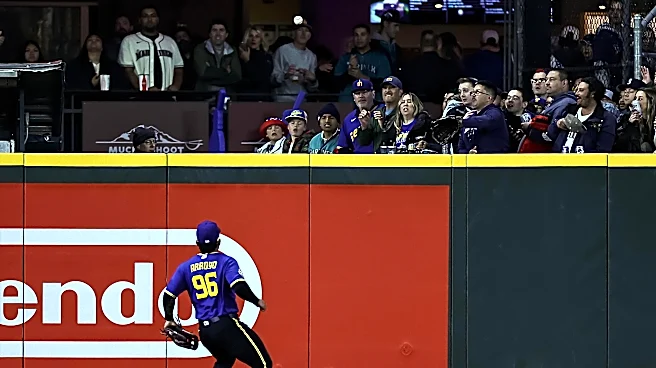
After parting ways with manager Dan Wilson yesterday, the Mariners announced sweeping changes to their coaching staff today. While pitching coaches Pete Woodworth and Trent Blank will return, the Mariners have now moved on from their hitting coaches with the exception of franchise legend Edgar Martínez, who Mariners GM Jerry Dipoto said would return “in some capacity”, as well as bench coach Manny Acta, and defensive coaches Perry Hill and Eric Young Jr. At a post-season press conference at T-Mobile
Park on Monday, Dipoto spoke about the need for a “culture reset” across the organization.
“We need to reset our culture and refocus ourselves on what we need to do to to get back to an efficient, clean, crisp brand of baseball like the Mariners have played for a number of years.”
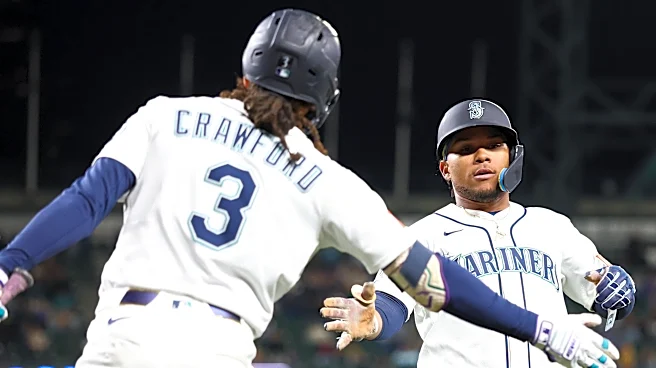
Some were surprised to see coaches Perry Hill, who has overseen two Gold Glovers in J.P. Crawford and Dylan Moore and will have a third if Cole Young wins one this winter, and Eric Young Jr., who oversaw part of Josh Naylor’s historic back-to-back 30 steals campaign, let go. But Dipoto was especially emphatic on how poorly the team played defensively, and how much that impacted the overall fortunes of the team given a pitching staff that is focused on throwing strikes and putting the ball in play.
“Being a bad defender is a choice,” said Dipoto. “Being a good defender sometimes requires a skill set that some players may or may not have. Our players have the skills to do it, and and for a five-year stretch, they’ve somewhere between a slightly above-average to, in some areas, a well above-average major league defense, and we didn’t beat ourselves. This year we led the league in throwing errors. It was awful to watch, and and it was awful for the players.”
The fault wasn’t just on the players underachieving defensively, Dipoto seemed to suggest, but on defensive positioning that didn’t set them up for success.
“We led the league in the least likely team to convert a double play that we started. That’s not helpful to our pitchers. A starting pitching staff who attacks the strike zone and has the ball put in play is harmed by by the lack of range and positioning our team, and we can solve some of that through more focus, more demanding and challenging practice, but especially in the positioning of those players. That’s something that we, as a scouting advance team, can can provide our players that we need to to implement more effectively than we did this year.”
The defense, particularly, was a letdown, but the overall poor performance served as a red flag to the front office that performance standards once upheld in the minor leagues were slipping. The Mariners model has for a long time been about connecting minor league standards of excellence to the major leagues, creating a pipeline of success with consistent messaging and, ideally, consistent performance. That wasn’t the case this year.
“The performance on the field this year has made us question a lot of the things that we are doing at the major league level, and I will say multiple of our major league players who came through our system have referenced what they learned in player development that that got abandoned in the big leagues this year. And not just the players who came up for the first time, but we have a host of players who’ve come through our system, and they saw a difference. We need to get back to to what we believe is a Mariners baseball process.”
“You can’t be the worst defensive team in baseball. You can’t make the mistakes that we made constantly throughout the year. You need to be better prepared and in line with a process that leads to winning.”
But the defensive downturn is just a symptom of a larger problem with the 2026 team: a lack of accountability, and a slipping of standards, as also expressed by Cal Raleigh in some of his postseason remarks. Like Raleigh, Dipoto dismisses the idea that injuries waylaid the 2026 Mariners, noting the Mariners had fewer injuries to deal with than many teams that were able to play to the end of the season and into the post-season. Instead, the problem was one of passivity and a lack of accountability. Dipoto defined what he sees “holding accountable” to mean.
“[It] looks like culture. It is, what are you willing to tolerate? Are you willing to tolerate less than full effort? Are you willing to tolerate less than full focus? What we saw in mid-season was a team playing with limited urgency and waiting for the water to turn on. And it just didn’t come on, instead of turning it on ourselves. And we saw it unfolding. Our players saw it unfolding. We talked about it a lot as the season went along. And again, it’s where I would count myself most at fault. You can talk about it or you can just go out and do it.”
“Accountability is just a word, unless you are accountable to a standard that is preset. Everybody understands what that standard is, and then we hold ourselves accountable to it. You know, the bigger issue is the standard itself, and that’s on me. The one person who has the ability to to drill down to the bottom, say we are not upholding these standards, we need to do better. I did an ineffective job of making sure that we held one another accountable, because we started with standards and it faded. And that’s not just on our players. That’s on that’s on me. It’s on our front office group. It’s on the staff and and the players collectively.”
“We had a tendency this year to just shrug it off, to [think] ‘oh, we’re more talented than the teams around us. Don’t worry, it’ll happen.’ Instead of going out and making our own thing happen, and that’s that’s what accountability looks like. It’s calling that out in the moment. It’s stopping it before it gets rolling any further. It’s being truthful in our discussion with one another, and for years our program has always been built on truth. We tell the truth with love, and and sometimes you might get your nose out of joint for a moment, but you wake up the next day and you realize that you’re loved, and you’re just trying to help one another.”
Despite Bryan Woo’s assertion that his most appreciated aspect of Dan Wilson as a manager was his ability to do exactly that – tell the truth – it seems that messaging got lost somewhere between Dipoto’s understanding of the standard and the players’ execution of that standard. Dipoto described the hiring of Wilson as looking for someone “who could bring levity to the environment” after nine years of a more severe tenure under Scott Servais, and someone who had built-in trust with the players, which Wilson did. For a new manager, Dipoto was explicit about wanting to look outside of the organization to get new eyes and new ideas about what went wrong this year.
“We will go outside to hire our manager,” he said. “We need fresh thought. We need something new. It could be a shift in programming. It could be a shift in messaging. It could be a shift in language. We’ll collaborate with whoever our future manager is, and and try to find the right person. If that person has major league managerial experience, that would be preferred. But generally speaking, we’re just looking for someone who has high character, growth mindset. You know, has the ability to think strategically in in the context of a major league game.”
“There are a lot of good people out there, and most of what we’ve done in recent years, especially, has been insular, and I think this year’s failure requires that we look outside to find someone who might be able to poke holes in what we’re doing and help us see something that perhaps we’re blind to. Because you know, obviously, this is this has not been what we intended nor what we expected from our team.”
Dipoto says he and Justin Hollander are beginning the process of seeking a new manager – making calls and looking into available candidates – but refuses to put a timeline on the managerial search, saying it will take “as long as it takes.” As much as he’ll have full autonomy in determining candidates, Dipoto also says whoever takes the job will have autonomy in choosing a coaching staff, hence part of the reason for the vast turnover announced today.
“We thought it was important that whoever we hire as the manager come in and have the ability to to have his hand on the wheel in creating his own staff. Handing a new manager [the task of] ‘we want to get better culturally. We want you to show us where we might be doing this wrong’ – with our people, seems to be a very difficult needle to thread. So that that manager, whoever it is, will have the ability to point us in the direction of the people he wants, if we can access them.”
Several players – Bryan Woo and Cal Raleigh among them – have expressed interest in having a voice in this cultural reset. Considering employee feedback during management changes isn’t an uncommon practice in the business world, although less common in the baseball world. Dipoto said this past week they’ve spoken with players – both long-tenured Mariners and those who are more recent additions – but declined to commit to how much players’ opinions will be weighted in the hiring process.
“I will say Cal’s been invested in this for years now. You know, I’ve joked around that he’s like an assistant GM, but we bounce all this off Cal, and he’s very communicative with us. He knows what we’re doing before we do it with player personnel,” said Dipoto.
“How much we will factor their opinions in on who the manager is, that remains to be seen. I think there’s also a danger zone there, but they’ll be in tune as to what we’re doing, and and they will give us the feedback that that is required to make sure that this is a good fit, but we’re not going to ask them to be a part of an interview process. I think that’s unfair. It’s unfair to the candidate as much as it is unfair to to the organization.”
The biggest question fans might as is how much of a culture reset can this be when there’s no change at the very top – Jerry Dipoto, the de facto architect of the team’s culture, will return in 2027. Dipoto – who says he thinks of his tenure in two stages, the first five years and what’s been the second six years – says the team culture is the foundation of the success they’ve seen in that back half of his tenure; the problem is having gotten away from that team identity in 2026.
“For the last five years, we’ve been one of the winningest teams in Major League Baseball. This year, we stunk, and it never got on track. And again, that’s on me first, and I’m trying to find solutions. I feel proud of what we’ve built organizationally over these years. You know, 11 years, it’s two different tenures that I’ve had, and and in the last six years, I feel proud of what we’ve accomplished on the field, if incomplete.”
“This year was an opportunity to take that next or final step, and we just didn’t. And if I didn’t have a job today, it’d be justified. You know, we failed, and again, we’re going to attempt to learn from that failure, and and lean into what I think is a great foundation to build on with homegrown players up the middle, a complete rotation that I think many in the league would love to have, and just reset our culture and refocus ourselves on what we need to do to to get back to an efficient, clean, crisp brand of baseball like the Mariners have played for a number of years.”
For fans hoping for a total teardown, that won’t be the case. It’s a reset, not a remodel. The overall vision remains in place: a team built around a young core of homegrown pitching that suppresses runs and up-the-middle players that plays clean defense, runs the bases well, and can score runs both via the small and long ball. That wasn’t the team that took the field in 2026 with any degree of consistency; towards the end of the season, they maybe checked none of those boxes on any given night.
It was an unacceptable performance that prompted sweeping personnel changes – although notably, not at the top. How fans feel about that depends on if they still believe in Dipoto’s vision and ability, give the financial limitations imposed upon him, to put the pieces in place that can bring that vision to life. The first, and maybe most foundational piece, will be identifying a manager who can bridge that gap between front office expectations and the actions of the players on the field.