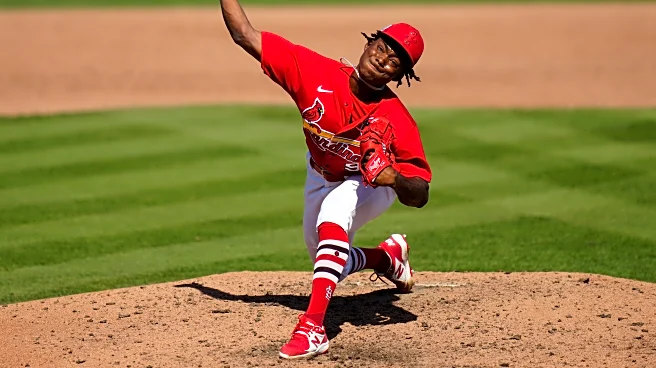

As my mind’s eye turns to Spring Training, hope stirs. What once seemed so far away is now just around the corner, even though it hasn’t moved one iota (for those keeping score at home, iota is the smallest
letter in the Greek alphabet and is proxy for really, really small amount). My mind wanders to considering the possibilities for young Tink Hence, one of my personal favorites. He reminds me a bit of Carlos Martinez, another personal favorite from years past, both in stature and in stuff.
In the abbreviated 2020 draft, the Cardinals drafted a 2-way player out of a Pine Bluff, Arkansas HS by the name of Markevian “Tink” Hence with their Comp-B pick (end of 2nd round). Arkansas. I wonder if he grew up a Cardinal fan? Perhaps listening via KDPX – Pine Bluff? He was converted to full-time pitcher and quickly received a lot of prospect accolades normally reserved for 1st rounder. Since, he has been listed in various Top-100 publications anywhere between 47th and 84th. Not too shabby.
This off-season, he has fallen out of the Top-100. This isn’t a lack of stuff, it is more about his availability, as he has only accumulated 257 IP over 5 minor league seasons, averaging just over 50 IP per year. One can look at this stat alone and wonder if he has a starter’s trait.
Coming into the 2026 season, people are left to ponder several unknowns.
Is he a potential star?
Baseball American (BA) now ranks him with a 55 scouting grade (above average), so his star potential is seen as diminished, but not absent. They rate him as high risk, which adjusts his scouting grade down to 40. Yuk. Individually, his FB and SL are grade 50, command is graded 50 and his change is graded at 60 (excellent!). Fangraphs is a little more bullish on his slider and change, giving the Change an FV of 70!
BA ranks him 15th in the Cardinal organization. No longer a prospect darling, he is in that typical saddle of prospect fatigue that so often occurs when initial hype is excessive and success isn’t immediate.
Beyond the scouting grades, it is hard to evaluate his stuff anymore. His Statcast data dates back to 2022 (ancient history!), and I’m not sure he is that pitcher anymore. Suffice to say, he would have had lots of red on his Statcast/Savant page. Good K-rate, north of 25%, decent walk-rate, good at suppressing hard contact (80th to 90th percentile). Since, he has pitched at High-A and AA, which do not support Statcast data collection. We will get a new look at the pitcher he has become when he hits Memphis.
Is he a starter or a reliever?
The IP totals in his minor league career suggest durability is lacking. He has yet to cross 100 IP in a season and has not regularly exceeded 5 IP in his starts. In the modern game, these aren’t significant concerns for young starters, but the time spent on the IL is.
His pitch mix and command says starter. His durability says reliever. His career arc begins to lean that way (see next paragraph). High leverage reliever is a sought after commodity in MLB, no?
Reports are the Cardinals are having that starter/reliever conversation internally. Their focus seems to be to get him to the place where he can start and finish a season healthy, and work from there. This seems sound.
Is he running out of time?
He is only 23 years old and projects to start this season at AAA, where he will be young for the league. In that sense, it is way too early to give up on such a dynamic arm.
That said, one of the challenges of drafting high school pitchers is the requirement that they be added to the 40-man roster after their 4th professional season. Hence was added last year. This means they had to burn one of his 3 minor league option-years last year, in what turned out to be a lost year. He has 2 such option-years left, and a second will undoubtedly get used when he is assigned to AAA around the middle of 2026 Spring Training. That will leave 1 remaining option, ostensibly to be used in the 2027 season (if needed. One can hope!).
Even if he were to join the major league team in either 2026 or 2027, given his relatively low innings build up, it is easy to imagine that he would not be on the MLB roster for an entire season. They will need to manage his innings and that is difficult to do at the major league level. Those options will be needed, and that safety blanket will come off in 2028, when he will be out of options. He will be merely 25 years old then and potentially the poster-boy for why teams shouldn’t draft HS pitchers.
Even the most optimistic innings projections would be unlikely to project him as built up much over 100 IP by 2028. So, in the race to build up his arm before he runs out of options, he appears to be running out of time.
Also, related to the time scale, is the fact that he is occupying a 40-man roster spot. It’s one thing to give a 40-man spot to a prospect, but quite another to not have that spot producing at either level. At some point, the Cardinals are going to face needing a roster spot for a different prospect and will have to choose between a high-upside/low availability option like Hence, or another prospect. That decision will be a bit tougher this next off-season, when the 40-man is refined yet again, especially if there has been any slippage in his stuff as the injuries have accumulated.
What kind of innings build up can a pitcher like this accept?
The Cardinals have a pretty complicated database that captures baseline (chronic, steady-state) workloads for pitchers and also acute (recent) workloads. They use this database to manage innings (and pitches) and protect pitcher health. Tink’s prior workloads likely present a unique challenge in this regard, as his pattern is a bit unusual, particularly for a starter. They are likely wondering …
What exactly is his baseline heading into 2026?
The average of 50 IP? That 21 IP from last year is artificially low, because he threw bullpens with some frequency, even though he didn’t get in games. They count this and factor it in, although it is lower stress, so not that low.
How about the 79 IP from the 2024 season? The 96 IP from 2023? Since they count more than innings, they really can’t put a single IP number on a target to shoot at. Pitch stress, max effort throws, high pitch count innings and things like that factor into workload calcs. But I’d bet they are looking at 80-100 IP as the high side of a target range this year. I’d also bet they start him but use him as more an opener (2 or 3 IP) to begin the season and work from there. While lower inning counts might be to his benefit, irregular usage is likely not his friend and he still needs to build experience, in addition to stamina.
Given health, 20-25 appearances might be a nice target, with 20 starts averaging 4 IP each (lower at the start of the season, higher toward the end), with a handful of MLB opener/bulk inning appearances to nudge that number up. Basically, once per week. They might set up framework like that. Within his MiLB starts, they would likely shorten them if stress pitches go up or if he has excessively long innings or if his velo drifts, as it can do. They do this with a lot of young pitchers anyway, but probably a bit moreso with him.
What does his future look like?
One could say 2026 is a big season for him, but really, any season is big for every prospect.
Because of his relative lack of experience, he is very likely to start the 2026 in the minors, most likely at AAA, which is where he was targeted last year before injuries derailed that trip.
Because of his 40-man spot and diminishing options, he is equally likely to see some time at the major league level. Because of the difficult innings management challenge they will face with him this season, it would seem more likely that they might spot him into starter/opener situations that they can control the timing and duration such appearances (such as 27th man for double headers, or a planned extra rest day for the rest of the rotation. They could slot him in as an opener or a bulk innings guy and return him to Memphis immediately after using him, where they can manage his innings. They could pretty much do this once a month throughout the season, without exceeding the limit of 5 minor league assignments in a single season. More practically, I wouldn’t expect to see any of these appearances before June. He will be one of nine (or so) pitchers at Memphis on the 40-man roster, and he wouldn’t seem to be first in line for promotion.
Beyond that, health, durability and performance will dictate, as it does with all pitchers. If he maintains health and given how starters are used in the modern game, it doesn’t appear that they need to make a permanent starter vs. reliever decision, but his path to the MLB will almost certainly start in the bullpen.
I will seek him out in Spring Camp at the end of February. I hope to see him pitch, at least in live BP if not in a game.