

Some players leave their mark on one sport. Zack Clayton somehow managed to leave fingerprints on three: baseball, basketball, and boxing.
Long before he stood in the ring for Muhammad Ali and George Foreman’s “Rumble in the Jungle,” and decades before the Naismith Memorial Basketball Hall of Fame enshrined his basketball greatness, Clayton spent part of his remarkable athletic life wearing the uniform of the New York Black Yankees. That chapter may only occupy a slice of his larger legacy, but it places
him in rare company even among baseball’s most fascinating figures. Today, one of the greatest sports Renaissance men in American history would have celebrated another birthday.
Zachary Morris “Zack” Clayton
Born: April 17, 1913 (Gloucester County, VA)
Died: November 20, 1997 (Philadelphia, PA)
Yankees Tenure: 1943-44 (New York Black Yankees)
Clayton’s story begins well beyond the diamond. After his family relocated from Virginia to Philadelphia, he developed into one of the city’s most gifted young athletes at Simon Gratz High School, starring in basketball, baseball, football, and track. Even in a city known for producing great athletes, Clayton stood out as someone whose game translated everywhere. That versatility became the defining thread of his life.
By 1932, while still building his basketball reputation, Clayton had already broken into Negro League Baseball with the Philadelphia Bacharach Giants at age-21, beginning the baseball half of his parallel sports life. He was a left-handed first baseman with enough defensive polish and athletic instincts to stay on major-league diamonds while also developing as a guard on the hardwood.
In 1935, his basketball career accelerated. Clayton joined the New York Renaissance, the legendary Rens, one of the most important teams in basketball history. That same general stretch also saw him appear in Negro League baseball with the Chicago American Giants, making him a true same-era dual-sport professional years before America even had the language for that kind of athletic identity (beyond the likes of Jim Thorpe).
By 1936 and 1937, Clayton’s life had become completely intertwined with elite Black sports institutions. He appeared with the Harlem Globetrotters, continued with the Rens, and returned to Negro League baseball, again splitting his time between professional basketball and professional baseball. It is one of the clearest early examples of an athlete refusing to specialize because he simply did not need to.
Then in 1939 Clayton helped lead the Rens to the inaugural World Professional Basketball Tournament championship, defeating the Oshkosh All-Stars and proving that Black teams could top the best white professional clubs in the country. He earned All-Tournament honors, cementing himself as one of the premier guards of the Black Fives era.
From 1940 through 1942, Clayton’s parallel sports careers only became more impressive. As the Rens transitioned into the new decade, he remained a core part of their championship-caliber nucleus while also moving into the Washington Bears orbit in 1942, another powerhouse built largely from former Rens talent. At the same time, his Negro Leagues remained active, keeping him in the rhythm of a true dual-sport professional athlete.
In 1943, Clayton helped the Washington Bears go 41-0 and win another world basketball championship, while also joining the New York Black Yankees, where he played first base during the 1943 and 1944 seasons. Over those two seasons, Clayton appeared in 42 big-league games (and many more exhibitions), collecting 33 hits, including two home runs.
Originally founded in Harlem in 1931 as the Harlem Black Bombers, the Black Yankees became one of the Negro Leagues’ most visible franchises because of their ties to Yankee Stadium, a venue that served as one of Black baseball’s grandest stages throughout the 1930s and 1940s. Though the club often struggled in the standings, its place in baseball history runs much deeper than wins and losses. Co-owned for a time by legendary entertainer Bill “Bojangles” Robinson and later featuring Hall of Fame talent such as Satchel Paige, Mule Suttles, Willie Wells, and Pop Lloyd, the Black Yankees represented a uniquely visible bridge between Harlem’s baseball culture and baseball’s biggest stage in the Bronx.

That is what makes Clayton’s place in the franchise so compelling: he was not simply playing for another Negro League team, but for one of Black baseball’s most publicly visible institutions, a club whose very name and stadium ties placed it in direct conversation with New York’s baseball mythology. Clayton’s Black Yankees years came during the same stretch in which he was winning basketball championships and building a reputation as one of the nation’s most gifted athletes.
Rather than belonging to one sport, Clayton seemed to exist above the idea of specialization entirely. He was part of a generation forced to maximize every available opportunity, and he did so at an elite level across disciplines.
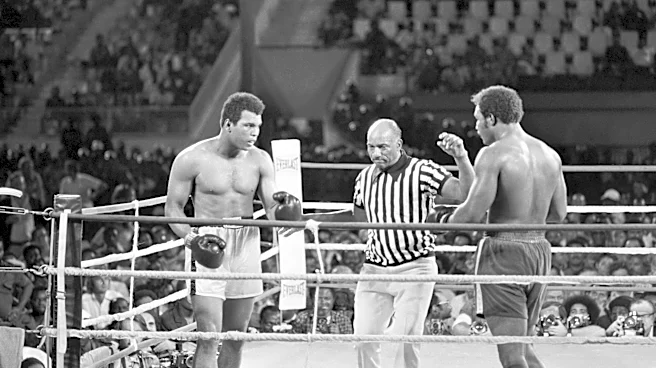
Then came Clayton’s extraordinary third act in boxing. Clayton became one of the boxing’s most respected referees. In 1952, he became the first Black referee to work a heavyweight title fight, and in 1974 he was there for one of the most famous sporting events ever staged. He was there for the “Rope-a-Dope.” He was there for history.

By the time Zack Clayton stepped into the ring for Muhammad Ali vs. George Foreman, the most famous fight on Earth somehow became just another chapter in an already unbelievable life. On that October night, with nearly 60,000 at Stade du 20 Mai in Kinshasa, Zaire (now the Democratic Republic of the Congo) and a global audience estimated in the hundreds of millions, Clayton became part of one of sports’ most iconic images: standing over George Foreman as he delivered the count that confirmed Ali’s eighth-round knockout and return to the heavyweight throne.
For a man whose athletic life had already stretched from Negro League baseball to championship basketball, being the referee at the center of Ali’s greatest triumph somehow felt perfectly on brand, another moment where Zack Clayton found himself standing in the middle of history. That alone might have made him unforgettable.
However, Clayton’s legacy was further cemented in 2017, when he was posthumously inducted into the Naismith Memorial Basketball Hall of Fame as part of its Early African American Pioneers Committee class. It was a long-overdue recognition for a player who helped define the Black Fives era, starring for the New York Rens, and winning the 1939 and 1943 World Professional Basketball Tournament titles. His great-niece, Lauren Meyers, spoke on Clayton’s behalf when he was honored. Clayton’s widow, Lunette, wasn’t in attendance, but she was still alive at age-102 to hear of her husband’s induction.

Yet Clayton’s legacy keeps expanding the longer you sit with it. Hall of Fame basketball player. Negro League first baseman. Historic boxing referee. Philadelphia fire lieutenant. Mentor and community leader. He feels less like a single athlete and more like an entire sports era condensed into one life.
For the Yankees birthday lens, that 1943-44 Black Yankees chapter matters because it reminds us the franchise’s history is bigger than pinstripes and Monument Park. It also includes the Black Yankees, the Negro Leagues, and players whose greatness spilled far beyond their production in pinstripes. Few people will ever better embody the phrase “more than a ballplayer” while still being the ballplayer like Clayton was able to.
Happy birthday, Zack Clayton.
See more of the “Yankees Birthday of the Day” series here