
As we here at Pinstripe Alley have been doing our “50 Biggest Yankees’ Free Agent Signings” series, we’ve tried to make it clear that not all of the signings are good. It’s not the “best” signings, it’s
“biggest.” Sometimes, that means one was big at the time it happened, it just didn’t work out on the field.
Today’s entry on the list is definitely one that did not work out on the field, for some fairly brutal reasons.
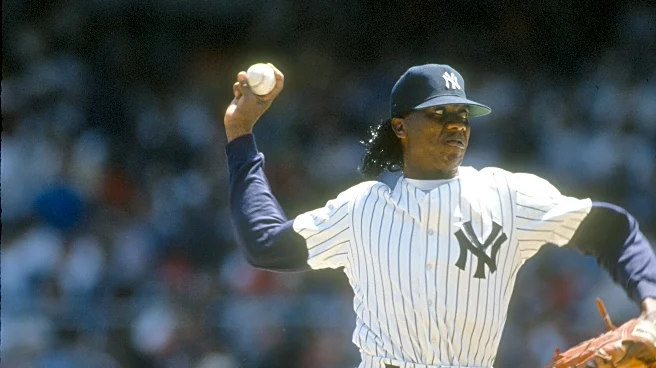
At his best, Pascual Pérez was absolutely electric on the field. With eccentricities on the mound, including checking on runners by looking between his legs, and an eephus that could genuinely fool people, Pérez could’ve made sense, but injuries and off the field issues prevented him from working out in New York.
Pascual Pérez
Signing Date: November 21, 1989
Contract: Three years, $5.7 million
Pascual Pérez was born May 17, 1957 in the Dominican Republic, the oldest of nine children born to his parents. He hailed from quite a sporting family, as he and his five brothers all played professionally at some level. Two other brothers also reached the major leagues with one, Mélido, also having an ill-fated Yankees stint. Pascual and all his brothers had to work hard to make it out of the extreme poverty his family came from, but he did, impressing scouts, and getting signed by the Pirates in 1976.
Battling through homesickness throughout his minor-league stint, Pérez made his MLB debut in 1980. He was solid enough in his first two seasons in Pittsburgh, but it was a bit stop-start, as he was sent up and down a couple times. In the end, it was a June 1982 trade to the Braves that really helped unlock him.
Pérez started his Braves tenure in the minors, but got promoted back after a hot start there. Not only did he pitch well after getting recalled, but a transportation mistake on his part was credited with helping bring the Atlanta team together. Having gotten his driver’s license shortly before, Pérez decided to take the wheel to make the quick drive to the stadium on August 19, 1982. However, a wrong turn led to him circling around the city of Atlanta for hours, leading to the team nervously contacting law enforcement to see if he had gotten in an accident (and earning himself the “Perimeter Pascual” nickname). He ended up missing the start that day, but went the next day, and put in an impressive 9.2 innings in a win. Braves manager Joe Torre also credited the event with loosening up the team and helping them catch fire and eventually win the division and make the NLCS — Atlanta’s only playoff berth in a 20-year span from 1970-90.

While his Braves career featured some impressive highs, including a 1983 All-Star Game appearance, Pérez also dealt with some lows, including a key role in a memorable fight with San Diego in ‘84, but many challenges came off the field. In 1984, he was arrested back in the Dominican Republic for cocaine possession. He would eventually develop an addiction, and became unreliable in showing up, on time or at all, for games and team events. He failed to complete a stint in rehab, and the Braves eventually cut him loose in April 1986.
Pérez spent 1986 attempting further rehab and then playing in the Dominican. His year with the Tigres del Licey got him back on the MLB radar, and the Expos signed him for 1987. In Montreal, Pérez was the best version of himself on the mound. In his three seasons there, he had a 2.80 ERA (131 ERA+) in 456.2 innings, becoming a fan favorite. However, throughout all that, he continued to struggle off the field, and returned to rehab in 1989.
When he was on the mound though, Pérez continued to be absolutely electric. When he hit free agency again after the ‘89 season, that potential was just too much to overlook, and George Steinbrenner and the Yankees inked him to a three-year deal. It was part of an offseason that also saw Steinbrenner come to terms with Andy Hawkins.
In retrospect, it’s very easy to say that this was a deal that shouldn’t have been done in a million years (and defensively-betrayed no-hit bid aside, the same goes for Hawkins). Even beyond his up-and-down results on the field, putting someone with substance abuse issues into New York City and someone who could be a bit erratic at the time in Yankees history that featured George Steinbrenner playing into his worst tendencies was a recipe for disaster.

On the field in 1990, Pérez’s Yankee stint started quite well. Over his first two starts, he allowed just one unearned run on five hits in 11 innings. However, he left his third start of the season after just three innings due to injury. He attempted to rehab the strained shoulder, but had to leave a tune-up in June after aggravating it further. Eventually, Pérez had to undergo surgery in August that ended his debut season in New York.
The following year, Pérez was back by mid-May and again looked electric. His 1991 season debut saw him go six innings against the Angels, allowing just two hits. After two more decent starts, he lasted just one batter in his fourth, as shoulder issues reemerged. He was perfectly solid once he returned for 10 starts from August through the end of the season, but off the field stuff started to pop back up again. He didn’t follow the Yankees’ advice of pitching in the winter leagues and the team was unable to reach him in regards to an offseason throwing program.
Going into 1992, the Yankees had acquired his brother, Mélido, and Pascual showed up on time to spring training, something he hadn’t done the previous two seasons. Despite that, not all was right off the field. Shortly into spring training, Pérez failed a drug test, which triggered a one-year suspension. He left the Yankee camp and would go on to blame the commissioner’s office, the Yankees, and more for framing him.
That marked the end of Pérez’s MLB career. While he would attempt to make some sort of comeback both in the Dominican Winter League and in Taiwan, too long had passed and too many chances had been given for any other major league team to take a chance.
Pérez eventually returned to live in the Dominican Republic, where he dealt with both his ongoing recovery and other medical conditions. On November 1, 2012, he was tragically found murdered in his apartment, where he had been brutally attacked with a hammer. Two men were eventually arrested and later convicted, having killed Pérez during a robbery attempt.
The story of Pascual Pérez’s Yankee career is certainly a gloomy one for the team. However, more than anything any player does on the field, they are also human beings. Sadly, the story of Pascual Pérez the person is more devastating than any injury or bad start on the field.
See more of the “50 Most Notable Yankees Free Agent Signings in 50 Years” series here.